Hearing loss and loneliness each linked to dementia
Recorded hearing loss was linked to a 38% higher relative dementia risk than no recorded hearing loss; loneliness appeared to explain little of the association.
Our read
Populations- Studied:
- Cohort study of 316,919 US volunteers, against participants without documented hearing loss
- What changed:
- Dementia risk was 38% higher in participants with documented hearing loss than in those without
- The catch:
- Depressive symptoms and baseline cognitive performance were not consistently measured, leaving potential confounding
- In the record:
- The 475th paper on hearing loss with results in people; 1,643 on record in all. Its result on dementia agrees with 43 of 44 other findings on record; 1 found no change.
- Why it’s aging research:
- It bears on staying healthy in midlife and later life.
Editor of record: Boris Djordjevic · AgingResearch.News
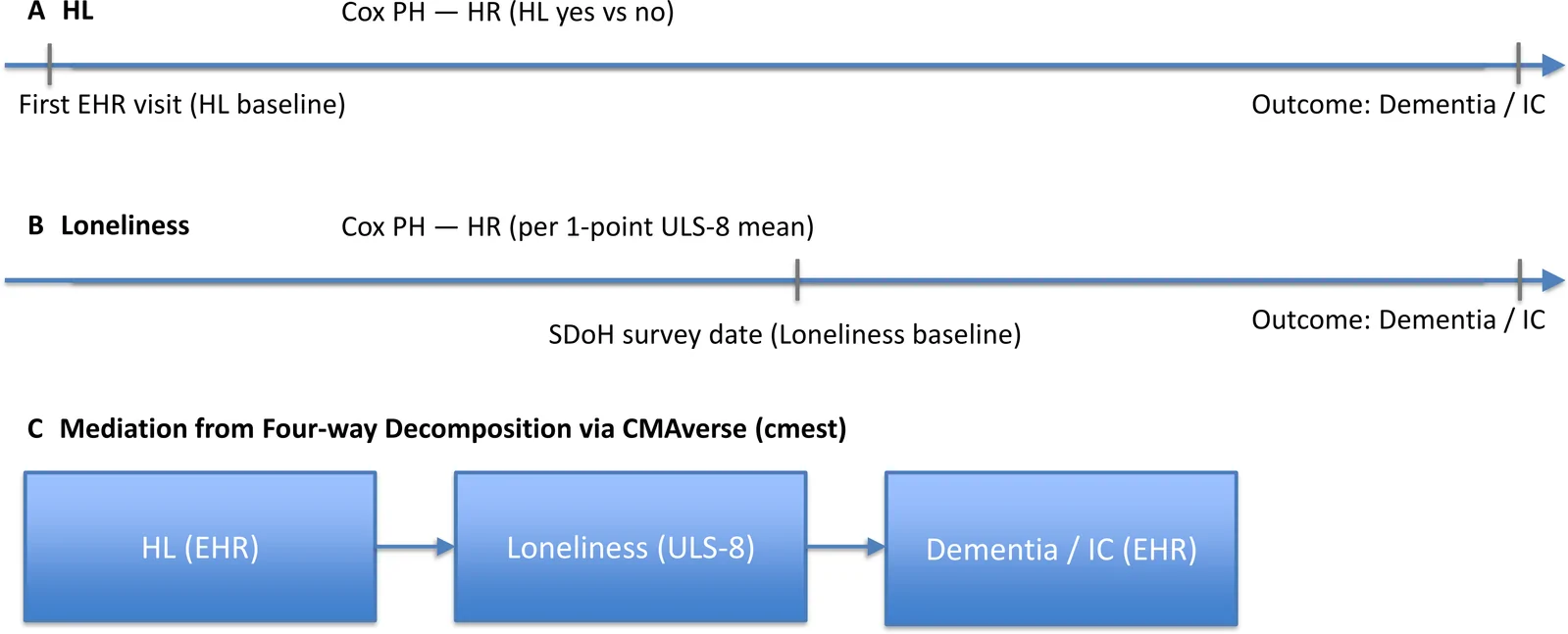
In an observational cohort study, researchers analyzed electronic health records from 317,108 US adult volunteers in the All of Us program. Records spanned an average of 11.8 years; 130,266 participants had loneliness questionnaire scores.
After accounting for age and other factors, recorded hearing loss and greater loneliness were independently linked to later dementia and recorded cognitive problems. The latter category covered non-dementia impairment or prominent cognitive symptoms, not a single diagnosis. Hearing loss was linked to a dementia hazard ratio of 1.38 versus no recorded hearing loss—a measure of relative risk over time. Models estimated that loneliness accounted for about 2.5% of the hearing loss–dementia association and 2.0% of the link with cognitive problems. The 2.5% mediation estimate for dementia was not statistically significant. The authors suggested that most of the observed association likely involved pathways other than loneliness.
Why it matters
Dementia is an age-related disease. The authors supported further evaluation of hearing rehabilitation and social-connection support as complementary strategies for cognitive health.
Caveats
This observational study cannot establish causes or show that hearing rehabilitation or reducing loneliness would prevent dementia. Results apply most directly to volunteers with linked records and relevant survey responses; hearing loss and cognitive outcomes came from recorded diagnoses.
From the paper
- Participants
After excluding 189 participants with dementia recorded on or before the first EHR visit, the incident dementia analytical sample included 316 919 participants.
- Result
In the fully adjusted model, HL was linked to a 38% higher hazard of dementia (HR=1.38, 95% CI 1.28 to 1.48, p<0.001).
- Limitation
First, HL status was determined from EHR diagnosis codes using a phenotype that, to our knowledge, has not been formally validated against audiometric testing within AoU.
Quoted word for word from the full text on PubMed Central.
The paper
University of Arizona
BMJ Public Health, Sep 2, 2026, Open access
Comments
Be the first to comment.