Program limited quality-of-life decline on prostate hormone therapy
At 12 months, questionnaire scores favored the program over enhanced usual care by 4.5 points for quality of life and 1.9 points for fatigue.
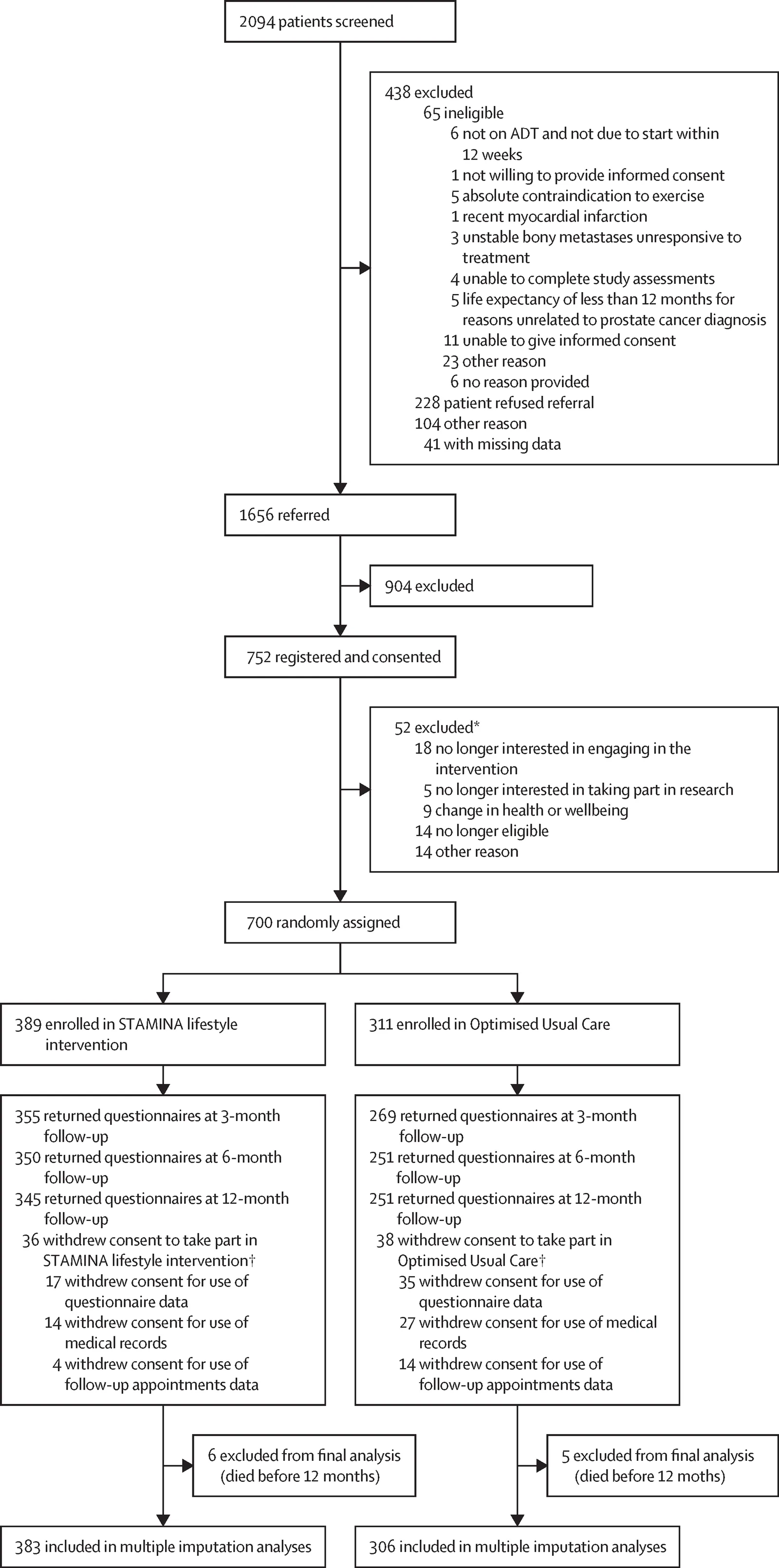
700 men, multicenter, registered ISRCTN46385239
Limit: Participants knew their assignment, which could bias self-reported quality of life
Edited by Boris Djordjevic · AgingResearch.News
A randomized trial in England enrolled 700 men with prostate cancer receiving or due to start androgen deprivation therapy, a hormone-lowering treatment. Their median age was 71.6 years. The 12-month program combined supervised aerobic and strength exercise, dietary advice, behavioral support and free gym membership. Supervision occurred twice weekly for 13 weeks, then every one to three months. The comparison group received enhanced usual care, including exercise information, behavioral prompts and exercise-safety checks.
The program limited deterioration in cancer-related quality of life and fatigue over 12 months compared with enhanced usual care. Three program-related serious adverse events occurred: temporary loss of consciousness, leg pain or weakness, and back pain. All affected participants recovered. No treatment-related deaths occurred.
Why it matters
For older men receiving prostate cancer therapy, the trial addresses how cancer services can support well-being alongside treatment. The authors concluded that the program could be implemented in England’s National Health Service trusts.
Caveats
Participants knew their assignments, outcomes were self-reported, and missing data were estimated statistically. Participants were 97% White; the trial excluded men with medical reasons not to exercise or life expectancy under 12 months.
From the paper
- Participants
52 participants were excluded after registration, mostly due to loss of interest and changes in eligibility, and 700 were randomly assigned: 389 (56%) to STAMINA lifestyle intervention and 311 (44%) to Optimised Usual Care.
- Who took part
Men already receiving ADT, or due to commence ADT over the ensuing 12 weeks, for prostate cancer were eligible for inclusion.
- Ages
Median age was 71·6 years (IQR 66·3–76·0), and 680 (97%) of 700 participants were White.
- Duration
Supervision was carried out twice weekly for 13 weeks, then negotiated between the participant and clinical exercise specialists (maximum once a month, minimum once every 3 months) over the subsequent 9 months (12 months in total).
- Harms
Three intervention-related serious adverse events occurred in the STAMINA lifestyle intervention group (transient loss of consciousness, leg pain or weakness, and back pain); all participants recovered.
- FACT-P
STAMINA lifestyle intervention was superior to Optimised Usual Care in offsetting deterioration in FACT-P (adjusted mean difference 4·5, 97·232% CI 1·7 to 7·2, p=0·0004) and FACIT-F (adjusted mean difference 1·9, 0·4 to 3·4, p=0·0068) over the 12 months of intervention.
Quoted word for word from the full text on PubMed Central.
The paper
Sheffield Hallam University
The Lancet Oncology, Sep 4, 2026, Open access
