Blood pressure gene scores show tissue-linked differences
An observational analysis of 411,463 UK Biobank participants found distinct blood pressure and cardiovascular disease associations after splitting genetic scores by tissue.
Our read
Biomarkers- Studied:
- Preprint: cohort study of 411,463 European ancestry individuals
- What changed:
- Blood pressure effects of partitioned polygenic risk scores differed across tissue-specific regulatory elements
- In the record:
- The 14th paper on antihypertensive medication with results in people; 32 on record in all.
- Why it’s aging research:
- It bears on staying healthy in midlife and later life.
Editor of record: Boris Djordjevic · AgingResearch.News
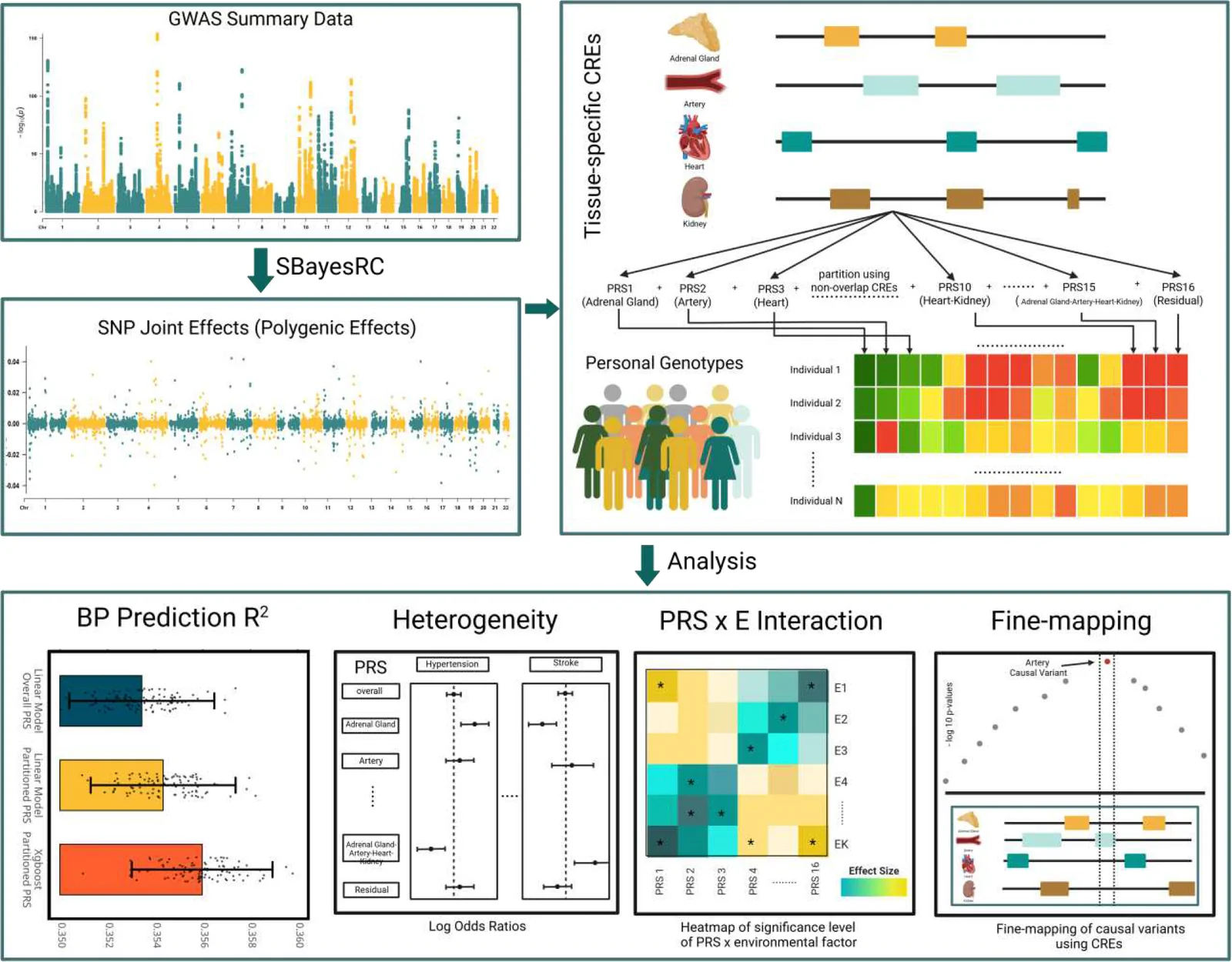
An observational study analyzed genetic data from 411,463 UK Biobank participants of European ancestry; sample sizes varied by outcome. Researchers divided polygenic risk scores—measures combining many genetic variants—according to DNA regions that regulate gene activity in four tissues: adrenal gland, artery, heart and kidney.
The resulting components differed in their associations with blood pressure and cardiovascular disease. The authors attributed this variation to interactions between genetic variants and environmental factors, including blood pressure medication use. Models incorporating these interactions improved prediction compared with a single overall score. For validation, researchers selected 98,833 All of Us participants of European ancestry aged 40–75, then excluded those missing required information. This independent analysis reproduced the differing associations.
Why it matters
For cardiovascular disease, an important threat to health in later life, the framework may help researchers investigate how inherited risk varies with medication use.
Caveats
The observational design cannot establish that medication caused the different genetic associations. This preprint has not been peer-reviewed, and the main analyses focused on people of European ancestry.
From the paper
- Participants
We further randomly removed one individual from each pair with a kinship coefficient greater than 0.0884, resulting in a total of 411,463 participants.
- Result
Notably, the K-tcPRS of BP_plei had an odds ratio 2.59 (95% CI: 2.18–3.08) on HTN, but it had protective effects on coronary artery disease (CAD) (OR: 0.589, 95% CI: 0.424–0.819) and myocardial infarction (MI) (OR: 0.576, 95% CI: 0.398–0.833) (Supplementary Table 8).
Quoted word for word from the full text on PubMed Central.
- Antihypertensive medication
- Human genetics
- Blood pressure
- Cardiovascular disease
- Polygenic risk score
- Humans
The paper
Case Western Reserve University
Research Square, Aug 27, 2026, Open access, Preprint, not yet peer-reviewed

Comments
Be the first to comment.