Baseline Body Mass Index Category and Incident Treated Hypertension in Australian Men: A Linked Prospective Cohort Study Using PBS/MBS Data
Declared no competing interests
Abstract
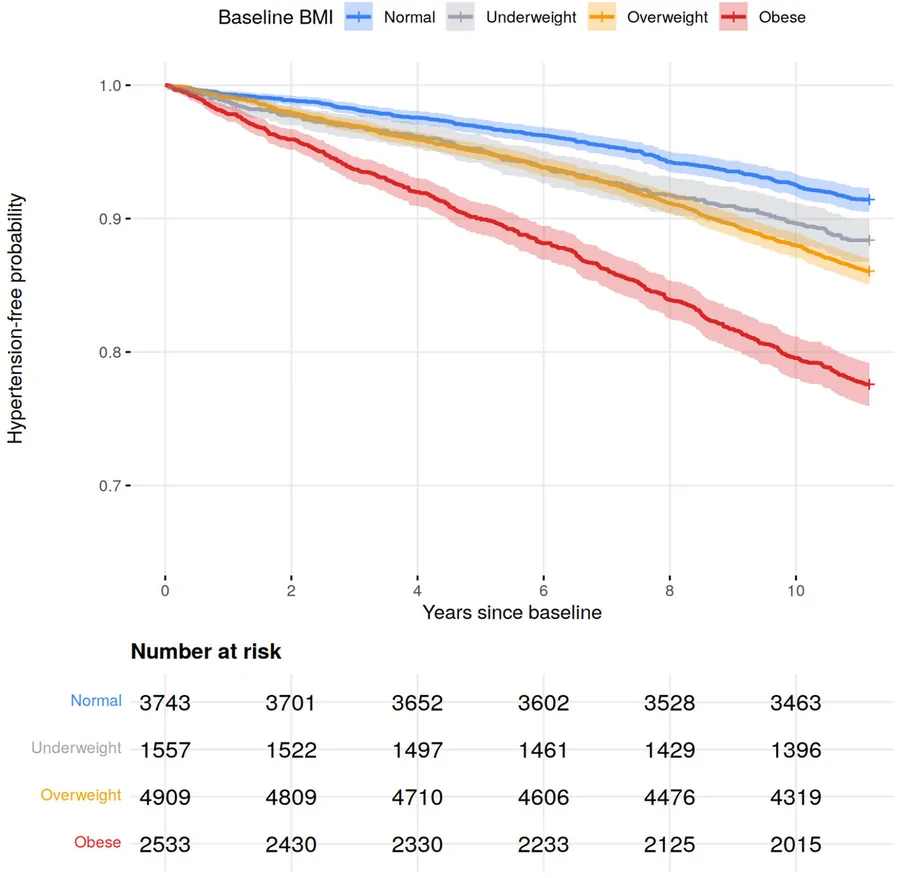
BACKGROUND: Excess adiposity is a major modifiable risk factor for hypertension; however, the incremental prognostic value of body mass index (BMI) beyond standard predictors remains unclear. We examined the associations between baseline BMI category and incident treated hypertension, and assessed whether BMI improved risk prediction. METHODS: Data were obtained from the Ten to Men longitudinal study (2013-2024) linked to Pharmaceutical Benefits Scheme (PBS) and Medicare Benefits Schedule (MBS) records. The cohort comprised 12,742 men aged ≥ 18 years without treated hypertension at baseline, followed for 133,038 person-years. Adjusted Cox proportional hazards models were fitted. Discrimination, calibration, decision curve analysis, E-values, and BMI × age interactions were evaluated using bootstrap 95% confidence intervals (CIs). RESULTS: During follow-up, 1755 men were initiated on antihypertensive therapy (13.2 per 1000 person-years). The 10-year cumulative incidence increased across BMI categories: 7.5% (95% CI 6.6-8.3) in normal-weight men, 10.3% (8.8-11.8) in underweight men, 12.0% (11.1-12.9) in overweight men, and 20.5% (18.9-22.0) in obese men. Fully adjusted hazard ratios (HRs) versus normal weight were 1.43 (95% CI 1.16-1.77) for underweight, 1.42 (1.22-1.67) for overweight, and 1.88 (1.59-2.22) for obesity; multiple-imputation estimates were similar. The BMI × age interaction was significant (p < 0.01), with the obesity effect stronger at ages 30-44 years (HR 2.39, 1.91-2.98) than at ages ≥ 45 years (HR 1.57, 1.28-1.94). Adding BMI to age improved discrimination (ΔC = 0.028), and the fully adjusted model achieved C = 0.754. CONCLUSION: BMI is independently associated with incident treated hypertension and provides a modest additional prognostic value beyond age, with obesity having the strongest relative effect in early midlife.
The paper
Edith Cowan University
Chronic Diseases and Translational Medicine, 30 Aug 2026