The Role of Spiritual Well-Being in the Relationship Between Frailty and Hopelessness Among Older Adults in Türkiye
Declared no competing interests
Abstract
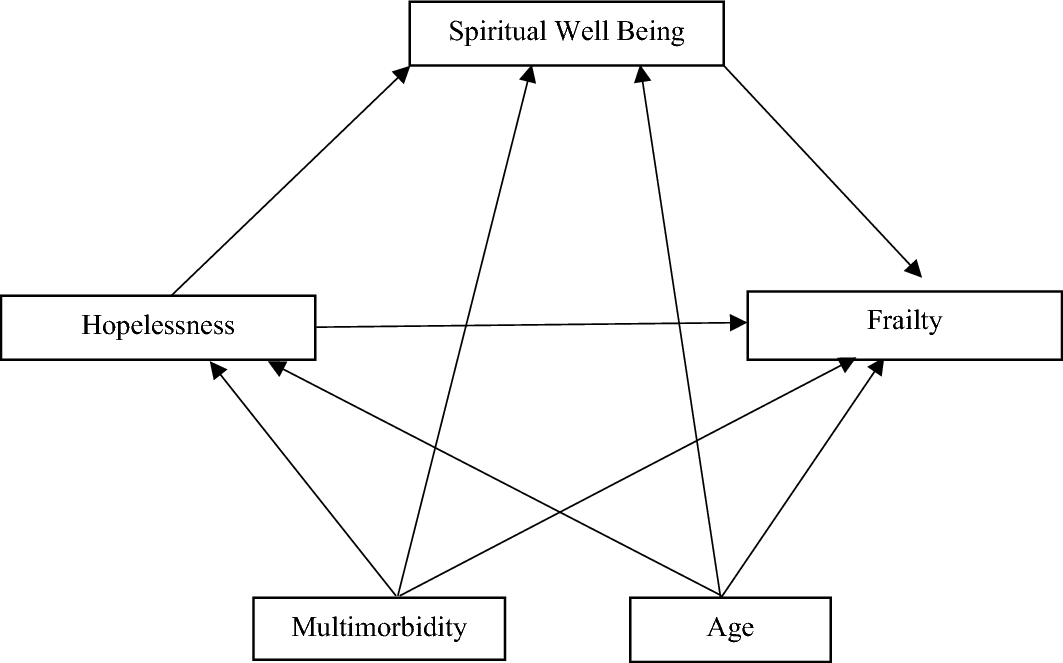
Spiritual well-being may play a protective role in the relationship between frailty and hopelessness in older adults. This study aims to examine the relationship between frailty and hopelessness among older adults and to assess the role of spiritual well-being in this relationship. This cross-sectional study was conducted with 328 older adults. The study data were collected using an Introductory Characteristics Questionnaire and the Three-Factor Spiritual Well-Being, Beck Hopelessness, and Edmonton Frail scales. Based on the Edmonton Frail Scale classification, 39.3% of the participants were not frail, 24.7% were apparently vulnerable, 20.7% were mildly frail, 11.0% were moderately frail, and 4.3% were severely frail. The spiritual well-being variable acted as a mediator in the relationship between the hopelessness and frailty variables. Frailty was positively and significantly correlated with age, hopelessness, and multimorbidity, whereas it was negatively and significantly correlated with spiritual well-being, transcendence, harmony with nature, and anomie. In addition, transcendence was significantly and negatively associated with frailty after adjusting for age and multimorbidity; however, this association was attenuated and became non-significant after the inclusion of anomie and hopelessness in the final model. These findings suggest that spiritual well-being, particularly transcendence, may play a protective role against frailty in older adults, although its independent contribution diminishes when other dimensions of spiritual well-being and hopelessness are considered.
The paper
Erciyes University; Ahi Evran University
Journal of Religion and Health, 31 Aug 2026