Structured Inequality, Uncertain Lifespans: Demographic Perspectives on Predicting Individual-Level Longevity
Abstract
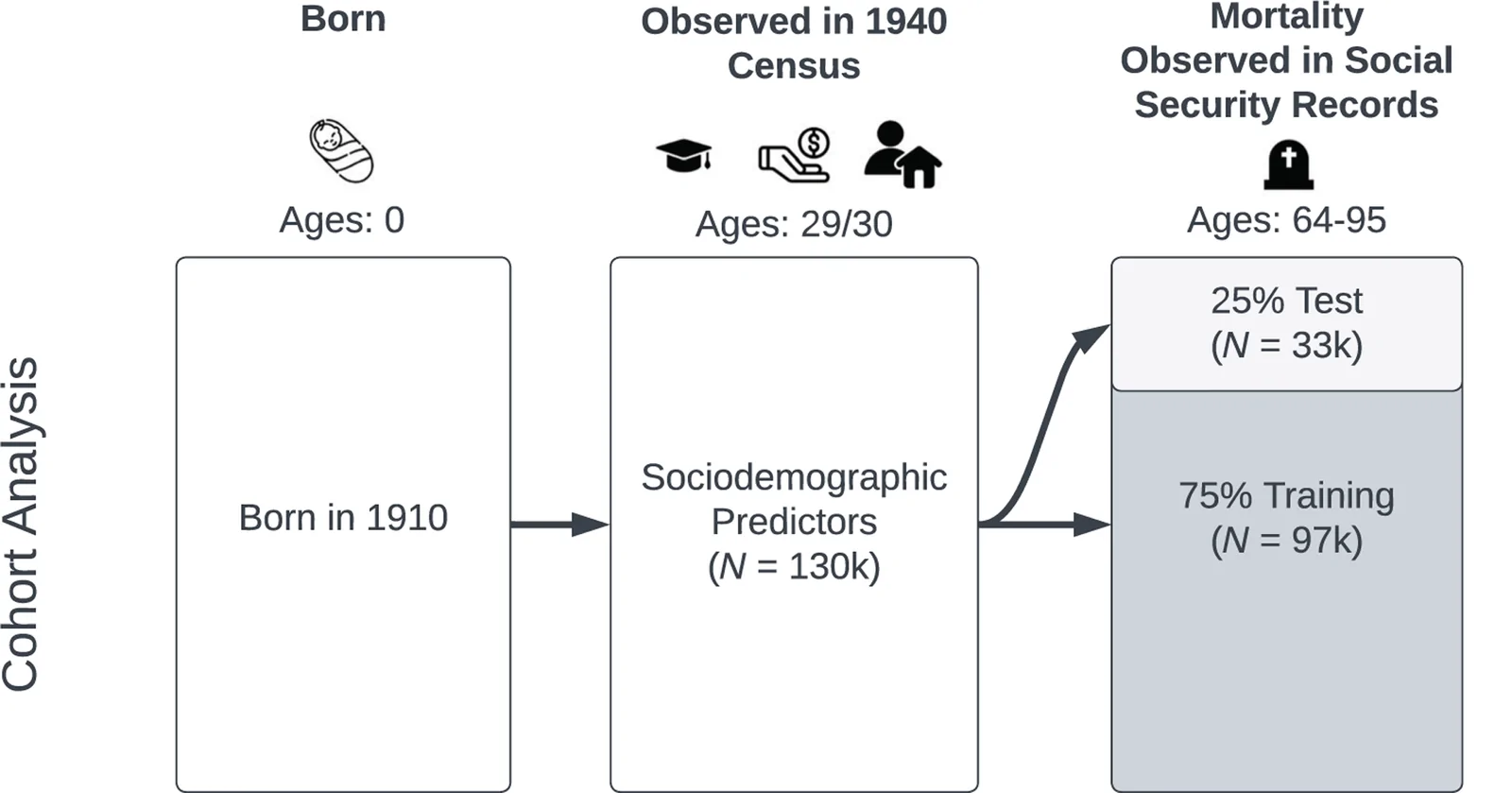
There are striking disparities in life expectancy across sociodemographic groups in the United States, shaped by structural forces such as racism, class inequality, and policy environments. To what extent do sociodemographic characteristics structure-or fail to structure-individual lifespans? Using U.S. Census data linked to administrative death records, we assess how well early-adulthood social, economic, and demographic characteristics predict individual lifespan in a cohort of men born in 1910 and observed through their deaths between 1975 and 2005 (N = 121,000). Despite large group-level disparities, we find that sociodemographic characteristics measured in early adulthood explain less than two percent of the overall variation in individual lifespan. These findings reaffirm a central demographic regularity: variance in life expectancy between groups is small compared to variation in lifespan within groups. This highlights the fundamentally nondeterministic nature of how structural inequality shapes individual mortality.
The paper
The University of Texas at Austin; University of California, Berkeley
Population and Development Review, 13 Apr 2026, Open access