Metformin may reduce irregular heartbeats after a heart procedure
At 12 months after the procedure, 78% receiving metformin versus 58% receiving usual care remained free of recurrent abnormal heart rhythms.
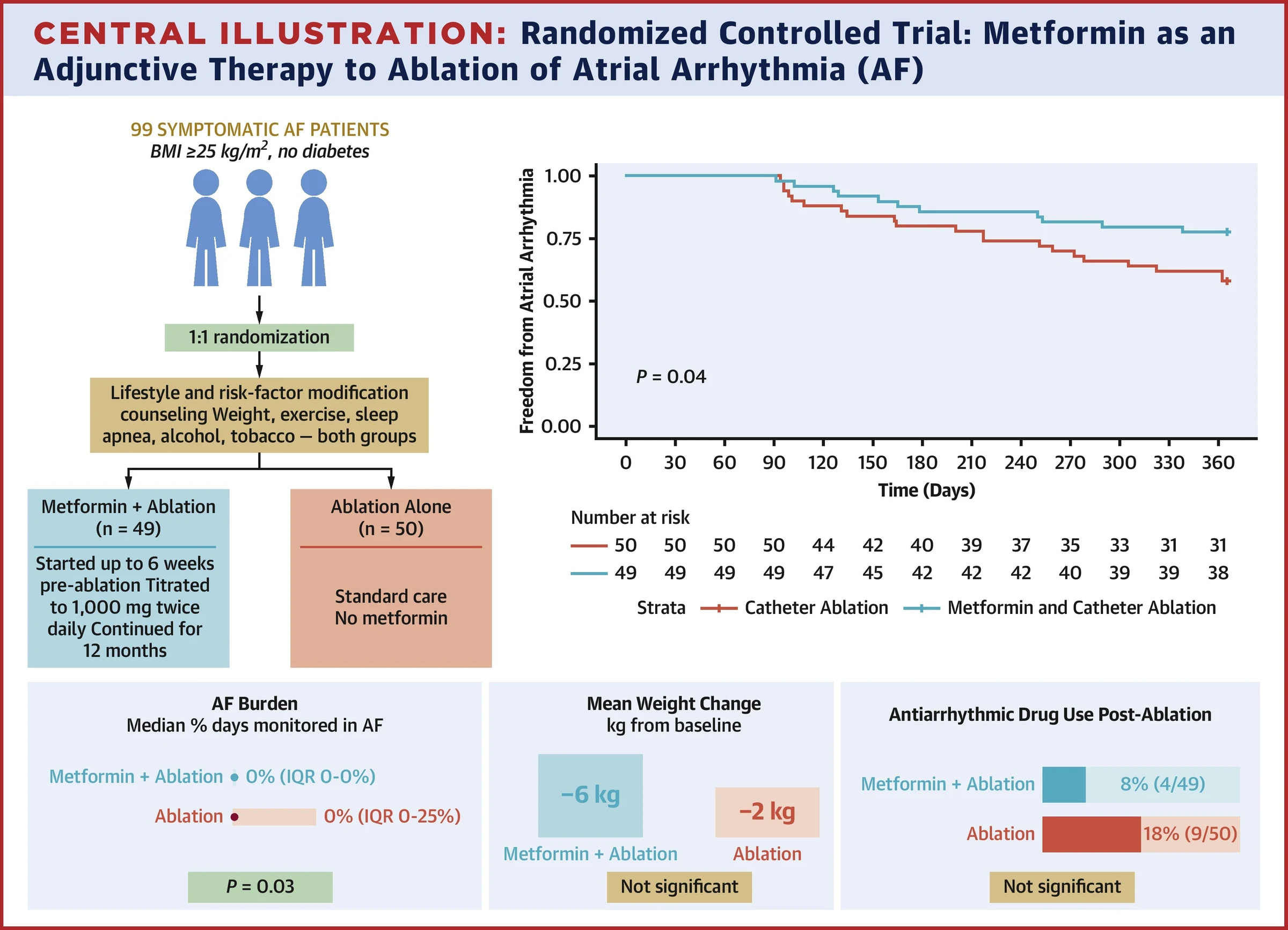
Limit: Only 99 participants were included; larger trials must confirm the finding
Edited by Boris Djordjevic · AgingResearch.News
A randomized trial studied 99 people with atrial fibrillation, an irregular heartbeat, and no diabetes. All had a body mass index, a measure of weight relative to height, above 25. Their average age was 63, and 70% were men. Researchers assigned 49 to metformin and 50 to usual care before catheter ablation, a procedure that interrupts faulty electrical signals in the heart. They increased metformin to each person's highest tolerated dose and continued it for one year after ablation. All participants received handheld heart rhythm monitors alongside routine monitoring.
At 12 months, 78% of the metformin group and 58% of the usual-care group were free of recurrent abnormal heart rhythms. The assessment did not count recurrences during the first three months. The authors concluded that metformin may reduce recurrence.
Why it matters
With participants averaging 63, the trial addressed a practical question in later-life heart care: whether medication could help maintain rhythm control after a procedure.
Caveats
The trial was small and conducted at one center, and participants and clinicians knew the assignments; larger trials must confirm the finding. It excluded people with diabetes or a body mass index of 25 or below, and the abstract does not report side effects.
Metformin is part of Bryan Johnson's Blueprint and David Sinclair's daily regimen in Lifespan
The paper
Metformin as an Adjunctive Therapy to Catheter Ablation of Atrial Fibrillation (META-AF)
Division of Cardiovascular Medicine; University of Michigan
JACC Clinical Electrophysiology, Aug 15, 2026, Open access


