Nanopore sequencing identifies parent-of-origin specific age-associated methylation changes at imprinted loci in the human genome
Abstract
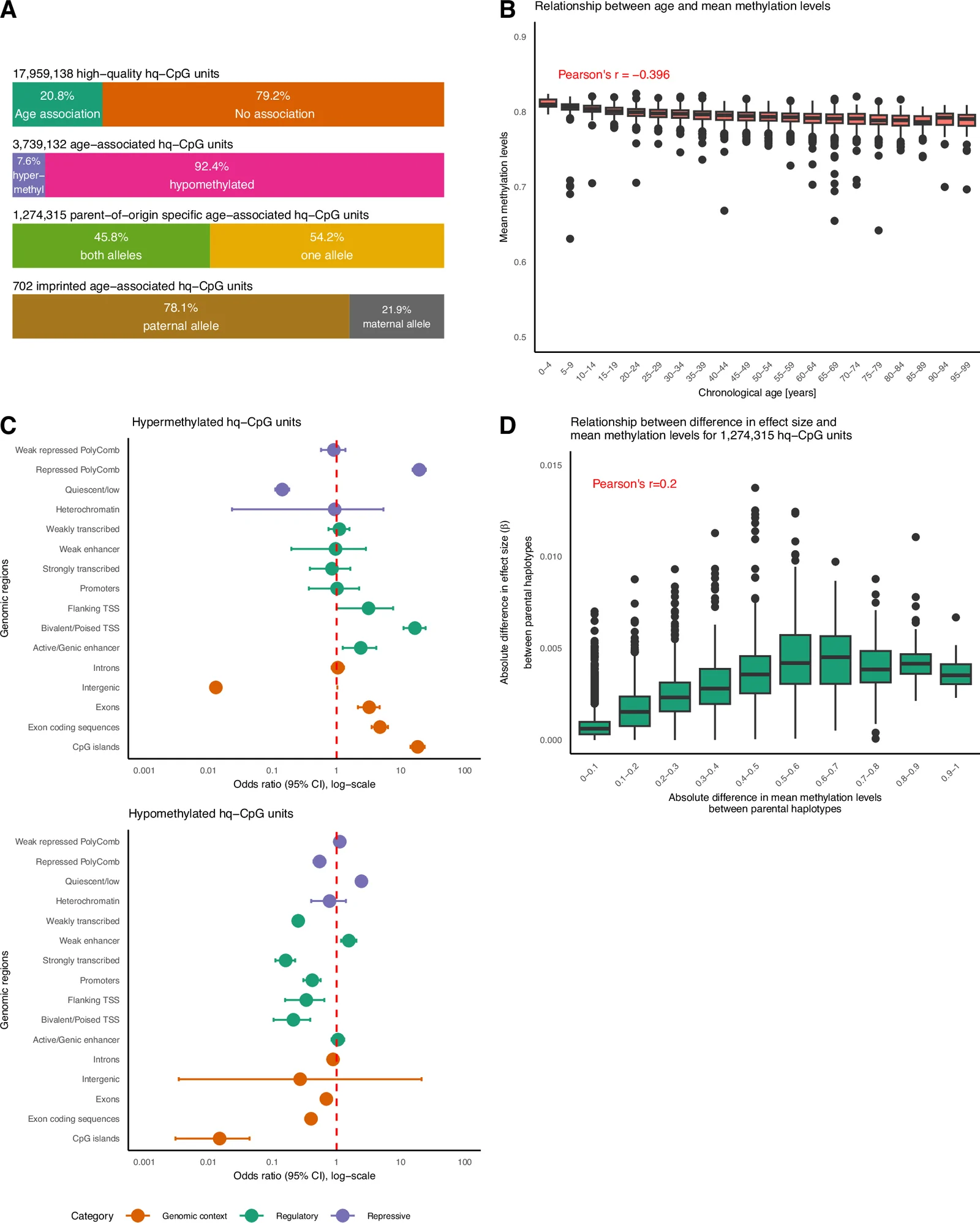
Aging is accompanied by widespread DNA methylation changes, yet their full genomic scope and parent-of-origin dynamics remain poorly understood. Here, we apply nanopore long-read sequencing to 7,284 whole blood samples enabling methylation measurements of 17,959,684 high-quality CpG units. Over 20% of the measured high quality CpG units undergo age-associated changes, predominantly hypomethylation. From these data, we construct a methylation aging clock from 1,373 high-quality CpG units, with median absolute prediction error of 2.43 years. Importantly, phasing the methylation to parental haplotypes enables systematic analysis of age effects in parent-of-origin specific context, uncovering 702 high-quality CpG units with parent-of-origin specific age-association, most of which are located at imprinted genomic regions. At the DIRAS3 locus, we detect age-dependent hypermethylation on the active paternal allele, indicative of attenuation of parent-of-origin specific methylation with age. Together, these findings establish nanopore sequencing as a powerful tool for mapping both genome-wide and parent-of-origin specific signatures of methylation aging and provide evidence that methylation patterns at imprinted loci become progressively altered with age.
- Epigenomics
- Machine learning
- DNA methylation
- Epigenetic regulation of gene expression
- Methylation aging clock
- Humans
The paper
Reykjavík University
Nature Communications, 29 Jul 2026, Open access


