Mendelian randomization study of smoking exposure in relation to primary ovarian failure
Abstract
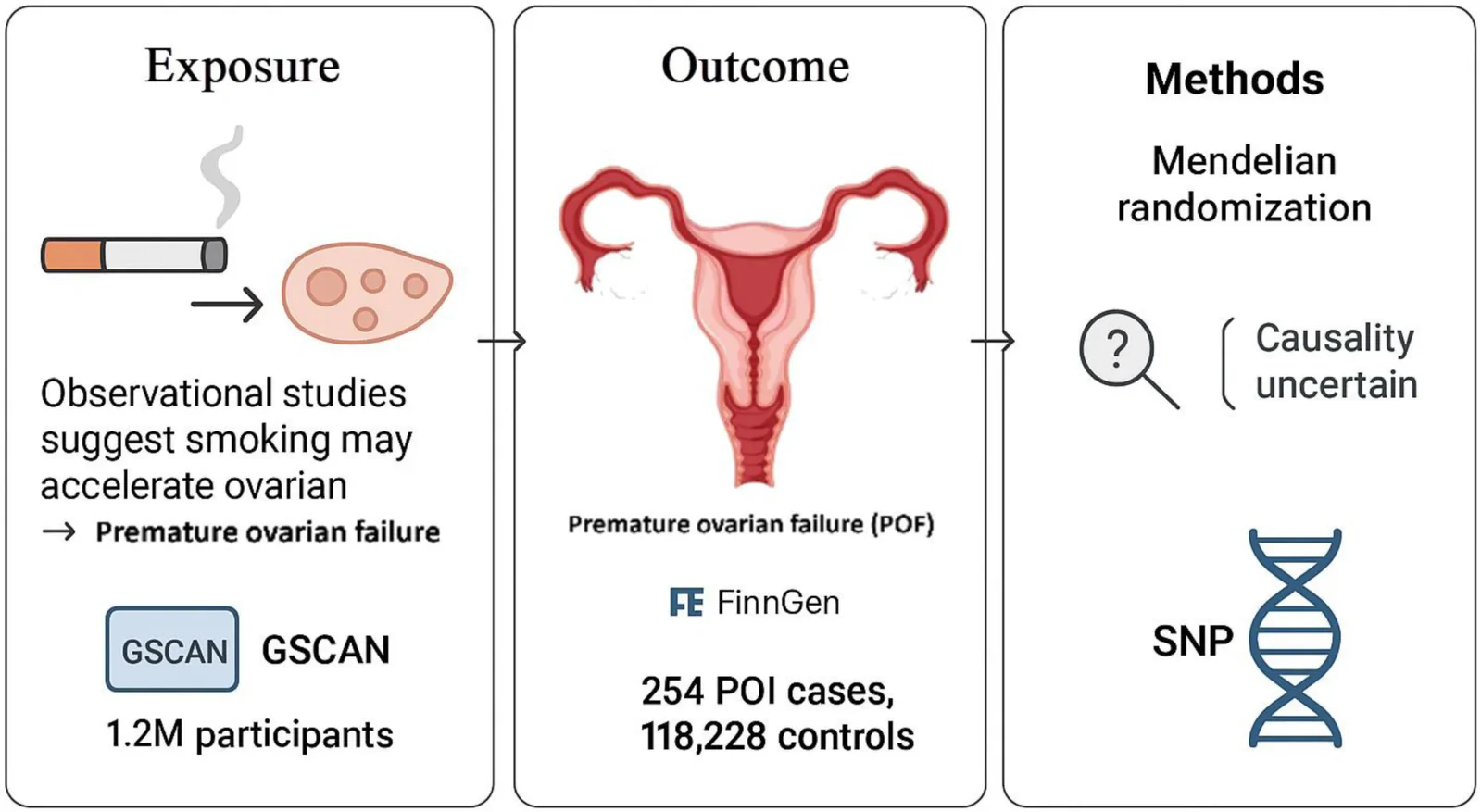
Although observational data suggest a relationship between primary ovarian insufficiency (POI) and smoking, there remain questions about causality. An unhealthy lifestyle, including smoking, can accelerate the depletion of the follicular pool and the early onset of menopause. Extensive research has been conducted on the detrimental effects of tobacco smoke on the ovaries. Mendelian randomization (MR) is a method that uses genetic variants as instruments for making causal inferences about an exposure and an outcome. SNPs associated with smoking behaviors were assessed from recent work by the GWAS and Sequencing Consortium of Alcohol and Nicotine Use (GSCAN), which analyzed up to 1.2 million participants. For the exposure variable, genetic variants associated with smoking behavior were selected, specifically focusing on the quantitative trait cigarettes per day (CPD)-the average number of cigarettes smoked daily by ever-smokers. We then applied GWAS summary statistics from FinnGen consortium data for POI. The dataset included 254 POF cases and 118,228 controls. We identified 22 SNPs associated with CPD to serve as instrumental variables. Genetic predisposition to higher cigarettes per day showed a suggestive but nonsignificant association with increased POI risk (OR = 1.443, 95% CI: 0.731-2.849, P = .289). We found limited evidence for an association between genetically predicted cigarettes per day and POI and indicate that moderate effects cannot be ruled out. There was little evidence of heterogeneity [QIVW = 21.19, P = .447; QEgger = 21.16, P = .387; I2 = 5.5%, 95% CI: 0.0%, 38.2%; I2GX = 97.24%] and pleiotropy [MR-Eggerintercept = 0.0063, P = .872; MR-PRESSOGlobal Test = 0.516]. This finding was consistently supported across multiple analytical methods. We found no strong evidence of a causal association between genetically predicted cigarettes per day and POI under the current study design; however, moderate effects cannot be excluded.
The paper
Babol University of Medical Sciences; Tehran University of Medical Sciences
Medicine, 21 Aug 2026, Open access