Cancer risk from one gene appeared mainly acquired in midlife
An observational analysis of 469,391 UK Biobank participants linked certain acquired gene variants, when abundant in blood, to higher blood-cancer risk but not solid-tumor risk.
Our read
Mechanisms- Studied:
- Genetic association study of 469,391 UK Biobank participants, against inherited classic LFS alleles
- What changed:
- Classic cancer-linked TP53 variants were more often acquired than inherited in healthy middle-aged adults
- The catch:
- Sampling healthy middle-aged adults can underrepresent inherited-variant carriers who developed cancer before recruitment
- In the record:
- The 147th paper on TP53 with results in people; 2,491 on record in all.
Editor of record: Boris Djordjevic · AgingResearch.News
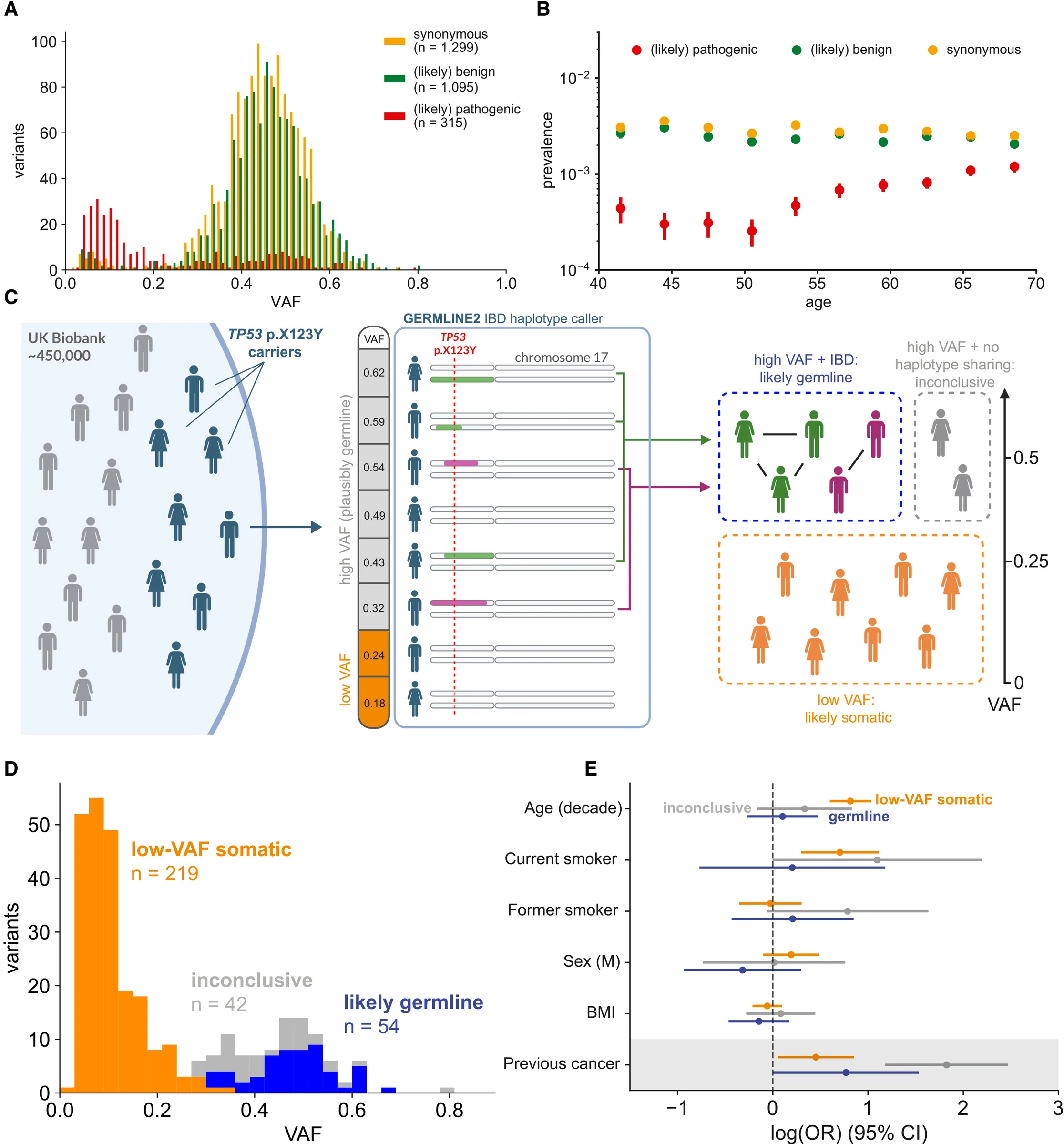
An observational genetic analysis used blood DNA from 469,391 UK Biobank participants to distinguish inherited changes in TP53, a gene that helps suppress tumors, from changes acquired during life. The researchers combined each variant’s abundance in blood with patterns of shared inheritance.
Inherited variants clustered at sites linked to partial loss of the gene’s protein function and a lower likelihood of developing disease. Variants classically linked to Li-Fraumeni syndrome, an inherited cancer-predisposition disorder, appeared predominantly acquired. When abundant in blood, these variants were associated with markedly greater risk of blood cancers, but not solid tumors. The findings pointed to an important contribution from expanding groups of blood cells carrying acquired variants. The authors concluded that acquired rather than inherited risk predominated in healthy middle-aged adults.
Why it matters
For middle-aged adults, the work addresses whether cancer-linked changes found in blood signal inherited susceptibility or changes acquired during life.
Caveats
This observational analysis identified associations, not proof that variants caused cancer. Its population-level conclusions concern healthy middle-aged adults, not people selected because they have Li-Fraumeni syndrome.
The paper
Shared inheritance reveals landscape of somatic and germline cancer risk in TP53
University of Cambridge
American Journal of Human Genetics, Aug 17, 2026, Open access


Comments
Be the first to comment.