Blood-cell mutations linked to two solid cancer subtypes
Solid cancer risk was higher in people with groups of mutated blood cells than in people without them, with a hazard ratio of 1.13.

Our read
Biomarkers- Studied:
- Preprint: cohort study in people
- In the record:
- The 275th paper on clonal hematopoiesis of indeterminate potential with results in people; 617 on record in all.
- Why it’s aging research:
- It studies something that builds up in the body with age.
Editor of record: Boris Djordjevic · AgingResearch.News
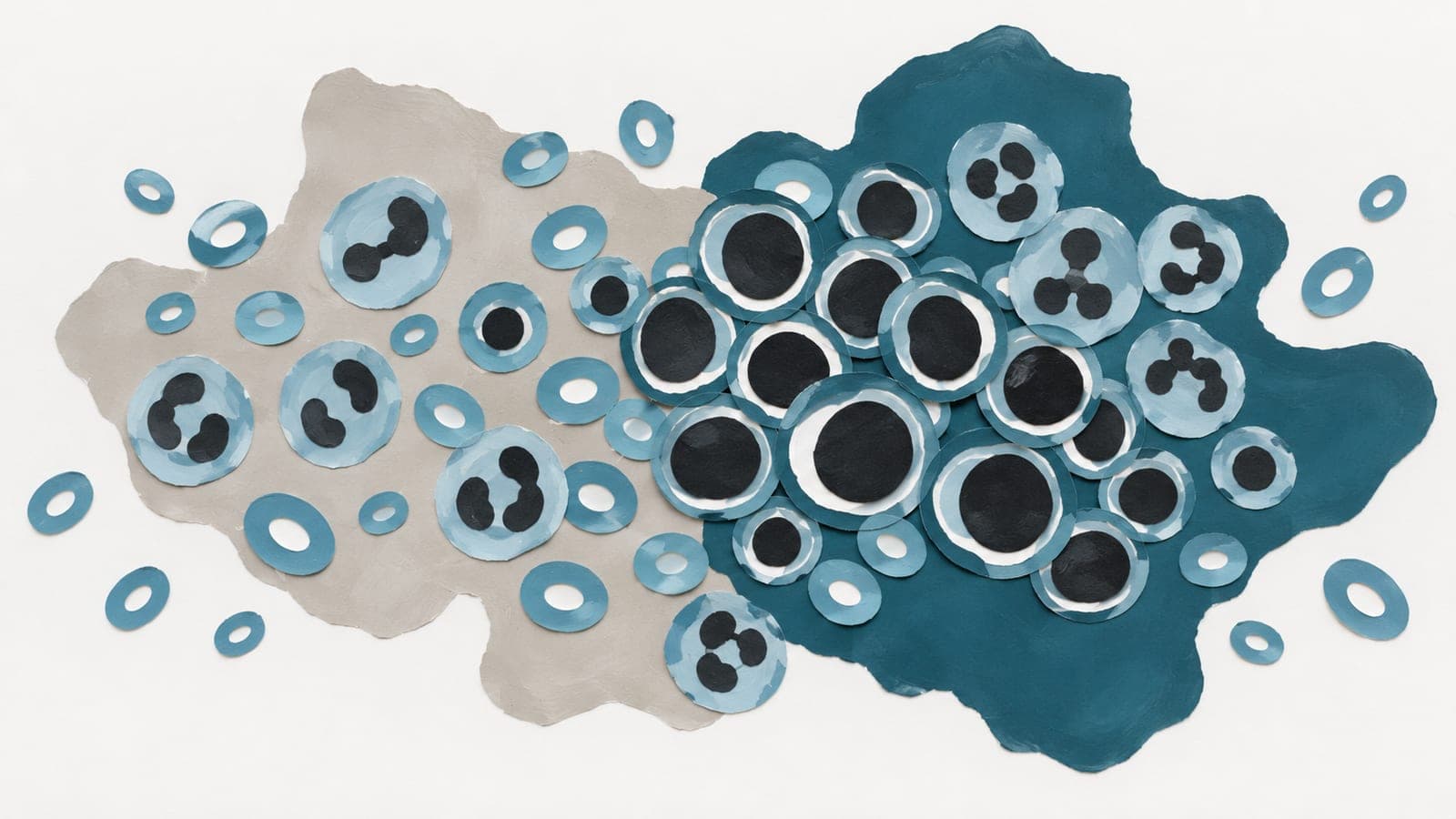
UK Biobank participants without cancer at baseline underwent genetic sequencing in a prospective cohort study that tracked later cancers through national registries. Researchers examined clonal hematopoiesis of indeterminate potential (CHIP), a condition in which groups of blood cells share acquired mutations.
CHIP was associated with higher solid cancer risk overall. Two subtypes remained associated after correction for testing multiple outcomes: lung adenocarcinoma, a gland-forming lung cancer, and esophageal squamous cell carcinoma, a cancer of flat cells lining the food pipe. Their hazard ratios—measures of relative risk compared with people without CHIP—were 1.79 and 2.28, respectively. Higher risk was associated with larger groups of mutated blood cells and multiple mutations. A separate analysis in Vanderbilt BioVU confirmed the association with solid cancers overall.
Why it matters
Cancer risk assessment matters for healthy aging. The authors called for risk models that account for the size of groups of mutated blood cells.
Caveats
The observational cohort comparison could not rule out other differences between people with and without CHIP as contributors to their differing cancer risks. The report is a preprint and has not been peer-reviewed.
- Cancer
- Clonal hematopoiesis of indeterminate potential
- Lung adenocarcinoma
- Esophageal squamous cell carcinoma
- Esophageal cancer
- Humans
The paper
The Ohio State University Comprehensive Cancer Center
medRxiv, Nov 6, 2026, Open access, CC BY-NC-ND, Preprint, not yet peer-reviewed
Comments
Be the first to comment.