Blood-cell mutations linked to death risk in heart rhythm disorders
Mutation carriers had a higher relative rate of death than noncarriers, with an adjusted hazard ratio of 1.26.
Our read
Populations- Studied:
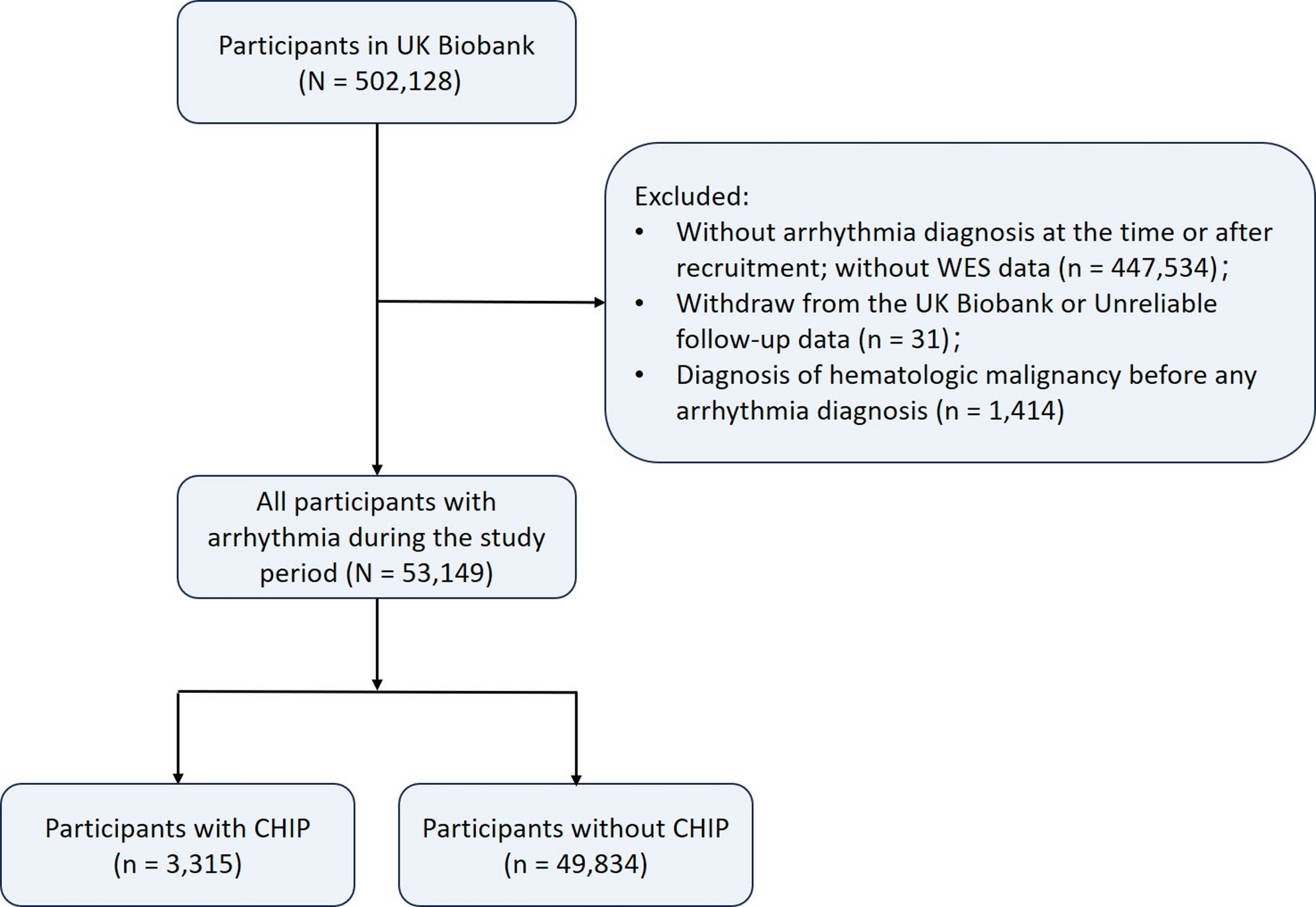
- Cohort study of 53,149 people hospitalized with arrhythmias, against patients without CHIP mutations (Multicenter)
- What changed:
- Death from any cause was higher with CHIP mutations than without them in arrhythmia patients (hazard ratio 1.26)
- The catch:
- Arrhythmia severity and treatment patterns could confound the link because AF burden was not adjusted
- In the record:
- The 227th paper on clonal hematopoiesis of indeterminate potential with results in people; 617 on record in all. Its result on mortality agrees with 39 of 45 other findings on record; 6 found no change.
- Why it’s aging research:
- It studies something that builds up in the body with age.
Editor of record: Boris Djordjevic · AgingResearch.News
UK Biobank participants hospitalized with heart rhythm disorders—53,149 people with a median age of 69—were studied in an observational cohort analysis. Of these, 38.7% were female. Blood DNA sequencing identified 3,315 people with clonal hematopoiesis of indeterminate potential (CHIP), in which groups of blood-forming cells share acquired mutations.
Over a median follow-up of 6.9 years, 35.1% of CHIP carriers died, compared with 27.0% of noncarriers. The association persisted after adjustment for other risk factors. Larger groups of mutation-carrying cells showed stronger associations with death. CHIP was also linked to higher rates of death from heart and blood vessel disease and from cancer. Associations persisted across types of heart rhythm disorder and were strongest in disorders affecting the heart’s lower chambers.
Why it matters
For older people with heart rhythm disorders, the authors suggested CHIP may serve as a marker of future outcomes and a potential treatment target.
Caveats
The cohort analysis did not test whether targeting CHIP would improve survival. The findings do not cover people diagnosed with a blood cancer before their heart rhythm disorder, whom the study excluded.
From the paper
- Participants
The primary study cohort comprised 53,149 individuals with any form of arrhythmia (Fig. 1), among whom 3,315 (6.2%) carried any CHIP mutation, and 1,764 (3.3%) harbored CHIP mutations with a VAF ≥ 10%.
- Follow-up
Among any arrhythmia population, over a median follow-up of 6.9 years (interquartile range [IQR], 2.7–10.7 years), 14,641 individuals died from any cause, including 13,477 (27.0%) without CHIP, 1164 (35.1%) with any CHIP mutation, and 699 (39.6%) with CHIP mutations at a VAF ≥ 10%.
- Result
… the presence of any CHIP (vs. no CHIP) was associated with increased risks of all-cause mortality (hazard ratios [HRs] 1.26, 95% CI 1.19–1.34, P < 0.001), cardiovascular mortality (HR 1.14, 95% CI 1.02–1.27, P = 0.020) …
Results, Multivariable-adjusted associations of CHIP with mortality
- Limitation
First, this study was observational in design; therefore, the observed associations between CHIP and mortality should not be interpreted as causal.
Quoted word for word from the full text on link.springer.com.
- Clonal hematopoiesis of indeterminate potential
- Cancer
- Cardiac arrhythmia
- Ventricular arrhythmia
- Variant allele fraction
- Humans
The paper
Chinese Academy of Medical Sciences & Peking Union Medical College; University of Oxford
Journal of Translational Medicine, Aug 8, 2026, Open access



Comments
Be the first to comment.