Differential Expression of SERCA and Myosin Heavy Chain Isoforms in Rat Laryngeal Muscles
Abstract
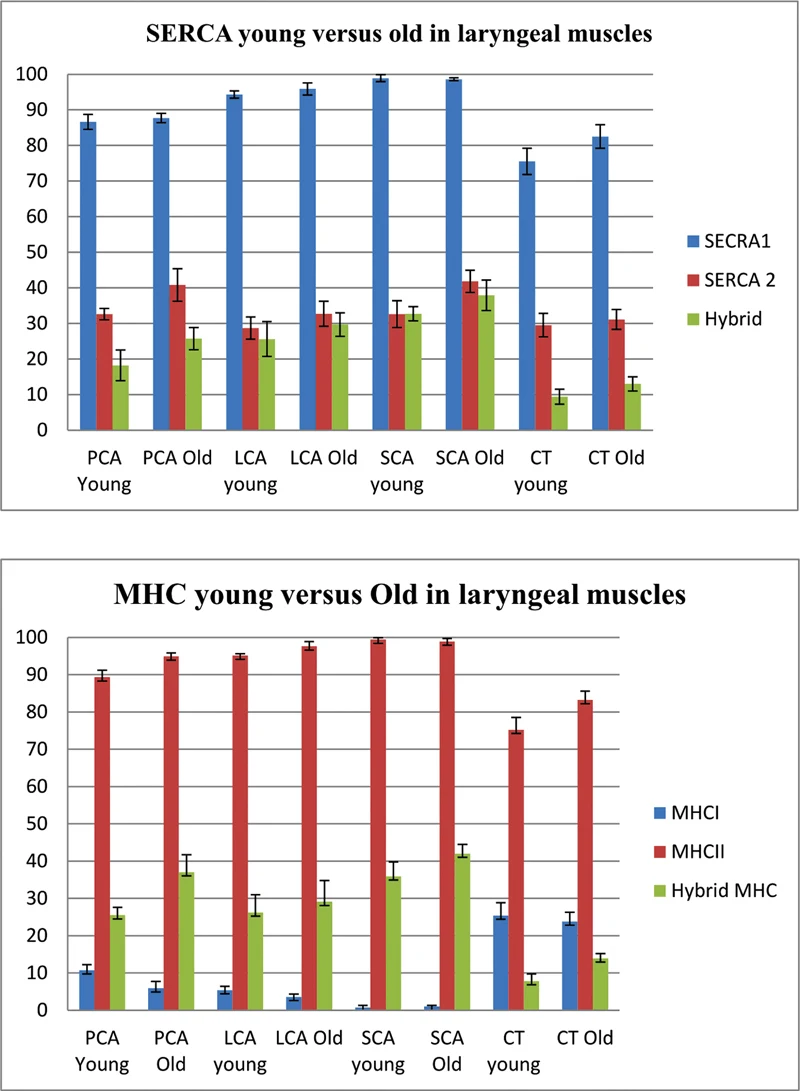
INTRODUCTION: Intrinsic laryngeal muscles (ILMs) play a fundamental role in airway protection, respiration, and phonation. OBJECTIVE: Knowledge of the distribution and roles of different sarcoplasmic reticulum Ca2+ ATPase (SERCA) and myosin heavy chain (MHC) isoforms in ILMs is essential for understanding their functions and associated pathophysiological changes. METHODS: We immunohistochemically characterized SERCA and MHC isoform expression and co-expression patterns in five ILMs of young, aged, and denervated rats. RESULTS: ILMs exhibited the predominant expression of fast fibers that would be important in airway protection. ILMs showed spatially different percentages of muscle fibers and SERCA2. Slow fibers were higher in medial thyroarytenoid (TA) muscles than lateral TA. Significant increases were observed in slow and hybrid fibers with aging. SERCA2 noticeably diminished after denervation, pointing to an increased vulnerability of the denervated muscle to fatigue. A compensatory increase in SERCA2 and hybrid fibers was observed in contralateral muscles likely reflecting adaptation to increased mechanical load. CONCLUSION: These results indicate that ILMs, like limb muscle fibers, are subject to neural regulation. These findings may significantly advance the understanding of the Ca2+ handling system in ILMs and its role in unique laryngeal muscle functions.
The paper
Kyoto Prefectural University of Medicine
International Archives of Otorhinolaryngology, 14 Aug 2026