Col4a2 mutation disrupts cerebral artery function in aged mice
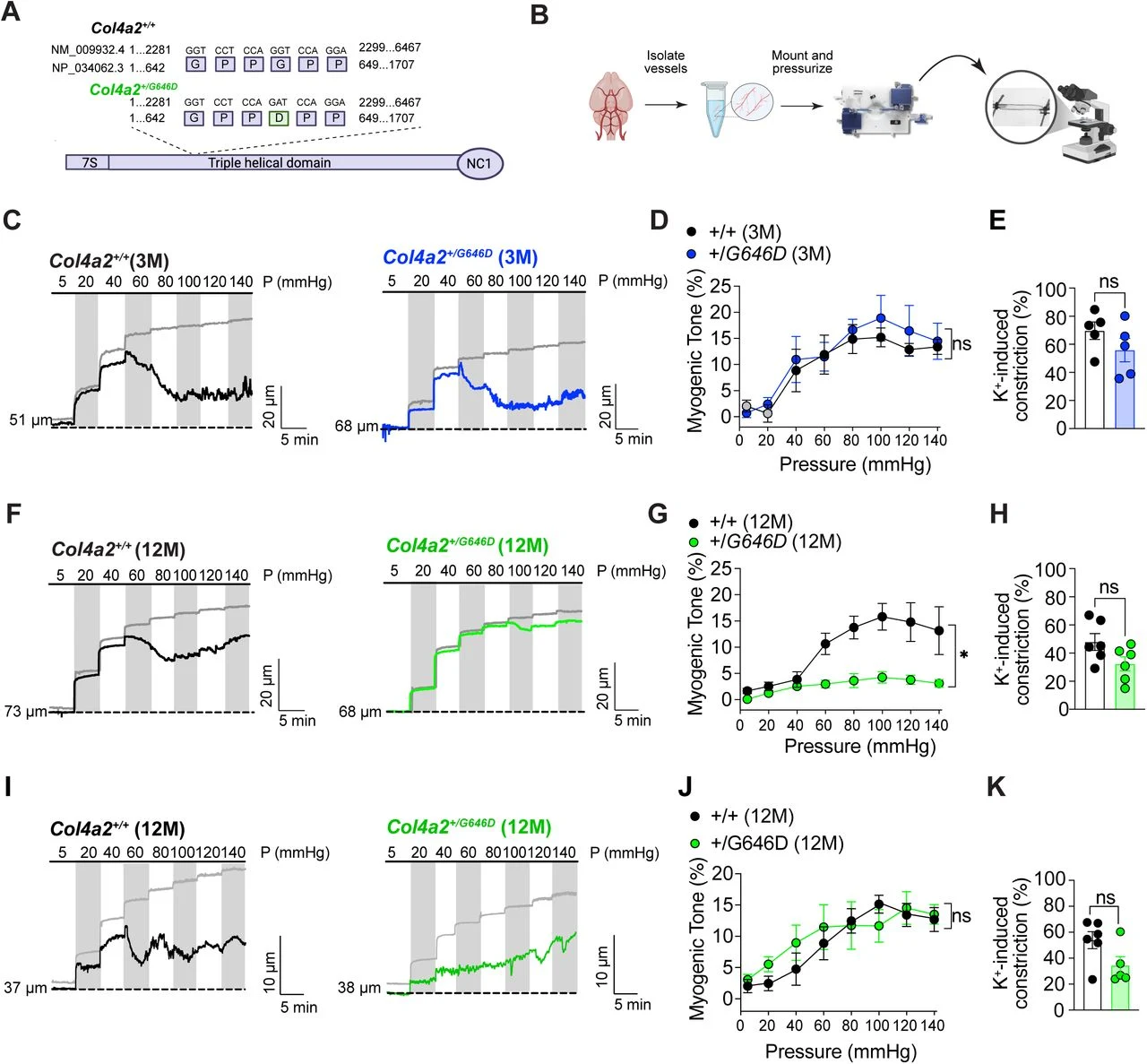
In 12-month-old Col4a2 mutant mice, cerebral pial arteries showed impaired myogenic tone driven by PKA-dependent remodeling of ryanodine receptor clusters.
Our read
Mechanisms- Studied:
- Preprint: experiments in mice
- In the record:
- One of 17 papers on COL4A2 on record: none yet with results in people, 1 in animals.
Editor of record: Boris Djordjevic · AgingResearch.News
In heterozygous Col4a2+/G646D mice, researchers investigated how a collagen mutation linked to cerebral small vessel disease affects arterial function over time. Cerebral pial arteries from 12-month-old mutant mice exhibited impaired pressure-induced myogenic tone, a defect absent in 3-month-old mutants and downstream parenchymal arterioles. Smooth muscle cells from these aged pial arteries showed higher calcium spark frequencies from ryanodine receptors (RyR2s) and elevated BK channel activity. While sarcoplasmic reticulum calcium load and Ryr2 transcript levels remained unchanged, super-resolution microscopy revealed enlarged RyR2 protein clusters. Activating protein kinase A (PKA) reproduced this cluster expansion, whereas PKA inhibition restored normal RyR2 cluster structure and BK channel activity.
Why it matters
These results show how a genetic risk factor for small vessel disease interacts with aging, uncovering nanoscale ion channel remodeling as a driver of vascular dysfunction. Understanding this pathway may offer molecular targets to preserve cerebrovascular tone during aging.
Caveats
The findings are based entirely on a mouse model, and the work is a preprint that has not yet undergone peer review.
The paper
Ryanodine receptor cluster remodeling links COL4A2 mutation to cerebral artery dysfunction
University of Rochester Medicine; University of California San Francisco Medical Center
bioRxiv, Oct 1, 2026, Open access, CC BY-NC-ND, Preprint, not yet peer-reviewed


Comments
Be the first to comment.