Reference equations for maximal inspiratory and expiratory pressures: From childhood to advanced age
Abstract
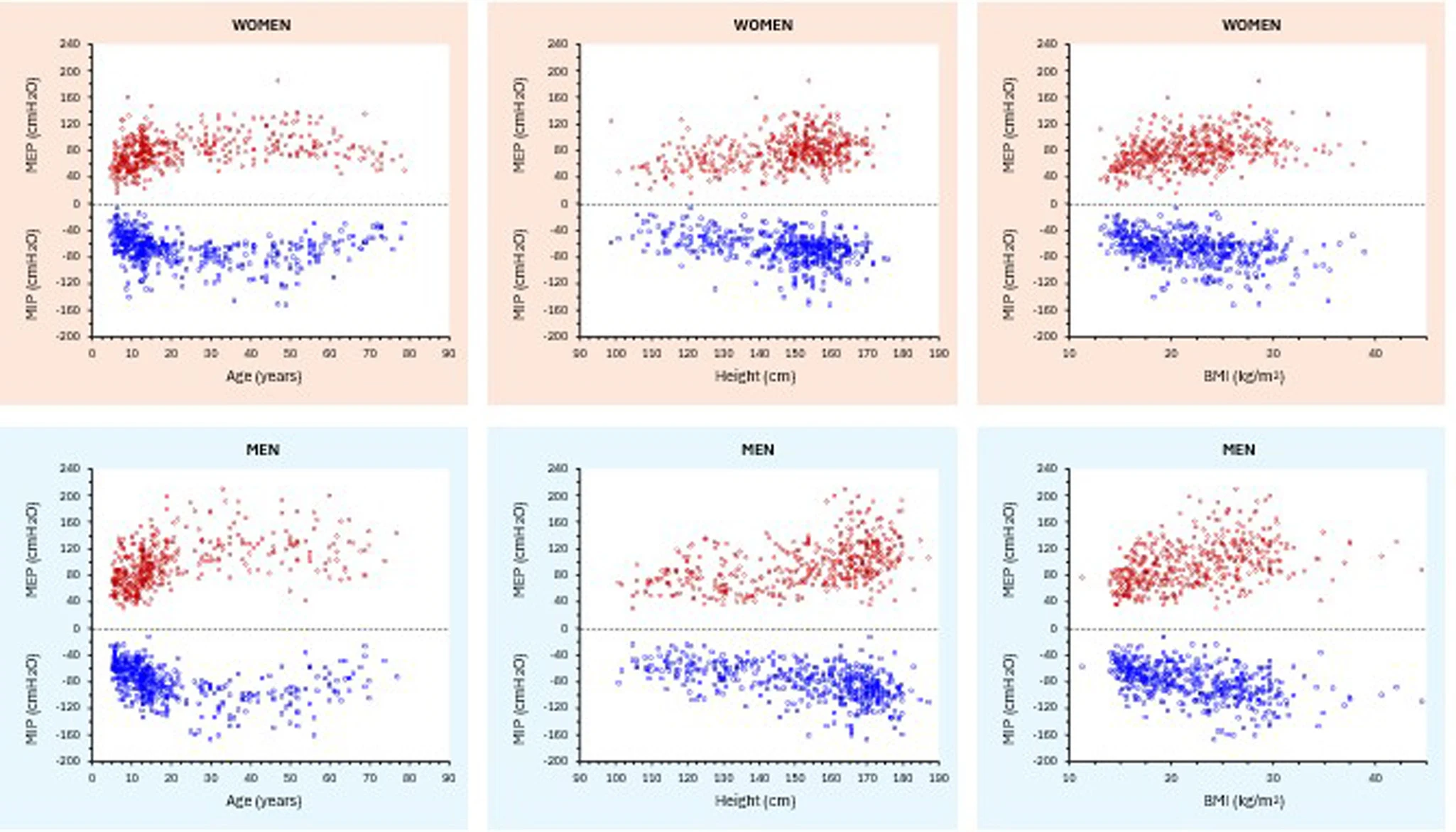
BACKGROUND: Maximal inspiratory (MIP) and expiratory (MEP) pressures indicate respiratory muscle strength. Published reference equations typically cover limited age ranges, causing artificial shifts in predicted values during age transitions. Our aim was to develop continuous MIP and MEP reference equations from childhood to advanced age. METHODS: We evaluated 892 healthy subjects aged 4.7-79 years (median: 14.3 years; 50.4% female) in Mexico City (2240m). MIP and MEP were measured following international guidelines. RESULTS: Reference equations and root mean square errors (RMSE) were: -MIP (cmH₂O)=19.08654+(13.82336·sex)+(2.529469·age)-(0.0341694·age²)+(0.9130152·BMI); RMSE=20.595 MEP (cmH₂O)=32.74452+(18.25912·sex)+(2.606639·age)-(0.0301438·age²)+(0.4891667 ·BMI); RMSE=25.157 where sex: male=1, female=0; age in years; BMI in kg/m². Age exerted the greatest influence on respiratory pressures, followed by sex and BMI. CONCLUSION: These continuous reference equations span most of the lifespan, eliminating transitional gaps and improving the clinical assessment of maximal respiratory pressures.
The paper
Instituto Nacional de Enfermedades Respiratorias
Revista de Investigacion Clinica; Organo Del Hospital de Enfermedades de la Nutricion, 14 Aug 2026