Non-linear association between mHealth-measured daily steps and subsequent healthcare expenditures among long-term app users in Osaka, Japan
6 months
Abstract
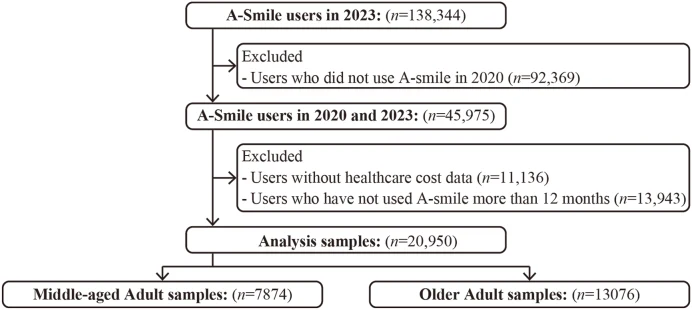
While physical activity has been associated with lower healthcare expenditures, existing studies relying on self-reports and linear models have struggled to characterize the non-linear shape of this association. Using a linked dataset of mHealth step counts and administrative claims data from 20,950 residents aged ≥40 years, this study employed Generalized Additive Models to elucidate the non-linear association between daily steps and future healthcare expenditures. The outcome was defined as the total healthcare expenditures accrued during the 6 months following each observation month; this 6-month window was chosen a priori for stability and interpretability, not because health effects of walking are assumed to emerge within exactly 6 months. Predicted 6-month healthcare expenditures decreased steeply as daily steps increased from low activity levels and then leveled off at approximately 10,000-12,000 steps/day, indicating a non-linear association between daily steps and subsequent expenditures. This low-expenditure plateau (point-estimate: ∼11,000 steps/day) was associated with a predicted geometric mean expenditure of 17,170 [16,174-18,229] JPY, though confidence intervals widened at higher step counts. Stratified analyses showed similar local nadirs in the data-dense range across age groups despite large differences in absolute magnitudes: the local nadir was 10,612 steps/day (48,407 [45,568-51,423] JPY) for older adults (≥65 years) versus 11,317 steps/day (1514 [1360-1685] JPY) for middle-aged adults, suggesting ∼11,000 steps/day as a common associational benchmark. These associations are observational and cannot establish that increasing walking causally lowers expenditures; rather, the non-linear shape suggests that strategies shifting population activity distributions toward this lower-expenditure range merit further evaluation.
The paper
Osaka Metropolitan University
SSM - Population Health, 3 Aug 2026, Open access


