Terpenoids as Emerging Senotherapeutics: Mechanistic Insights and Therapeutic Potential
Abstract
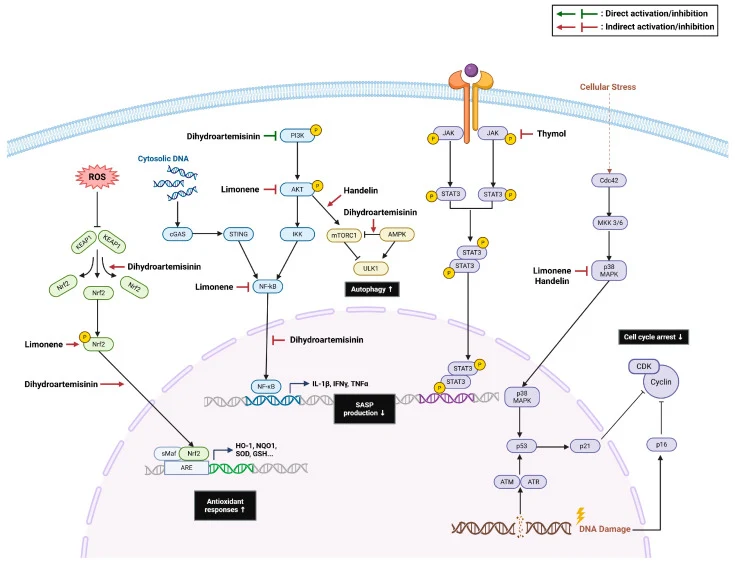
Cellular senescence, characterized by stable cell cycle arrest, drives organismal aging and functional decline. Senescent cells (SnCs) increase in multiple tissues with age and contribute to pathology by resisting apoptosis, impairing regeneration, and releasing senescence-associated secretory phenotype (SASP) factors. Senotherapeutics, including senolytics and senomorphics, aim to reduce the impact of SnCs by selectively clearing SnCs or suppressing SASP production. Natural terpenoids are structurally diverse plant- and fungus-derived metabolites with antioxidant, anti-inflammatory, and cytoprotective properties. Growing evidence supports their ability to counteract senescence-associated phenotypes, including senescence-associated β-galactosidase (SA-β-gal) activity and the expression of p53, p21, and p16. In this review, we examine mono-, sesqui-, di-, and triterpenoids that modulate cell cycle regulation, SASP attenuation, redox homeostasis, mitochondrial function, autophagy, and apoptosis-related mechanisms. We also outline the principal pathways underlying these anti-senescence activities and highlight natural terpenoids as emerging modulators of cellular senescence.
- Terpenoids
- Apoptosis
- Autophagy
- Cell cycle regulation
- Senescence-associated beta-galactosidase
- Senescent cell count
The paper
Korea University
International Journal of Molecular Sciences, 31 Jul 2026
