Gene variant linked to lower lung cancer risk in former smokers
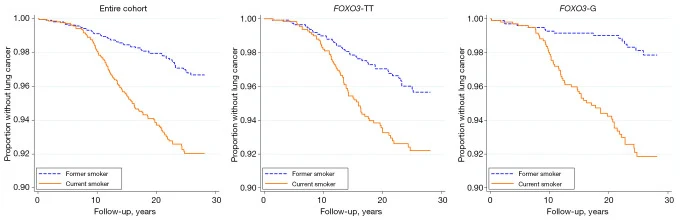
Former smokers carrying a longevity-linked gene variant had lower relative lung cancer risk than noncarriers, with a hazard ratio of 0.42.
Our read
Populations- Studied:
- Cohort study of 4,339 ever-smoking American men of Japanese ancestry, 28 years
- What changed:
- Former smokers carrying FOXO3-G had lower lung cancer risk than FOXO3-TT carriers (hazard ratio 0.42)
- The catch:
- Only 180 lung cancer cases supported analyses split by smoking status and genotype
- In the record:
- The 113th paper on smoking cessation with results in people; 351 on record in all. Its result on lung cancer agrees with all 7 other findings on record.
- Why it’s aging research:
- A leading disease of aging, its risks or menopause.
Editor of record: Boris Djordjevic · AgingResearch.News
A prospective cohort study followed 4,339 American men of Japanese ancestry, aged 51–75, who were current or former smokers without lung cancer at enrollment in 1971–1975. During a median 22.8 years of follow-up, 180 developed lung cancer.
Researchers compared variants of FOXO3, a gene involved in cells’ stress responses and processes linked to longevity. Among former smokers, carriers of its longevity-associated G variant had lower lung cancer risk than men with two copies of the alternative T variant. The adjusted hazard ratio, a measure of relative risk over time, was 0.42. Age-adjusted rates were 7.2 versus 16.2 cases per 10,000 person-years, which combine participants’ time in the study. Researchers observed no difference between variants among current smokers. They concluded that FOXO3 variants may modify the association between quitting and lung cancer risk.
Why it matters
FOXO3 helps regulate cellular stress responses and longevity pathways. The authors suggest that information about its variants may help tailor lung cancer prevention.
Caveats
This observational study cannot establish that the gene variant caused the difference in cancer risk. Its findings do not establish the same associations in women, never-smokers or people of other ancestries.
The paper
Kuakini Medical Center; University of Hawaiʻi at Mānoa
Translational Lung Cancer Research, Jun 10, 2026, Open access
Comments
Be the first to comment.