Brain organoids show reduced energy and signaling gene activity
Experiments compared patient-derived disease models with controls and found particularly pronounced changes in mature dopamine-producing nerve cells.
Our read
Interventions- Studied:
- Experiments in patient-derived midbrain organoids, against disease-free controls
- What changed:
- Energy production and signaling gene activity was lower in patient-derived organoids than in disease-free controls
- The catch:
- Only three organoid batches per condition were pooled before sequencing
- In the record:
- The 107th paper on nicotinamide riboside with results in people; 603 on record in all.
- Why it’s aging research:
- It studies an intervention with evidence of extending healthy life.
Editor of record: Boris Djordjevic · AgingResearch.News
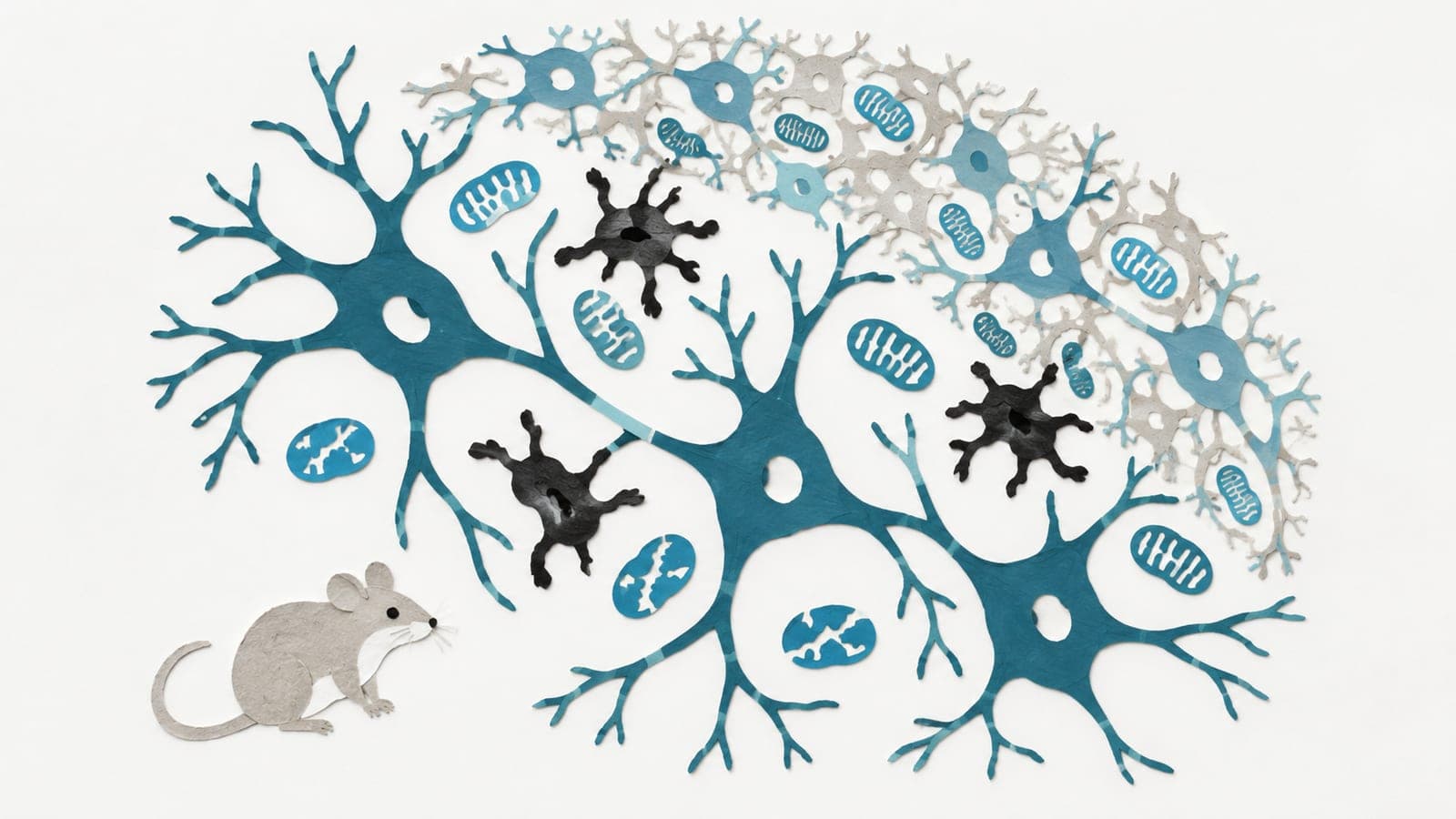
Researchers compared human midbrain organoids—three-dimensional cell models grown from patient-derived stem cells—with disease-free controls in a lab experiment. The patient cells carried a mutation in POLG, a gene involved in copying DNA in mitochondria, cells’ energy-producing structures. Controls included cells with the mutation genetically corrected.
Measuring gene activity in individual cells revealed lower activity in genes involved in energy production and signaling between nerve cells. Changes were particularly pronounced in mature dopamine-producing neurons, nerve cells that make the chemical messenger dopamine. Researchers also gave disease-model organoids the compound nicotinamide riboside daily at 1 millimolar for two months, starting on day 30 of development. Exposure was associated with partial normalization of energy- and signaling-related gene activity and changes in the proportions of nerve-cell subtypes.
Why it matters
Progressive nerve-cell degeneration is central to POLG disease. Mapping energy-related gene activity may help researchers investigate why some nerve-cell types are more vulnerable than others.
Caveats
Gene-activity measurements in lab-grown organoids do not establish restored energy production or nerve-cell function. The researchers pooled three independently grown organoid batches per condition before sequencing.
- Nicotinamide riboside
- Mitochondrial translation
- NAD+ metabolism
- Oxidative phosphorylation
- POLG-related mitochondrial disease
- Humans
The paper
Shanghai Jiao Tong University; University of Bergen
Journal of Translational Medicine, Jul 31, 2026, Open access
Comments
Be the first to comment.