Cell-death enzymes may help aged human muscle stem cells develop
Lab experiments in cells from 12 young and nine older men suggested that enzymes involved in cell death also support muscle development under nutrient stress.
Our read
Mechanisms- Studied:
- Experiments in skeletal muscle stem cells from male donors, up to 72 h
- What changed:
- Blocking caspase enzymes impaired formation of immature muscle fibers in aged muscle stem cells
- The catch:
- The experiments measured myotube formation, not muscle regeneration
- Why it’s aging research:
- Old against young, or naturally aged tissue.
Editor of record: Boris Djordjevic · AgingResearch.News
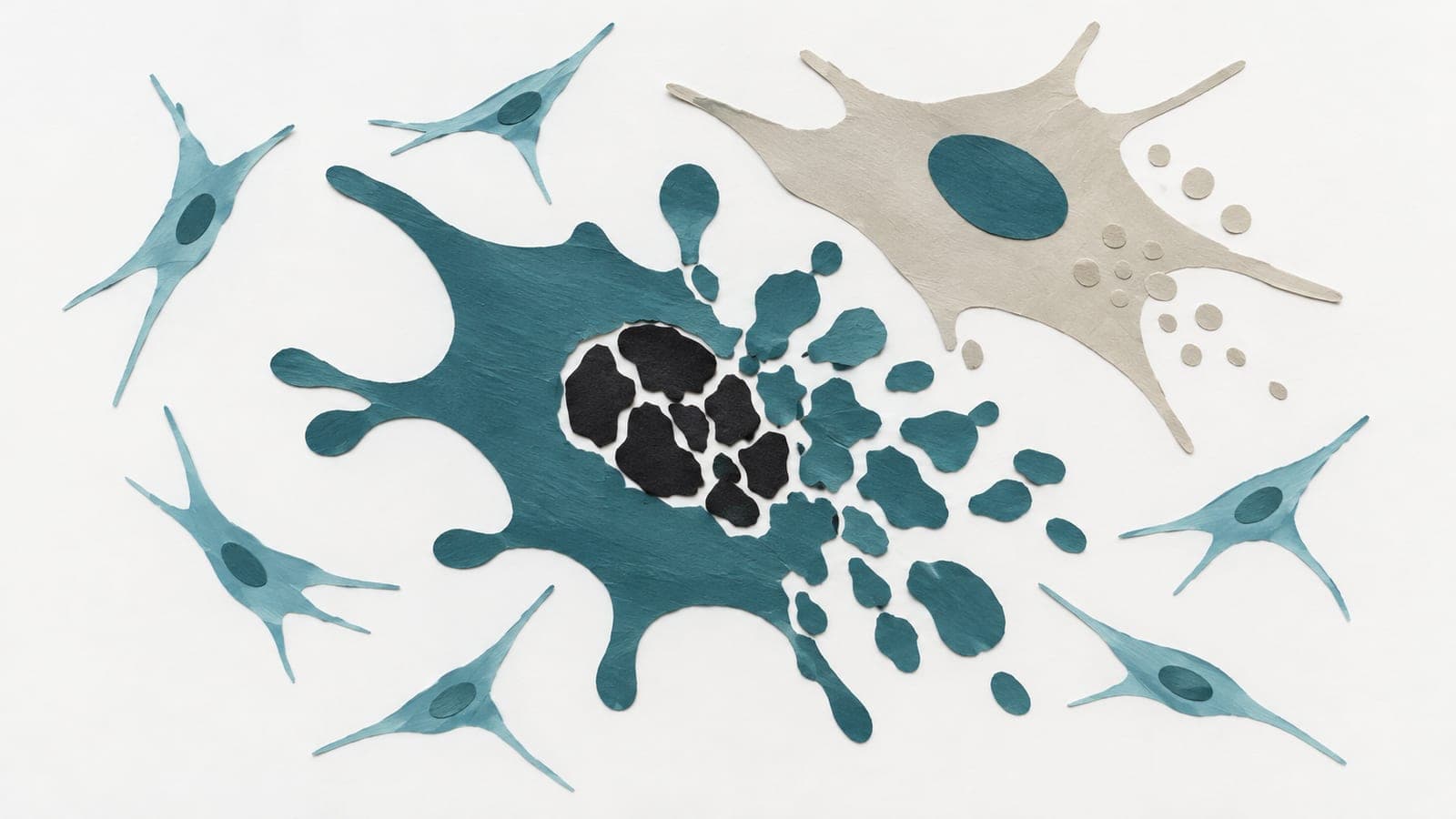
Researchers studied human satellite cells, skeletal muscle stem cells, from 12 healthy young men averaging 23.8 years old and nine healthy older men averaging 72.3 years. In lab experiments, they grew the cells without serum, a blood-derived growth supplement, for up to 72 hours to model acute nutrient stress. Older donors’ cells were more susceptible to stress-induced programmed cell death.
At 72 hours, activated caspase-3, a cell-death enzyme, appeared where older donors’ cells were reshaping their nuclei, the structures containing DNA. A substance that inhibited caspase enzymes impaired formation of myotubes, immature muscle fibers, after 24 hours. The authors suggested that caspases serve two roles in aged muscle stem cells: mediating heightened stress responses and helping reshape nuclei as the cells develop into muscle.
Why it matters
Muscle repair depends on stem cells whose function declines with age. This work addressed how aging shapes their response to severe environmental and nutrient stress.
Caveats
These were experiments in cells grown in the lab under acute nutrient stress, not tests of muscle regeneration in people. All donors were healthy men.
The paper
Non-apoptotic role of caspase enzymes in satellite cells from human skeletal muscle
University of Chieti-Pescara
Biogerontology, Jul 25, 2026, Open access

Comments
Be the first to comment.