Worms use fat signals to avoid a lifespan-extending food
Laboratory food-choice tests lasting up to 72 hours linked worms’ avoidance to sensory nerve cells and their bodies’ fat processing.
Our read
Mechanisms- Studied:
- Experiments in 315 C. elegans worms, against worms offered ethanol-treated control food (Blinded, sample size calculated)
- What changed:
- Nearly all worms avoided food supplemented with palmitic acid in favor of ethanol-treated control food
- The catch:
- Other metabolites in Methylobacterium could also contribute to avoidance attributed to fats
- In the record:
- One of 4 papers on methylobacterium on record: none yet with results in people, 2 in animals.
Editor of record: Boris Djordjevic · AgingResearch.News
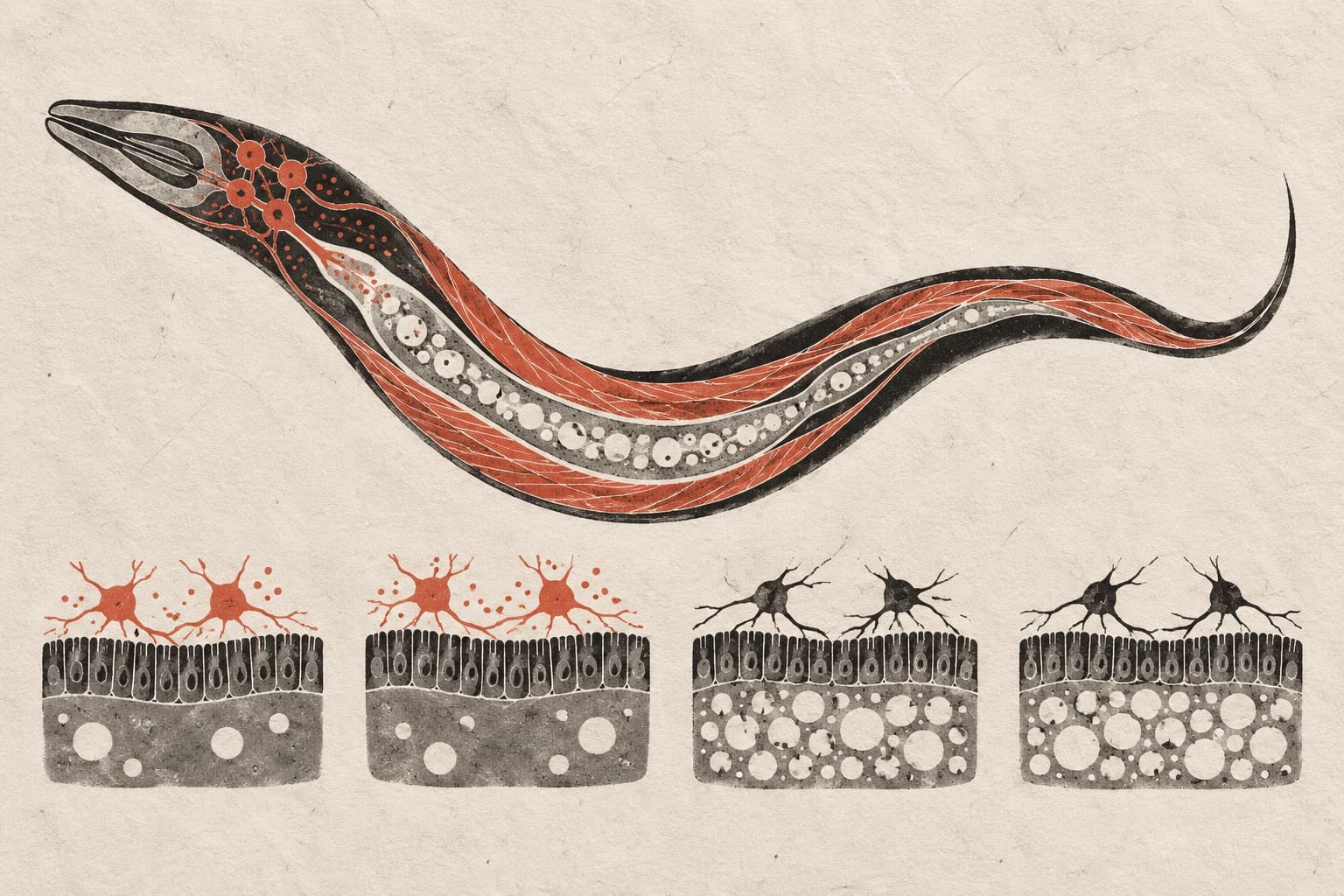
C. elegans worms avoided Methylobacterium, a bacterium that promotes longer life, after eating it in laboratory experiments. Researchers offered worms a choice between this food and other bacteria and tracked their locations for up to 72 hours. The worms consistently preferred the alternatives.
Chemical profiling found that Methylobacterium was enriched in saturated fats. Genetic tests identified four sensory nerve cells and an odor-sensing enzyme as mediators of avoidance. Altering the worms’ own fat metabolism changed how strongly they avoided the food, suggesting that their internal fat balance influenced food preference. In separate lifespan experiments, Methylobacterium extended life in every genetic background tested. Disrupting some sensory nerve cells changed the size of that benefit. The authors suggested that food avoidance was associated with how strongly the diet extended lifespan.
Why it matters
Diet can influence lifespan in worms. These experiments address how sensing and processing dietary fats may connect food choices with longevity.
Caveats
Lifespan tests offered worms only one diet, so they did not measure whether freely choosing between foods changed survival.
The paper
A lipid-sensitive food choice behavior influences aging outcomes from a longevity-promoting diet
Broad Institute; University of Southern California
The FEBS Journal, Jul 6, 2026, Open access


Comments
Be the first to comment.