Mitochondrial stress disrupts signaling in human brain cells
Experiments using three human stem-cell lines found signs of senescence in stressed brain immune cells, alongside disrupted communication with neighboring cells.
Our read
Mechanisms- Studied:
- Experiments in human stem cell-derived neurons, astrocytes and microglia, against control tricultures
- What changed:
- Predicted communication between human brain cells decreased in CDDO-Me-treated cultures compared with controls
- The catch:
- CellChat predicted communication from gene expression rather than measuring signals exchanged between cells
Editor of record: Boris Djordjevic · AgingResearch.News
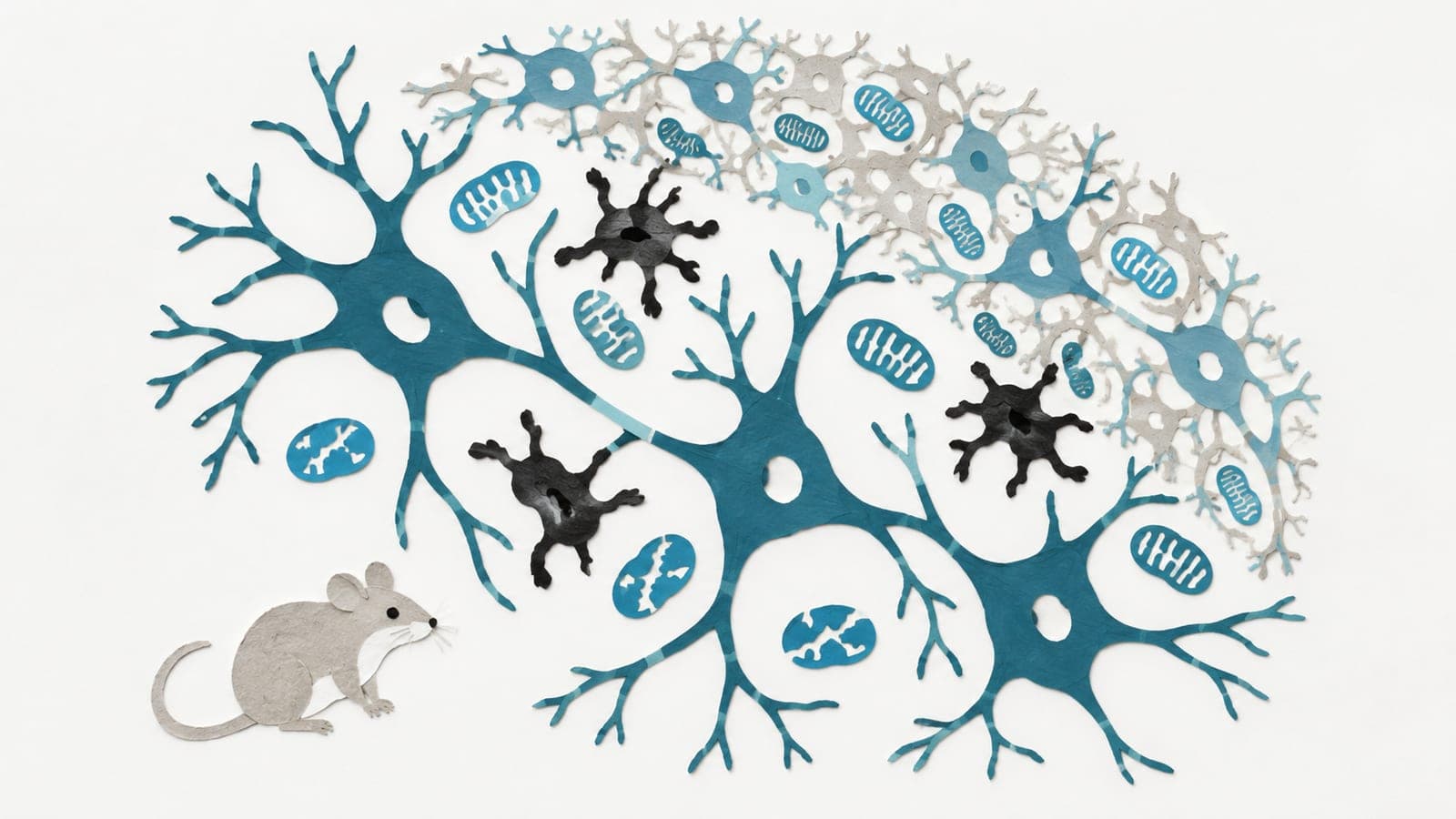
Human microglia, the brain’s immune cells, showed signs of senescence—a stress-related cell state associated with aging—in experiments using cells derived from reprogrammed stem cells. Researchers disrupted protein maintenance inside mitochondria, the cells’ energy-producing structures. Stressed microglia changed their metabolism and released inflammatory signals.
In mixed cultures of neurons and support cells, six hours of exposure to 1 micromolar CDDO-Me, a drug that disrupts mitochondrial protein maintenance, increased predicted senescence scores specifically in microglia. Gene-activity analysis predicted weaker communication from microglia to neighboring cells. Brain organoids—three-dimensional cell models—containing microglia with a genetic defect in mitochondrial protein maintenance showed higher levels of a senescence marker and amyloid-beta, a protein that can form deposits.
Why it matters
The authors identify mitochondrial stress responses in brain immune cells as a contributor to processes involved in neurodegenerative disease.
Caveats
The human experiments used laboratory-grown cells and organoids, not intact human brains; communication changes were predicted from gene activity. Senescence markers normalized after the stress-inducing drug was withdrawn.
- Cellular senescence
- Inflammation
- Lipid and ceramide metabolism
- Neurodegenerative disease
- S-adenosylmethionine
- Humans
The paper
Max Planck Institute of Immunobiology and Epigenetics; Institut des Maladies Génétiques Imagine
Nature Neuroscience, Jun 26, 2026, Open access
Comments
Be the first to comment.