Brain charts for neuroanatomical sex differences across the human lifespan
Abstract
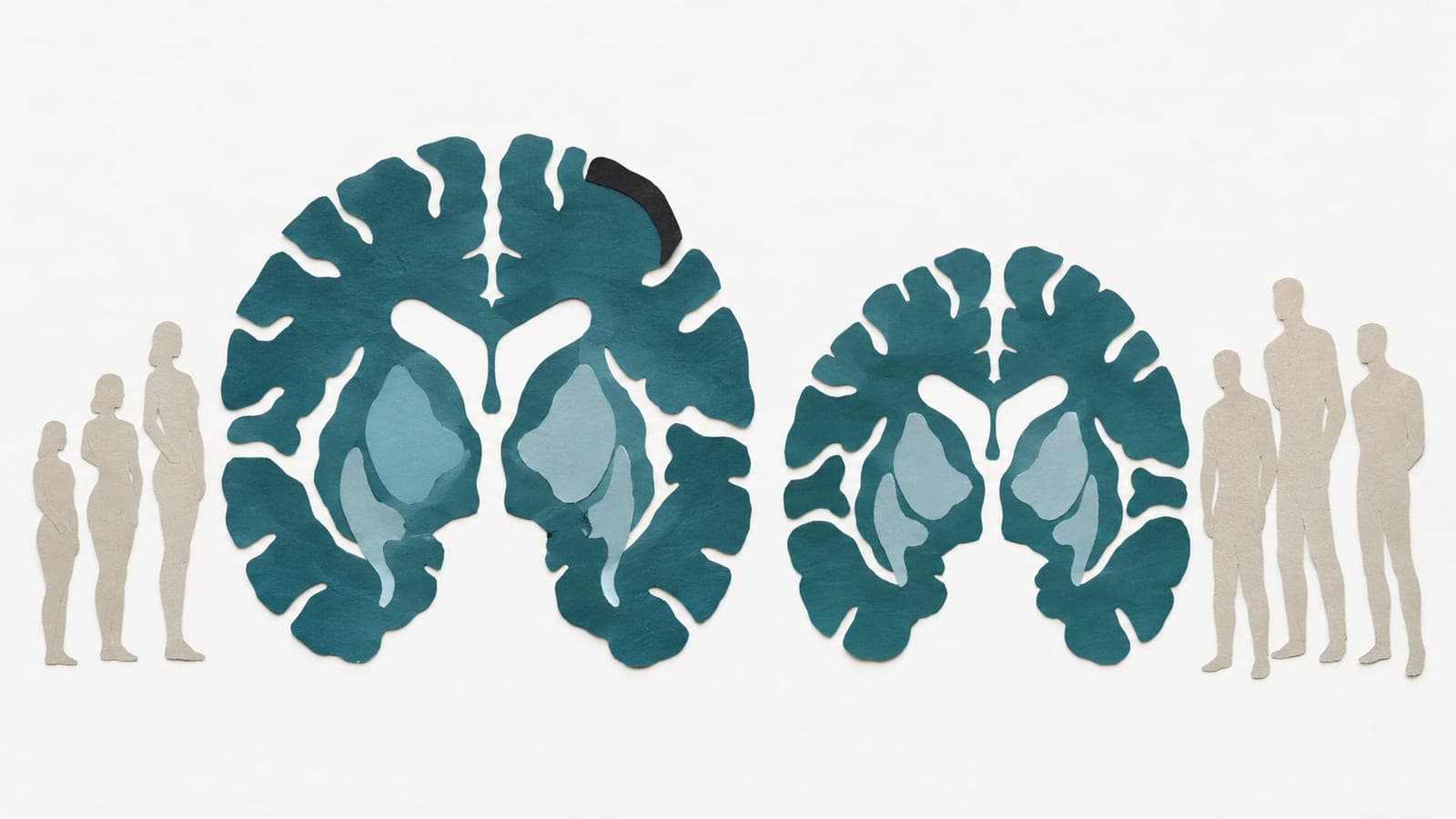
Population-level sex biases in human neuroanatomy have been highly debated, with prior literature often limited by narrow age windows and simplistic assumptions about how brain regions scale with sex differences in average total brain size. Recent work leveraging massive, global datasets to flexibly chart normative brain structures across the lifespan provides a framework to overcome these hurdles. Here, using magnetic resonance imaging (MRI) data from over 100,000 individuals (51.7% F) from mid-gestation to 99 years, we chart normative population trajectories of 241 structural features capturing age-varying sex effects. We use split-half cross-validation, fitting generalized additive models for location, shape, and scale with nonlinear scaling terms to test sex's impact on each feature's distribution and map changes in sex biases over time. Our results reveal replicably significant age-varying sex biases in nearly all brain structures, and show that sex's effects survive nonlinear correction for total brain size. We find that after correcting for total brain size, regions are equally likely to be larger in males versus females, while males tend to show higher interindividual variability in a majority of regions. Probing temporal dynamics reveals that sex biases tend to increase with age, with male and female trajectories diverging across the lifespan. Finally, we demonstrate that normative scores from these models of age-varying sex effects are sensitive to case-control differences in six neuropsychiatric disorders. This work resolves several existing methodological issues to establish and quantify population-level sex biases in the largest-to-date study of lifespan sex-biases in the human brain.
The paper
Children's Hospital of Philadelphia
bioRxiv, 11 May 2026, Open access, Preprint, not peer-reviewed