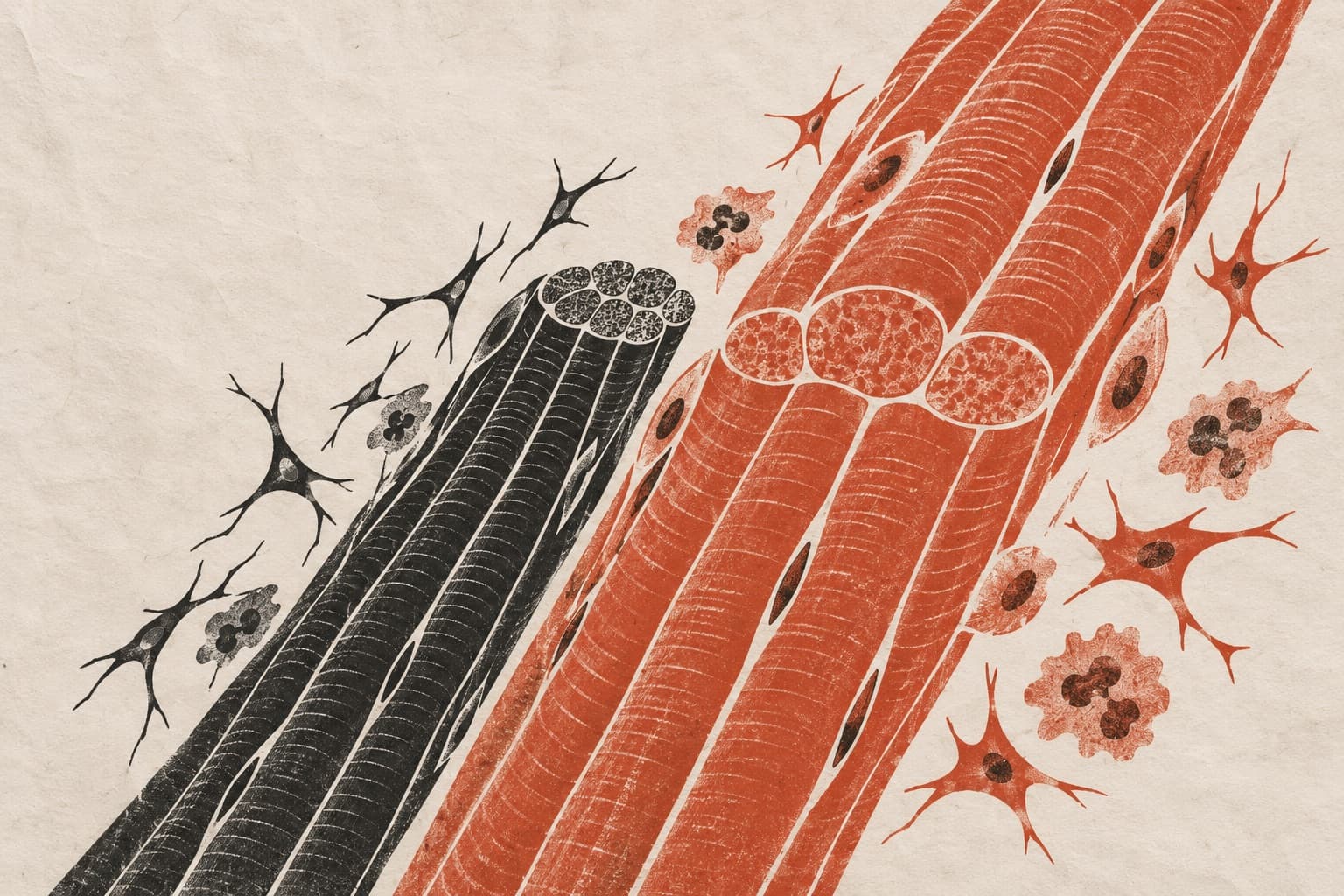
Muscle Hypertrophy Is Fascia-Driven, Not Fiber-Driven
Abstract
Conventional models of muscle hypertrophy emphasize intracellular pathways—mTOR activation, satellite-cell fusion, metabolic stress, and microdamage. Yet these frameworks fail to explain several robust empirical phenomena: the hypertrophic potency of stretch-based training, the directional specificity of growth, and the tight long-term correlation between “the pump” and hypertrophy. Here, I propose a unifying mechanical model in which muscle growth is governed not primarily by intracellular biochemistry, but by poroelastic syneresis and abnormal Poisson-driven compression within the collagenous extracellular matrix (ECM). During resistance exercise, longitudinal tension generates an unusually high effective Poisson ratio (ν_eff >= 1.5), producing intense lateral compression that collapses fascial porosity and rapidly expels interstitial fluid. This acute poroelastic syneresis—manifesting macroscopically as the pump—acts as the initiating mechanical event. Repeated cycles of high-tension Poisson compression drive a three-stage remodeling cascade: (1) planarization, in which wavy collagen fibers are forcibly reoriented into aligned planar sheets; (2) mechanical confinement of resident fibroblasts and fibro-adipogenic progenitors (FAPs), triggering fibroblast/FAP-to-myofibroblast transition (FMT); and (3) biological welding, where activated myofibroblasts deposit and LOX-crosslink collagen, permanently thickening and reorienting fascial layers. This fascia-first remodeling expands the geometric envelope that muscle fibers subsequently fill, resolving the long-standing paradox that connective-tissue activation precedes any detectable increase in myofiber cross-sectional area. The model mirrors fetal fascial morphogenesis—where spontaneous movement sculpts initially homogeneous “white-tablet” connective tissue—suggesting that the same fundamental mechanical laws operate across the lifespan, albeit at different magnitudes and timescales. Finally, this framework unifies diverse hypertrophic stimuli—loaded stretching, isometrics, high-rep pump training, vibration, and blood-flow restriction—under a single principle: hypertrophy scales with the cumulative product of Poisson-driven compression and poroelastic fluid dynamics within the fascial matrix. By redefining hypertrophy as mechanically driven fascial remodeling rather than fiber-intrinsic expansion, this model generates clear, testable predictions across biomechanics, histology, and exercise physiology.
The paper
Zenodo, 5 Jun 2026, Open access, CC BY, Preprint, not peer-reviewed