Deep-Learning-Based Assessment of Breast Arterial Calcification on Mammography: Technical Validation, Cardiovascular Prognostic Value, and Clinical Translation—A Narrative Review
Abstract
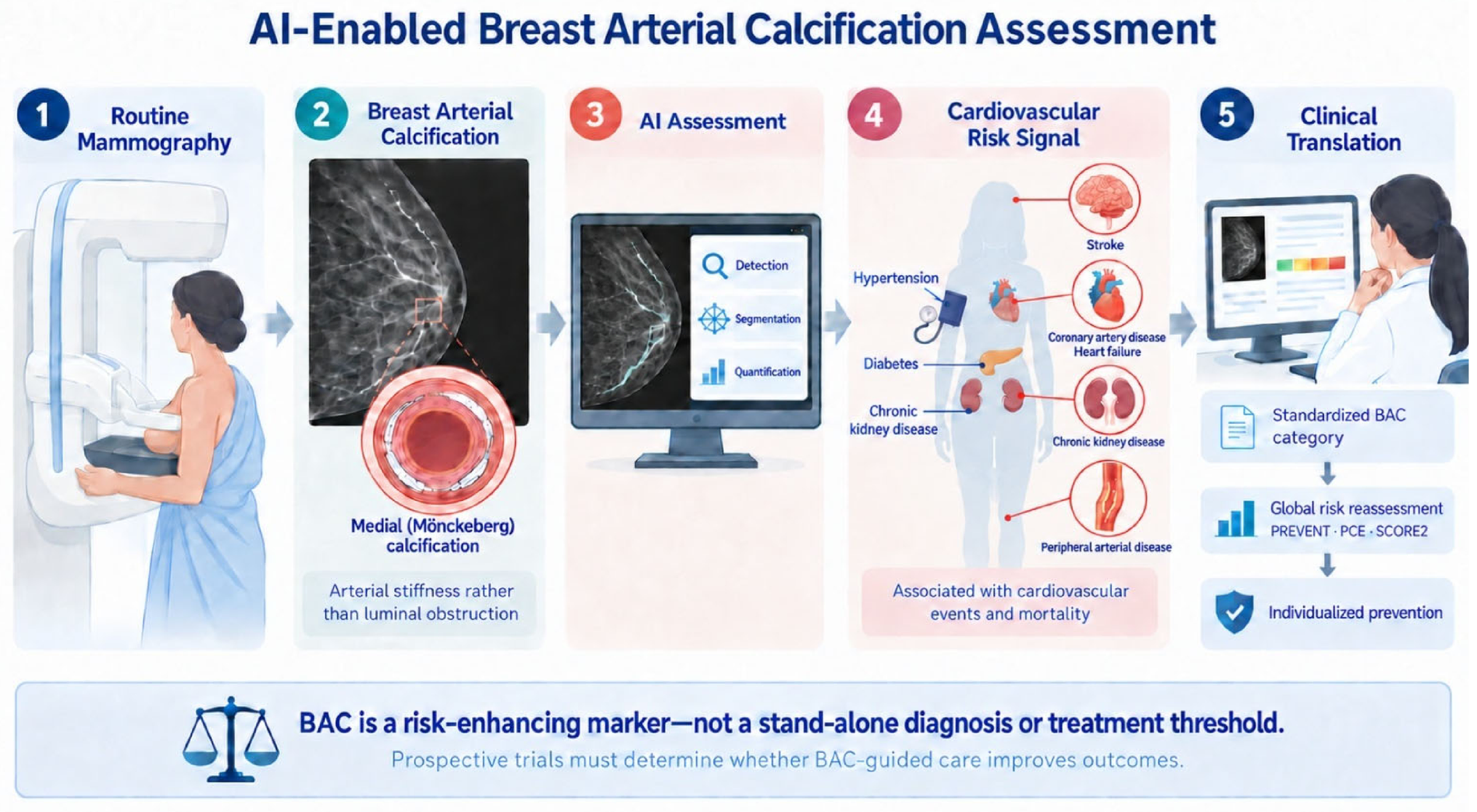
Breast arterial calcification (BAC) is a manifestation of medial arterial calcification frequently detected incidentally on screening mammography. Increasing evidence suggests that BAC may also serve as a marker of cardiovascular risk. This narrative review critically synthesizes the evidence on artificial intelligence (AI)-based detection, segmentation, and quantification of BAC. It also evaluates the cardiovascular prognostic significance of automatically quantified BAC and examines the requirements for clinical translation. A targeted literature search of PubMed/MEDLINE, Scopus, Web of Science, and Google Scholar was conducted for English-language publications available from database inception through 3 September 2026, with additional studies identified from reference lists. Deep-learning approaches included convolutional neural networks, U-Net-derived segmentation architectures, transfer-learning models, and semi-supervised methods. Reported technical performance varied according to task and validation strategy. Representative segmentation models achieved Dice/F1 scores ranging from 0.666 to 0.756 and Jaccard indices from 0.581 to 0.614. Case-level BAC detection achieved areas under the receiver operating characteristic curve (AUCs) of up to 0.95–0.96 in selected test cohorts. However, external validation, learning-curve reporting, multivendor evaluation, and robustness assessment remained inconsistent. Prognostic studies demonstrated graded associations between automated BAC burden and cardiovascular outcomes. In a cohort of 21,514 women without known cardiovascular disease, age-adjusted BAC burden was associated with major adverse cardiovascular events (MACEs) among women classified as low risk, with adjusted hazard ratios (HRs) of 1.66 and 2.31 for BAC below and above the age-specific median, respectively. In 123,762 women from two healthcare systems, MACE risk increased progressively with BAC burden after adjustment using the Predicting Risk of Cardiovascular Disease EVENTs (PREVENT) equations, reaching approximately 2.8- to 3.3-fold higher risk with severe BAC. Nevertheless, incremental predictive improvement may be small—in one study, the addition of BAC changed the 5-year AUC from 0.645 to 0.646. Overall, available evidence supports the feasibility of scalable AI-based BAC assessment and demonstrates consistent associations between AI-quantified BAC and cardiovascular outcomes. However, technical performance and independent prognostic associations alone do not establish clinical utility. Standardized BAC definitions, genuinely independent external validation, and prospective implementation studies are required before BAC-guided cardiovascular management can be recommended.
- Breast arterial calcification
- Cardiovascular disease
- Major adverse cardiovascular events
- Breast arterial calcification burden
- PREVENT
- Humans
The paper
Grigore T. Popa University of Medicine and Pharmacy
Medical Sciences, 14 Oct 2026, Open access, CC BY