Retinal age gap as an index of biological aging: a scoping review of its derivation, determinants, and clinical associations
Abstract
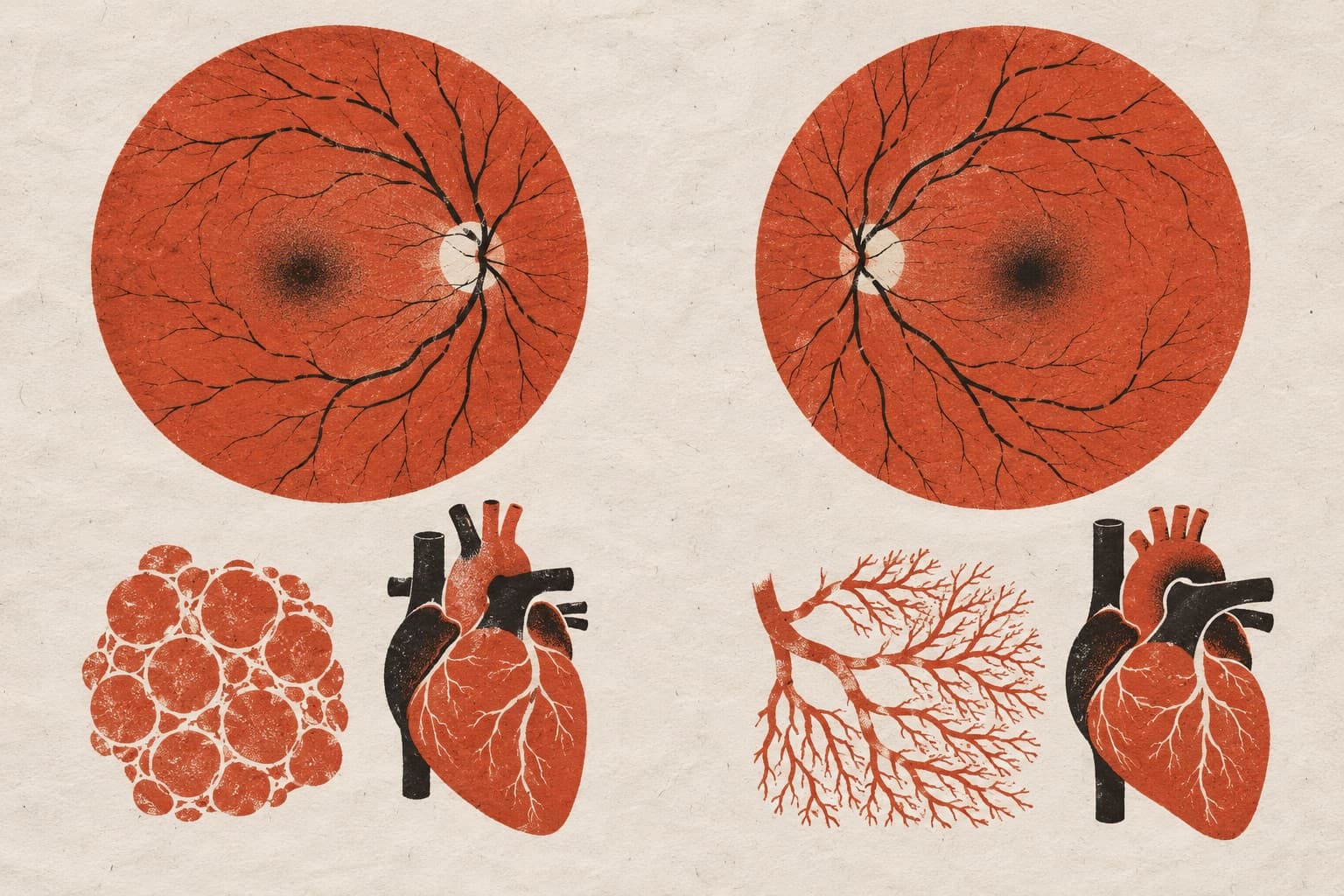
Biological aging, the progressive and heterogeneous decline in physiological function that underlies most age-related morbidity and mortality, does not advance uniformly across individuals of the same chronological age. A growing body of work has explored different estimators of biological age that capture organ- or tissue-specific aging trajectories. The retina is a particularly attractive substrate for such measurement, as it provides a window for the noninvasive, direct, and in vivo visualization of microvasculature and nervous tissue. Over the past years, deep learning models trained on ocular fundus images from disease-free individuals have been shown to predict chronological age with mean absolute errors of roughly 2–4 years in healthy populations. The discrepancy between a model's predicted age and the participant's chronological age, referred to as the retinal age gap (RAG), has been proposed as an index of biological aging, with positive and negative values interpreted as accelerated and decelerated biological aging, respectively. This scoping review aims to systematically map the current literature on retinal age computation and RAG, with three principal objectives: to characterize the deep learning models that have been developed to quantify biological age from retinal imaging, to summarize the reported associations between RAG and various pathological conditions, and to identify diverse factors that have been reported to influence RAG. Expected outcomes include a comprehensive inventory of retinal age prediction models with side-by-side comparison of their characteristics, a structured catalog of the pathological conditions for which RAG has been examined as a predictor, and a parallel compilation of the factors that impact RAG. By consolidating this fragmented and rapidly expanding body of literature, this study seeks to serve as a reference resource for researchers investigating the clinical utility of RAG as an index of biological aging, identify knowledge gaps, and inform priorities for future research.
The paper
Preprint, 1 Jan 2026, CC BY-NC-ND, Preprint, not peer-reviewed