Internet use is linked to health gaps in older adults
In four cohorts of adults aged 50 and older, accounting for reported internet use shrank the link between socioeconomic status and health by 11.3% to 24.2%.
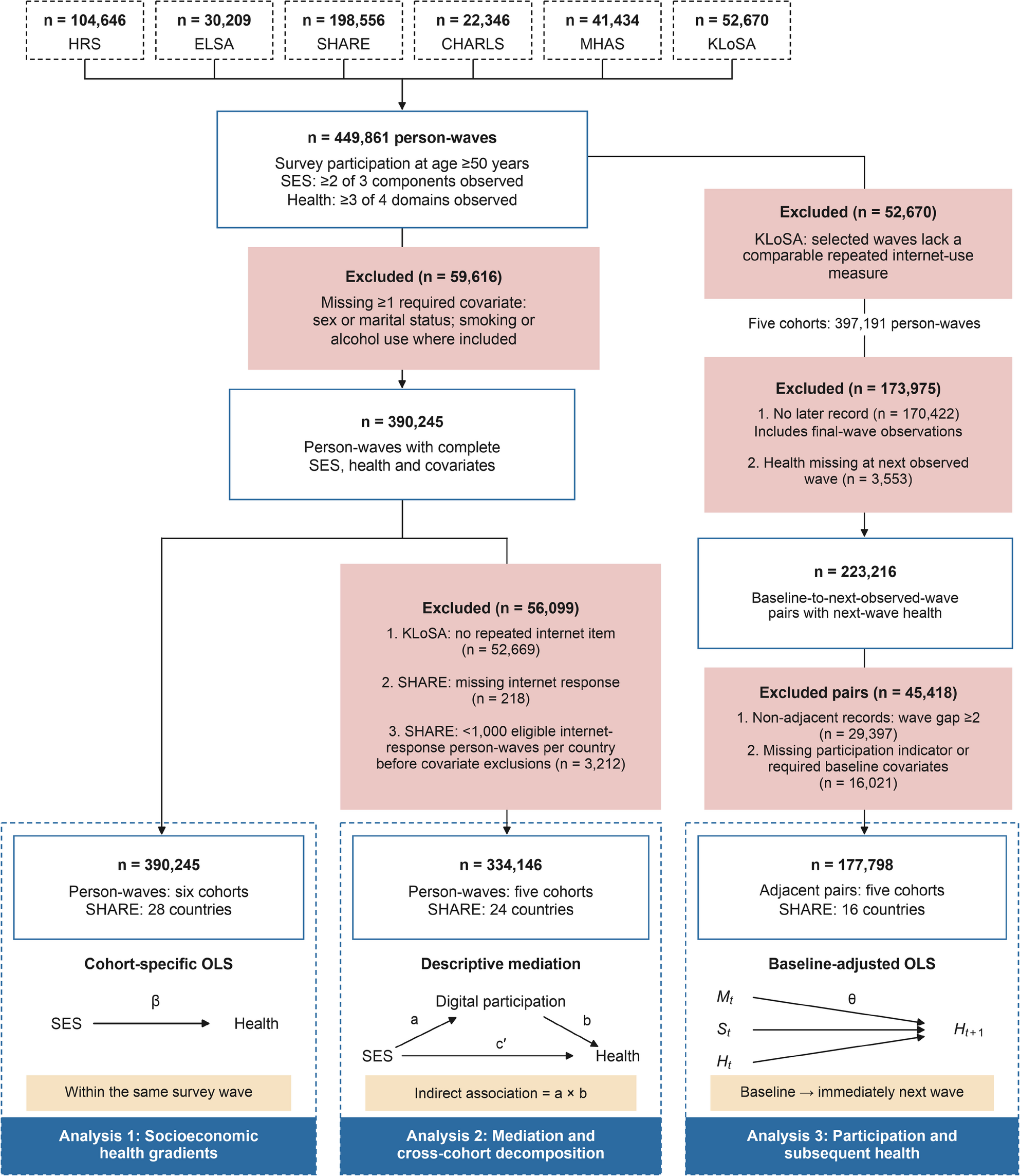
449,861 person-waves
Limit: Poor health can limit internet use, so the order may be reversed
Edited by Boris Djordjevic · AgingResearch.News
In an observational study of 449,861 person-waves from six cohorts of adults aged 50 years or older, researchers examined how socioeconomic status relates to composite health. Higher socioeconomic status was associated with better health in every cohort, with adjusted differences ranging from 0.185 to 0.411 standard deviations. After accounting for reported internet use, the statistical link between socioeconomic status and health was 11.3% to 24.2% smaller across four cohorts, and 6.3% smaller in MHAS using a broader communication indicator. Adults who participated digitally at baseline had higher adjusted health scores at the adjacent wave; in MHAS, the difference was 0.021 standard deviations, and the range of likely values included no difference.
Why it matters
Health inequalities frequently shape how people age, affecting physical and cognitive resilience in later life. Understanding whether digital tools help disadvantaged older adults maintain well-being could guide efforts to address social gaps in healthy aging.
Caveats
Because the study was observational, it cannot determine whether digital participation directly improves health or narrows socioeconomic gaps. The analyses also relied on self-reported participation and complete cases that excluded people with missing data.
From the paper
- Result
After accounting for access and internet use, the ELSA activity measure was associated with a further 5.6-percentage-point reduction in the fitted SES–health coefficient (95% confidence interval [CI] 4.4–6.7), whereas the CHARLS device-count measure changed it by 0.2 points (95% CI − 0.3 to 0.6).
Quoted word for word from the full text on link.springer.com.
The paper
Guangdong Pharmaceutical University
BMC Public Health, Oct 21, 2026, Open access, CC BY-NC-ND