Sarcopenia and sonographic hepatic steatosis in older adults: associations with non-invasive fibrosis risk indices
Abstract
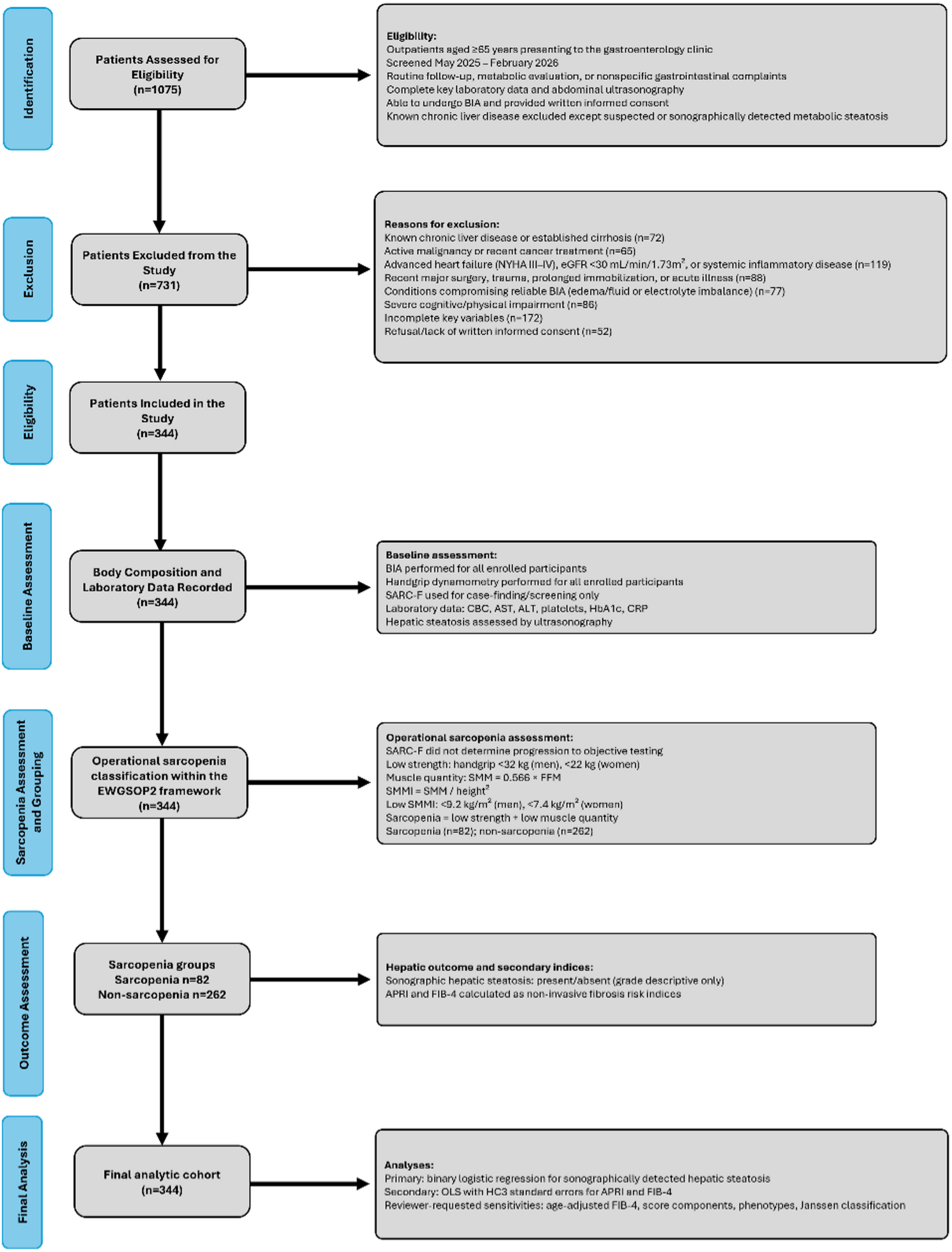
Sarcopenia and hepatic steatosis often coexist in older adults within a shared background of adiposity, diabetes, and functional decline. This study examined whether study-defined sarcopenia was associated with sonographically detected hepatic steatosis and non-invasive fibrosis risk indices. This single-center cross-sectional study, conducted between May 2025 and February 2026, included 344 consecutive adults aged ≥65 years. Muscle quantity was defined from bioelectrical impedance analysis (BIA)-derived fat-free mass (FFM) as skeletal muscle mass (SMM) = 0.566 × FFM and skeletal muscle mass index (SMMI) = SMM/height²; study-defined sarcopenia required both sex-specific low handgrip strength and low SMMI. Hepatic steatosis was assessed by conventional abdominal ultrasonography and analyzed primarily as present or absent. The aspartate aminotransferase-to-platelet ratio index (APRI) and Fibrosis-4 index (FIB-4) were secondary non-invasive fibrosis risk indices. Multivariable models adjusted for demographic, adiposity, and metabolic covariates. Logistic effect estimates are reported as odds ratios (ORs) with 95% confidence intervals (CIs). Study-defined sarcopenia was identified in 82 of 344 participants (23.8%). Sonographic steatosis was present in 78.0% of participants with study-defined sarcopenia and 54.2% of those without it (p<0.001). In the main model adjusted for age, sex, body-fat percentage, diabetes, and hyperlipidemia, the estimate remained positive but imprecise (OR 1.88, 95% CI 0.99–3.54; p=0.052); the body mass index (BMI)-adjusted sensitivity estimate was larger (OR 2.97, 95% CI 1.56–5.66; p=0.001). Study-defined sarcopenia was associated with higher APRI and FIB-4 values in ordinary least-squares (OLS) models with heteroskedasticity-consistent type 3 (HC3) standard errors, including an age-adjusted FIB-4 model, but these associations were substantially attenuated after platelet-component adjustment. Using the study-defined operational classification, sonographically detected hepatic steatosis was more prevalent among participants classified as having sarcopenia. The adjusted estimate was positive but imprecise and varied with the adiposity measure and with how muscle quantity was operationalized. Associations with higher APRI and FIB-4 values were substantially attenuated after platelet-component adjustment and do not demonstrate fibrosis. Measurement uncertainty, selection, residual confounding, and the cross-sectional design preclude causal, prognostic, or clinical risk-stratification conclusions.
From the paper
- Participants
This single-center cross-sectional study, conducted between May 2025 and February 2026, included 344 consecutive adults aged ≥65 years.
- Result
In the main model adjusted for age, sex, body-fat percentage, diabetes, and hyperlipidemia, the estimate remained positive but imprecise (OR 1.88, 95% CI 0.99–3.54; p=0.052); the body mass index (BMI)-adjusted sensitivity estimate was larger (OR 2.97, 95% CI 1.56–5.66; p=0.001).
Quoted word for word from the full text on link.springer.com.
The paper
Ankara Etlik City Hospital
BMC Geriatrics, Oct 15, 2026, Open access, CC BY-NC-ND