Mouse model implicates vessel lining in inherited brain disease
Experiments compared mutant and control mice at 2 and 24 months, finding early changes in cells lining brain blood vessels.
Our read
Mechanisms- Studied:
- Experiments in mutant and control mice, against control mice
- What changed:
- Brain arterial and venous endothelial cells in mutant mice had 980-1656 differentially expressed transcripts compared to control mice
- The catch:
- Vessel structure and gene activity were measured; cognitive decline was not
- In the record:
- One of 41 papers on NOTCH3 on record: 12 with results in people, 6 in animals.
- Why it’s aging research:
- It studies organisms or tissues that aged naturally.
Editor of record: Boris Djordjevic · AgingResearch.News
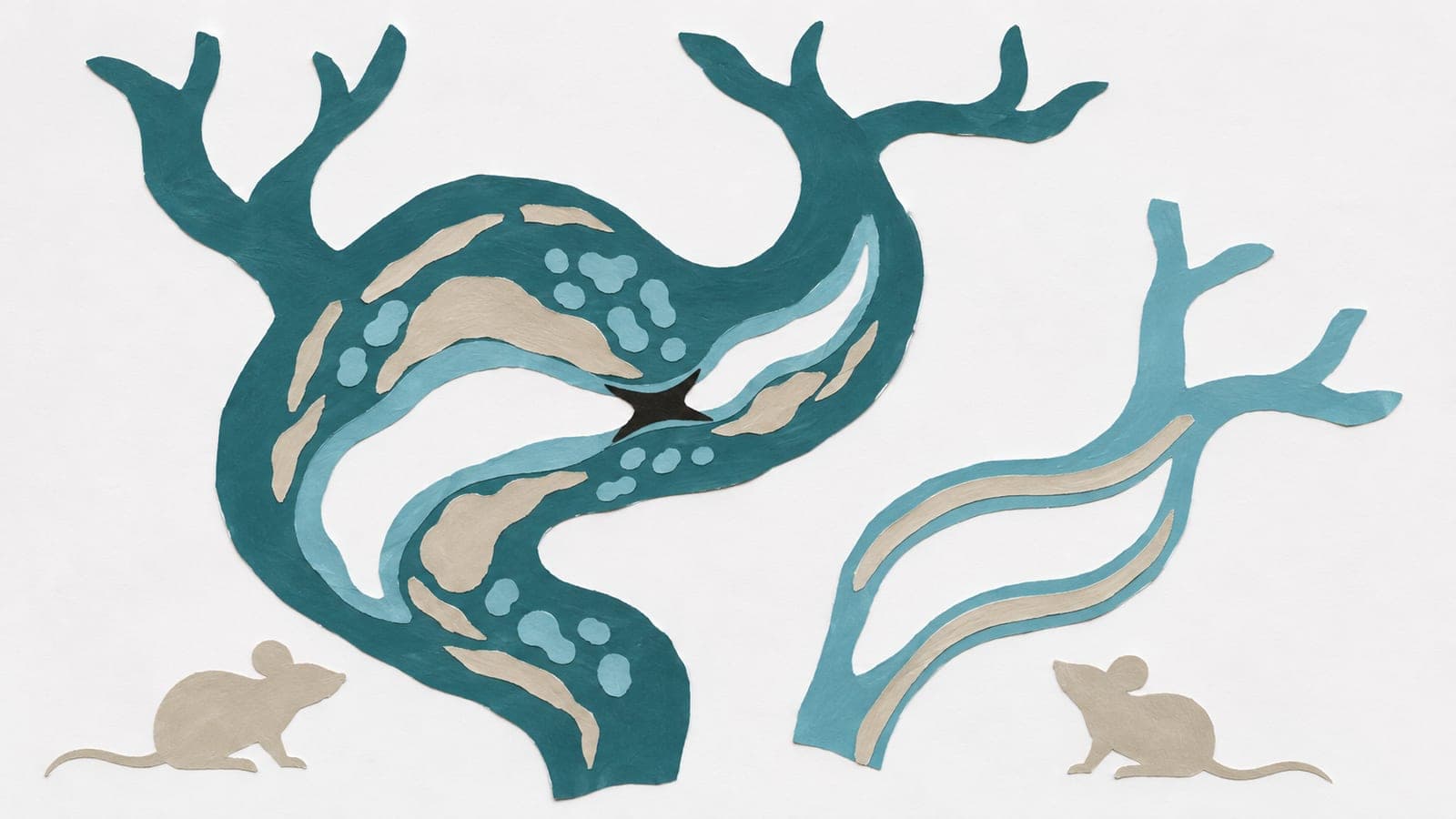
Mice engineered to carry a mutation linked to CADASIL, an inherited disease of small brain blood vessels, underwent experiments examining vessel structure and gene activity. They developed twisted blood vessels in the eye by 2 months, with changes progressing as they aged. Deposits appeared in brain vessels by 1 year.
The team compared vessel cells from mutant and control mice at 2 and 24 months. At 2 months, gene activity changes in brain vessel-lining cells pointed to processes involving inflammation, barrier function and control of bleeding. Microscopic examination found frequent twisting and blockage of small vessels, consistent with localized shortages of blood supply. Older mutant mice also had changes in circulating inflammatory proteins. The authors proposed that degeneration of vessel muscle cells drove severe dysfunction in the vessel lining.
Why it matters
Vascular dementia involves declining thinking abilities caused by blood vessel dysfunction. This model offers a way to investigate how vessel abnormalities progress with age in an inherited small-vessel disease.
Caveats
The experiments used genetically engineered mice and did not test whether vessel-muscle degeneration drives vessel-lining dysfunction in people with CADASIL. The work was reported in a scientific-meeting abstract.
The paper
From Smooth Muscle Degeneration to Endothelial Dysfunction: Reframing CADASIL Pathogenesis
Northwestern University
AHA Scientific Sessions 2026 Abstract, Nov 2, 2026
Presented at AHA Scientific Sessions 2026, abstract 17410
Comments
Be the first to comment.