Strength training showed mixed results in older adults
A 12-week randomized trial of 69 adults aged 60–85 found differences between groups in breathing-muscle strength and selected biological markers, but not lung function.
12 weeks, registered NCT06682221
Edited by Boris Djordjevic · AgingResearch.News
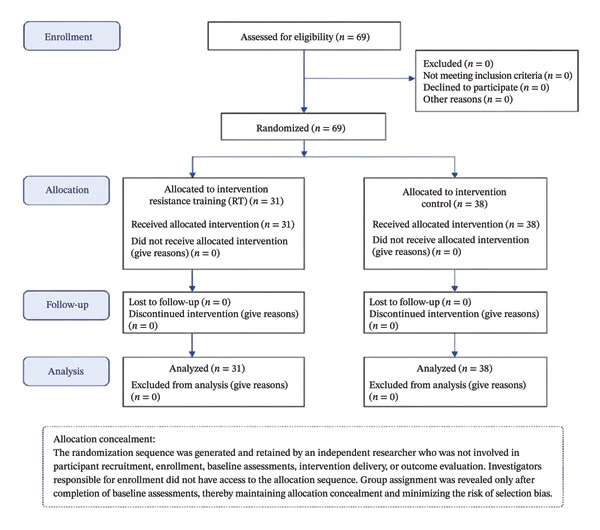
In a randomized trial, 69 adults aged 60–85 who had not participated in structured exercise for at least a year joined a strength-training or control group. Researchers recruited them through a community program at a Brazilian university. They assigned 31 participants to supervised strength training three times a week for 12 weeks and 38 to the control group.
The groups did not differ significantly in changes in lung function. Changes in breathing-muscle strength differed between groups, but only controls showed statistically significant changes from their starting values. Only controls showed a statistically significant improvement on a sit-to-stand test. Changes in selected blood and breath markers related to inflammation and aging also differed between groups. Overall, the results did not show consistent improvement across the measures assessed.
Why it matters
Lung function and immune regulation decline with age. The trial addressed whether strength training alone could help counter these changes.
Caveats
This 12-week trial involved older adults who had not participated in structured exercise for at least a year; it does not establish effects in regular exercisers. The abstract does not report the size or direction of biomarker changes or adverse events.
From the paper
- Participants
To account for potential dropouts, recruitment was increased by approximately 25%, resulting in 69 enrolled participants.
- Result
The bootstrap analysis showed a between-group difference in change of +1.23% points for FVC (95% CI −3.43 to 5.51), +0.58% points for FEV1 (95% CI −4.87 to 5.85), −0.51% points for FEV1/FVC (95% CI −3.49 to 2.62), +7.96% points for FEF25%–75% (95% CI −3.27 to 19.21) …
- Limitation
An additional consideration is the unequal distribution of cardiometabolic comorbidities between groups.
Quoted word for word from the full text on onlinelibrary.wiley.com.
The paper
Laboratory of Pulmonary and Exercise Immunology (LABPEI) Evangelical University of Goias (UniEVANGELICA) Anápolis Goiás 75083-515 Brazil
Journal of Aging Research, Nov 2, 2026, Open access, CC BY
Comments
Be the first to comment.