Exercise-linked blood proteins differ before cancer diagnosis
An observational analysis identified 52 proteins linked to exercise and to differences between healthy people and people who later received cancer diagnoses.
Our read
Interventions- Studied:
- Cohort study of people with and without cancer diagnoses, against healthy controls (Registered NCT03405675)
- What changed:
- People later diagnosed with cancer differed from healthy controls in 52 exercise-responsive blood proteins
- The catch:
- More-active people may have been healthier initially, confounding links between exercise and protein patterns
- In the record:
- The 10th paper on supervised exercise with results in people; 14 on record in all.
- Why it’s aging research:
- It bears on staying healthy in midlife and later life.
Editor of record: Boris Djordjevic · AgingResearch.News
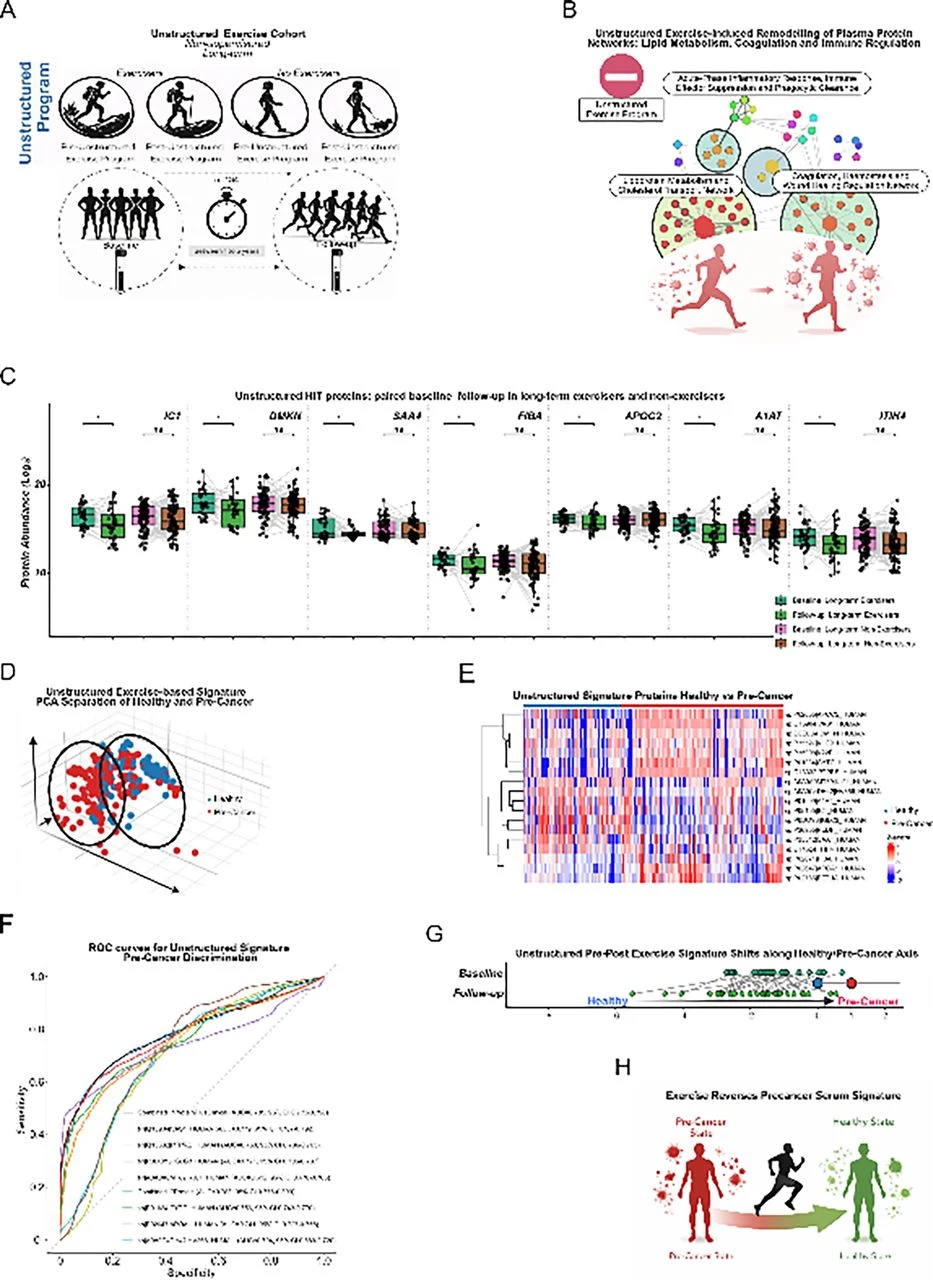
In Singapore, 89 healthy controls, 148 people who were cancer-free at baseline but later diagnosed, and 57 cancer patients supplied blood for an observational protein analysis. Exercise comparisons used paired samples from an observational vigorous-activity group of 134 people and a supervised exercise component involving 56 people, drawn from a randomized trial. These comparisons included matched lower-activity controls.
The researchers identified 52 exercise-responsive proteins associated with differences between healthy controls and people later diagnosed with cancer. Scores combining several proteins shifted toward healthier profiles after both exercise exposures. Several exercise-linked changes ran opposite to changes seen before cancer diagnosis, including changes in processes involving fats, blood clotting and immune defenses.
Why it matters
For cancer, an age-related disease, the findings support testing whether physical activity can influence biological changes before diagnosis.
Caveats
The analysis measured protein patterns, not whether exercise reduced cancer incidence. More-active people in the observational comparison may also have been healthier to begin with.
The paper
130 Exercise-responsive serum proteins map a modifiable pre-cancer proteomic continuum
Agency for Science, Technology and Research
Journal for ImmunoTherapy of Cancer, Nov 2026, Open access, CC BY-NC




Comments
Be the first to comment.