Lower insulin signaling cut mutation rates in worms
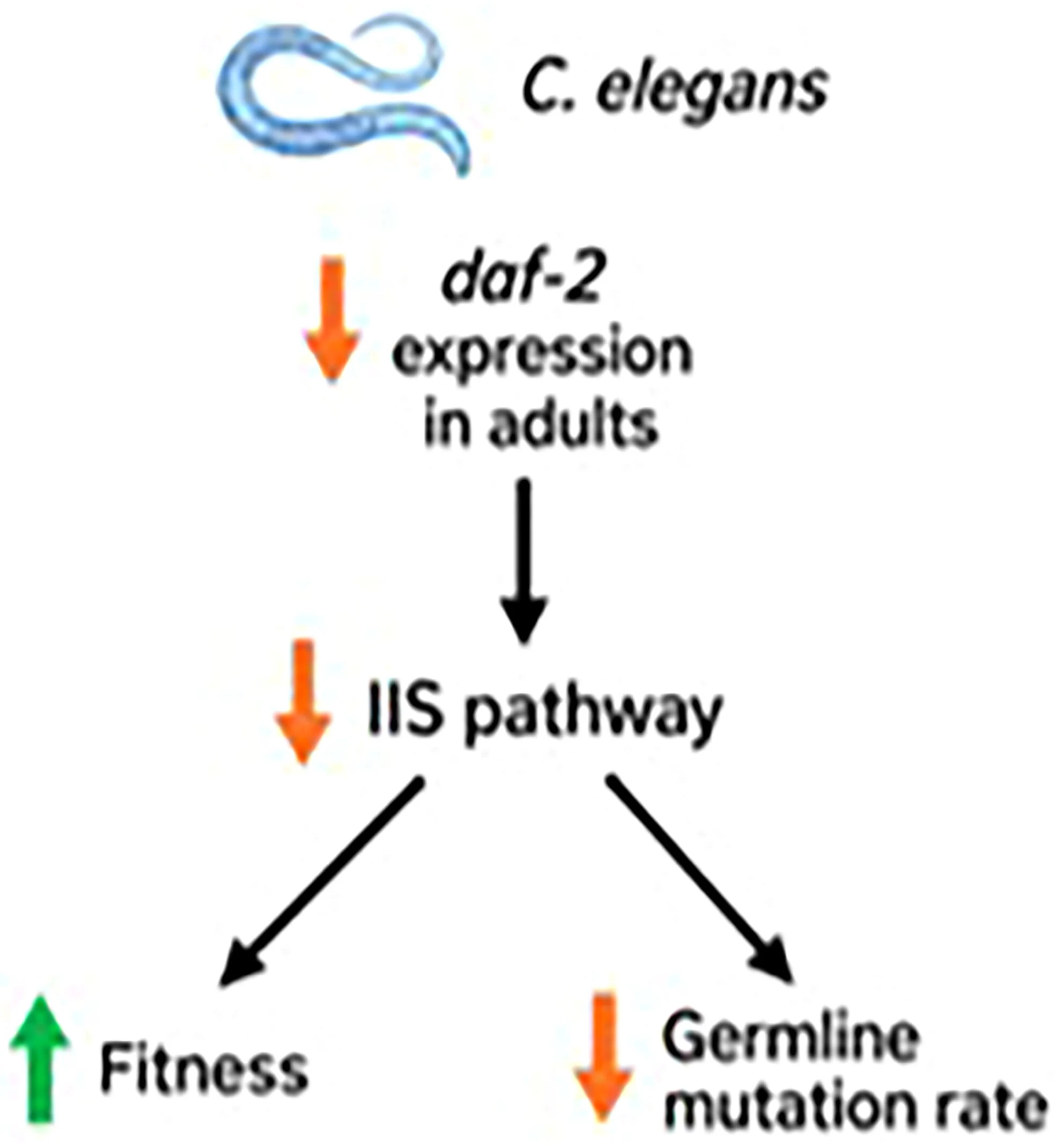
Lowering the signal only in adulthood cut single-letter DNA mutation rates by up to about 50% versus controls, but protection required a gene-silencing protein.
Our read
Interventions- Studied:
- Experiments in wild-type and mutant C. elegans worms, against empty-vector control worms
- What changed:
- Mutation rates fell by up to ~50% in wild-type worms with reduced insulin signaling versus empty-vector controls
- The catch:
- Mutation estimates omit lineages lost to extinction before reproduction
- In the record:
- One of 4 papers on hrde-1 on record: none yet with results in people, 4 in animals.
Editor of record: Boris Djordjevic · AgingResearch.News
Caenorhabditis elegans roundworms underwent an experiment that lowered insulin signaling only in adulthood and tracked mutations in DNA passed to offspring. Researchers reduced activity of daf-2, the insulin receptor gene, in each generation. They sequenced DNA from wild-type, or nonmutant, worms after 25 generations with ultraviolet exposure or 35 generations without it.
In wild-type worms, the intervention reduced single-letter DNA mutation rates by up to about 50% versus controls. It also prevented the rise in mutation rates caused by ultraviolet exposure, without detectable costs to offspring production or the persistence of breeding lines. Protection required HRDE-1, a protein that helps small RNA molecules silence genes. In worms lacking it, the intervention instead increased single-letter mutations and insertions from mobile DNA under ultraviolet exposure, making breeding lines die out sooner.
Why it matters
Insulin signaling helps regulate lifespan. The work addresses whether mechanisms that extend life can also preserve the DNA passed to future generations.
Caveats
The mutation results came from laboratory worms with two genetic backgrounds; whether other animals share this protection remains open.
Where the evidence stands
daf-2
- 52 independent labs in 19 countries
- 5 findings against
- Funders: National Institutes of Health and others
- 7 of 79 findings with company ties
hrde-1
- 1 lab in 1 country
- Funders: European Research Council and 7 more
- daf-2
- hrde-1
- Cellular homeostasis
- Germline single-nucleotide mutation rate
- Transposable-element-driven insertions
- C. elegans
The paper
Lifespan‐Extending Downregulation of Insulin Signalling Reduces Germline Mutation Load
School of Biological Sciences University of East Anglia Norwich UK
Aging Cell, Nov 17, 2026, Open access, CC BY
Comments
Be the first to comment.