Farmed salmon show fat changes resembling those in aging mammals
A three-stage comparison found molecular signs of altered fat handling, while a five-week feeding experiment supported the hypothesis that dietary spermidine may counter these aging-related changes.
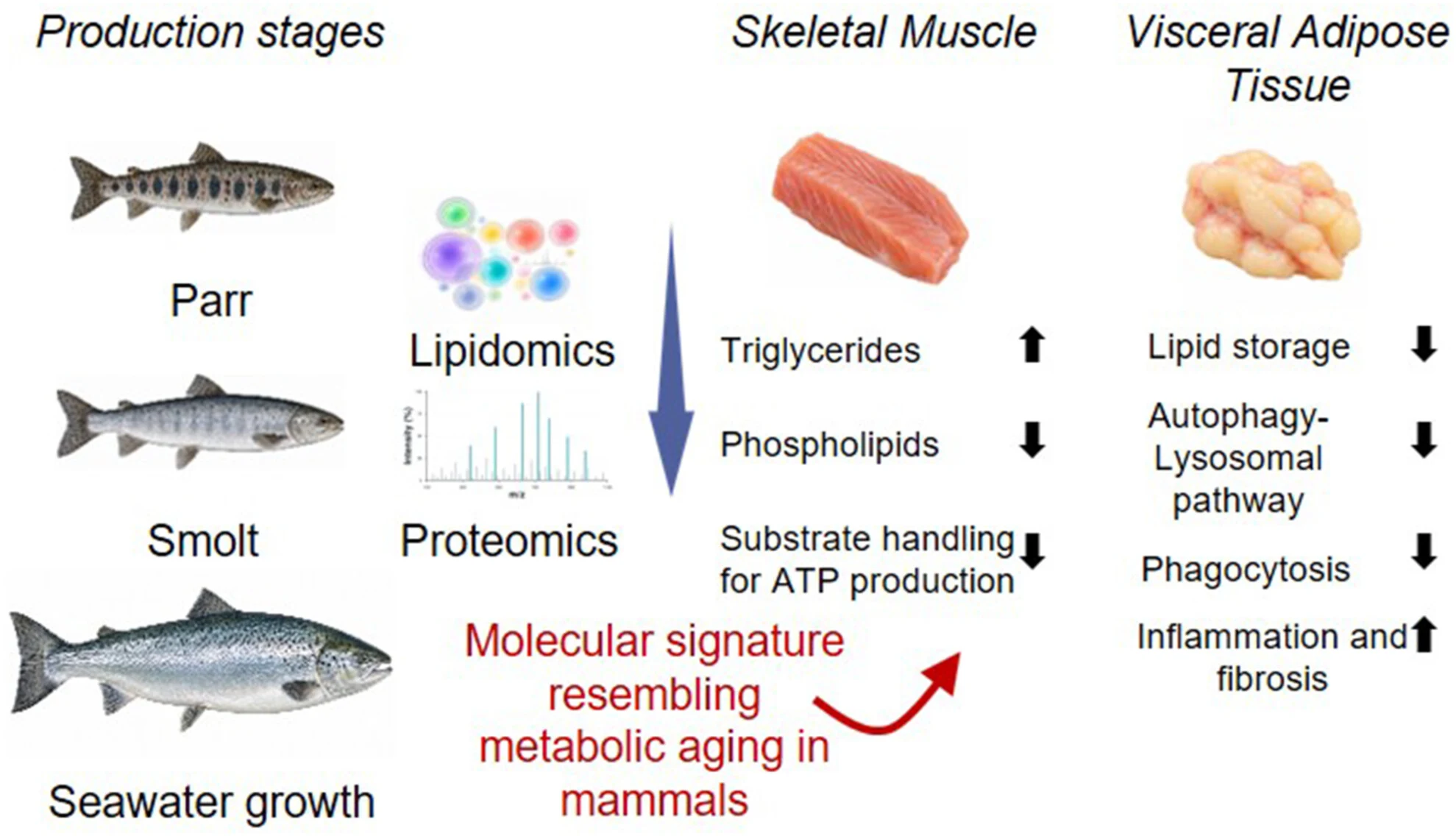
Our read
Interventions- Studied:
- Cross-sectional study of farmed Atlantic salmon, against earlier-stage salmon
- What changed:
- Late-stage seawater salmon had more muscle fat and fewer membrane lipids than earlier-stage salmon
- The catch:
- Life-stage differences in diets and fish origins could explain the apparent aging-like changes
- In the record:
- One of 477 papers on spermidine on record: 72 with results in people, 175 in animals.
Editor of record: Boris Djordjevic · AgingResearch.News
Farmed Atlantic salmon were compared at three production stages in a cross-sectional study, with six fish sampled per stage. Two stages were 9 months old; the later seawater stage was 20 months old. Changes during seawater growth differed from those accompanying the transition toward seawater life. Fat around the intestine showed impaired fat storage and protein changes consistent with inflammation and faulty cellular waste disposal. Muscle accumulated stored fats and had more proteins associated with senescence, a state in which cells stop dividing.
In a separate five-week feeding experiment, earlier-stage seawater fish weighing around 300 grams received feed with or without 5 milligrams of spermidine per kilogram. Supplementation changed the distribution of fatty acids, the building blocks of fats, in both tissues, alongside fat and protein changes that may alter fat handling.
Why it matters
Age-related changes in fat handling remain poorly understood in farmed animals. The authors propose farmed salmon as a model for studying aging in vertebrates, animals with backbones.
Caveats
The authors note that the cross-sectional comparison involved differences in fish origins, facilities and diets, which could account for some of the aging-like patterns.
Where the evidence stands
Spermidine
- 158 independent labs in 39 countries
- 36 findings against
- 10 trials
- Funders: National Natural Science Foundation of China and others
- 101 of 837 findings with company ties
- 2 of 10 trials sponsored by its developers
Inflammation
- 1,052 independent labs in 77 countries
- 205 findings against
- Funders: National Natural Science Foundation of China and others
- 382 of 4,624 findings with company ties
From the paper
- Limitation
Our life-stage comparisons were cross-sectional and confounded by commercial realities: parr were sampled from different facility/origins than smolt and SWO, while fish were fed standard commercial diets matched to life stage requirements, with dietary compositions therefore non-standardised.
Quoted word for word from the full text on onlinelibrary.wiley.com.
The paper
The Roslin Institute and Royal (Dick) School of Veterinary Studies The University of Edinburgh Midlothian UK
Aging Cell, Nov 11, 2026, Open access, CC BY
Comments
Be the first to comment.