Aging shifts the brain’s natural glow toward red in mice
Experiments in 3- and 21-month-old female mice found larger clumps of fluorescent material in brain immune cells and age-related changes in emitted light.
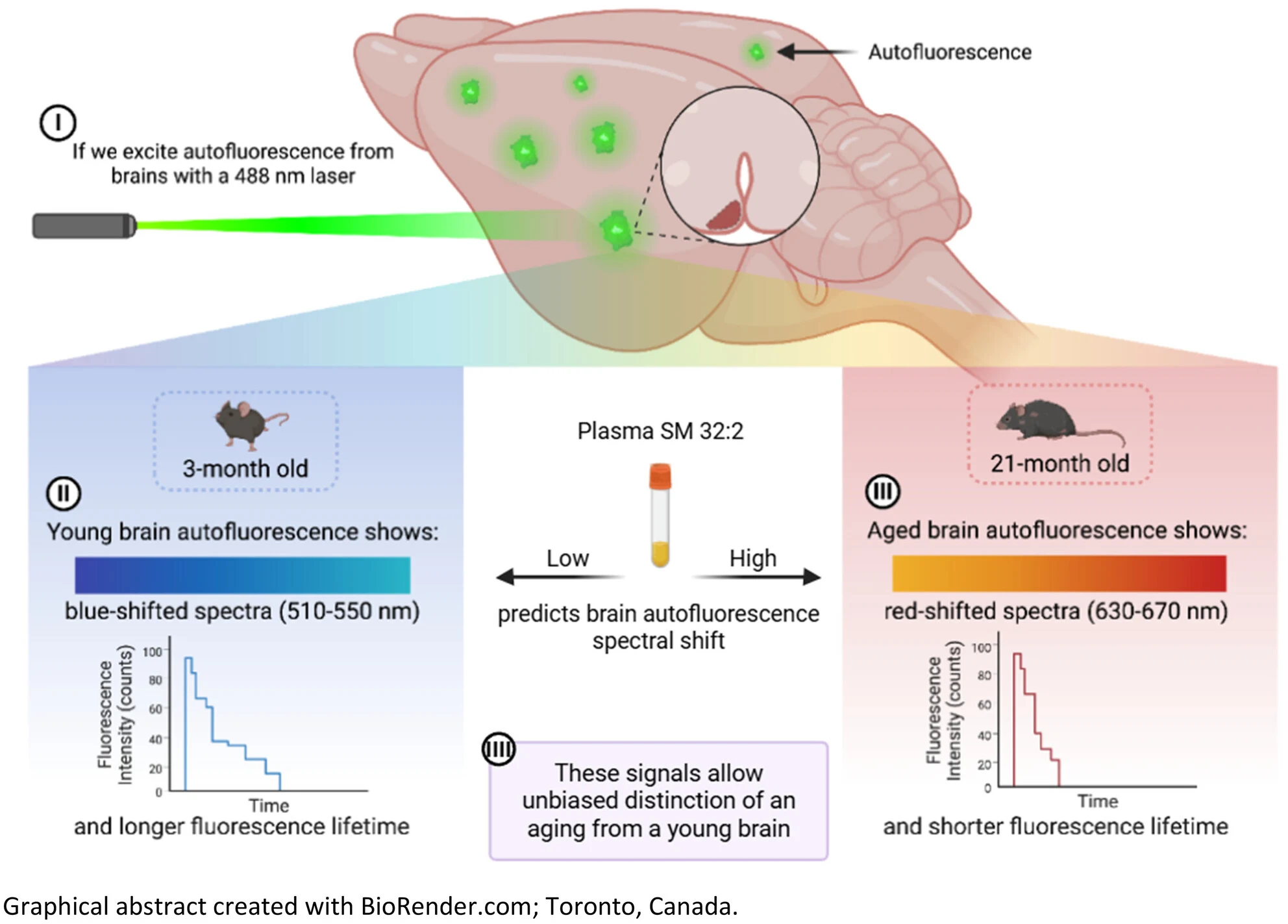
The catch: The red-shift comparison also differed in aggregate size, mixing size with age
Edited by Boris Djordjevic · AgingResearch.News
In an animal experiment, researchers compared two brain regions in 3-month-old and 21-month-old female C57BL/6 mice. They examined autofluorescence, the light some materials emit after illumination, in microglia, immune cells in the brain.
Older mice had a greater volume of fluorescent material in microglia, including an abundance of extra-large clumps. In the arcuate nucleus, one of the regions studied, larger clumps found only in older brains emitted stronger far-red light than the fluorescence in young brains. Blood analysis identified 22 lipids, or fat-like molecules, whose concentrations differed with age. One remained associated with the brain’s light signature after statistical checks accounting for multiple comparisons and validation in a separate group of mice.
Why it matters
Chronic inflammation in the aging brain is linked to neurodegeneration risk. The authors suggest that brain autofluorescence may help monitor brain aging noninvasively.
Caveats
The findings came from comparisons of young and old female mice, not a test of noninvasive monitoring in people. The blood lipid link was an association, not evidence that the lipid caused the brain changes.
Where the evidence stands
Lipid and ceramide metabolism
- 223 independent labs in 36 countries
- 16 findings against
- Funders: National Institutes of Health and others
- 35 of 323 findings with company ties
- Imaging
- Lipid and ceramide metabolism
- Brain autofluorescence lifetime
- Brain autofluorescence spectral profile
- Far-red autofluorescence emission
- Mice
The paper
Establishing a Biophotonic Signature of Brain Ageing
Justus-Liebig-Universität Gießen; RMIT University
Aging Cell, Nov 1, 2026, Open access, CC BY

Comments
Be the first to comment.