Pregnancy complications linked to heart and blood vessel disease
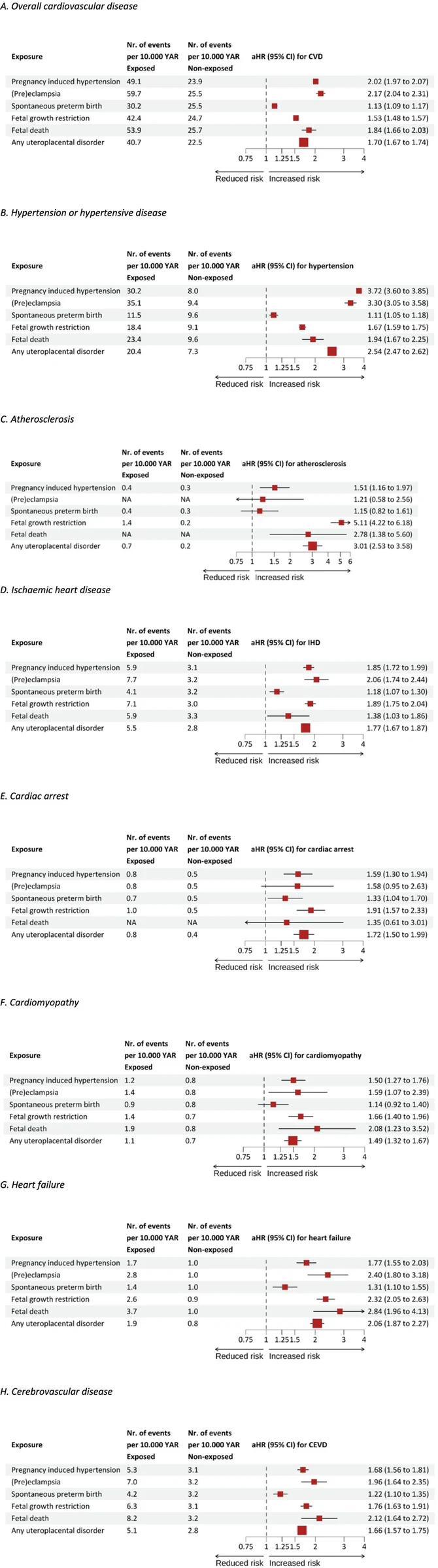
Women with these complications had a higher relative rate of heart and blood vessel disease than women without them, with an adjusted hazard ratio of 1.70.
Limit: Smoking and body mass index were unavailable for adjustment, leaving potential confounding
Edited by Boris Djordjevic · AgingResearch.News
A population-based cohort study included 1,669,681 women in the Netherlands who had not previously given birth and had a pregnancy involving one baby. Researchers linked birth-registry records with national hospital admissions data from 2000–2022. Median follow-up was 11 years.
Pregnancy complications were associated with higher rates of heart and blood vessel disease after adjustment for other factors. Associations were similar after pregnancy-induced high blood pressure, preeclampsia—a pregnancy disorder involving high blood pressure—restricted growth of the unborn baby, or fetal death. The association after spontaneous preterm birth was weaker. Most relative risks were highest shortly after pregnancy but remained elevated more than 10 years later. High blood pressure risk stood out after pregnancy-related blood pressure disorders. After restricted fetal growth, the increased risk of atherosclerosis, a buildup of fatty deposits in arteries, was most notable.
Why it matters
The timing of premature cardiovascular disease bears on when cardiovascular screening should begin after complicated pregnancies. The authors called for early screening.
Caveats
This observational study cannot establish that pregnancy complications caused later cardiovascular disease. The cohort excluded pregnancies involving multiple babies, and the abstract does not report absolute cardiovascular event rates.
From the paper
- Follow-up
… and cerebrovascular disease were significantly increased among women with a history of a uteroplacental disorder, adjusted for confounders (overall CVD: aHR 1.70, 95% CI 1.67–1.74; median follow-up time 11 years, IQR 6–17 years).
- Result
… and cerebrovascular disease were significantly increased among women with a history of a uteroplacental disorder, adjusted for confounders (overall CVD: aHR 1.70, 95% CI 1.67–1.74; median follow-up time 11 years, IQR 6–17 years).
- Limitation
First, the observational design of the study limits the ability to establish causal relationships between the exposures and outcomes.
Quoted word for word from the full text on obgyn.onlinelibrary.wiley.com.
The paper
Department of Obstetrics and Gynaecology Amsterdam UMC Location University of Amsterdam Amsterdam the Netherlands
BJOG, Nov 2, 2026, Open access, CC BY
Comments
Be the first to comment.