Muscle function improved after training in older adults
In a before-and-after study, 37 older adults trained twice weekly for 12 weeks, with gains in physical performance and force from individual muscle fibres.
Non-randomised trial
Limit: No control group separated training effects from other changes over time
Thirty-seven community-dwelling older adults, averaging 70.4 years old, completed a 12-week, before-and-after exercise study. They trained under supervision twice weekly using a device for eccentric exercise, in which muscles lengthen while producing force. Researchers assessed body composition, strength and physical performance, and tested individual fibres from thigh muscle samples.
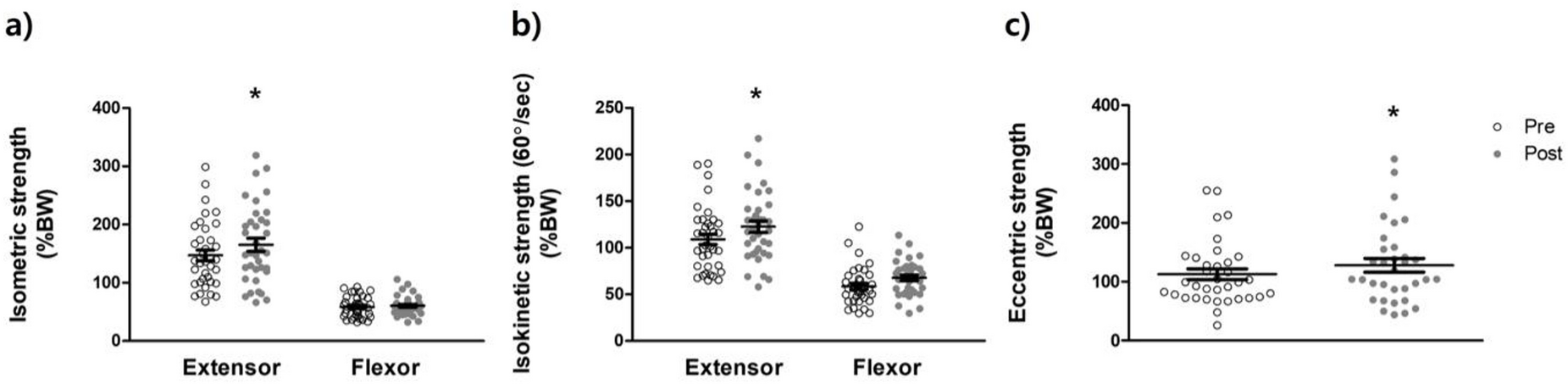
Muscle mass increased, while body weight remained unchanged. Participants improved on a test of standing up, walking and sitting down, and on a stair-climb test. Both fibre types tested produced more force for their size, without growing larger. Type IIa fibres, a faster-contracting muscle fibre type, also showed greater residual force enhancement—the extra force produced after a fibre is stretched while contracting.
Why it matters
The study addressed whether older muscles’ force-producing properties remain responsive to exercise. Its findings support eccentric resistance training as a potential strategy for improving muscle function in older age.
Caveats
The abstract described no control group, limiting conclusions about whether training caused the changes. The results came from 37 community-dwelling older adults, and the abstract did not report harms.
- Eccentric resistance training
- Eccentron
- Stair climb test
- Isokinetic strength
- Muscle fiber cross-sectional area
- Humans
The paper
Seoul National University Bundang Hospital; Seoul National University
Scientific Reports, 15 Oct 2026, Open access, CC BY-NC-ND


