Joint association of the cholesterol–high-density lipoprotein–glucose index and waist-to-height ratio with incident cardiovascular disease in a high-risk Chinese cohort
Abstract
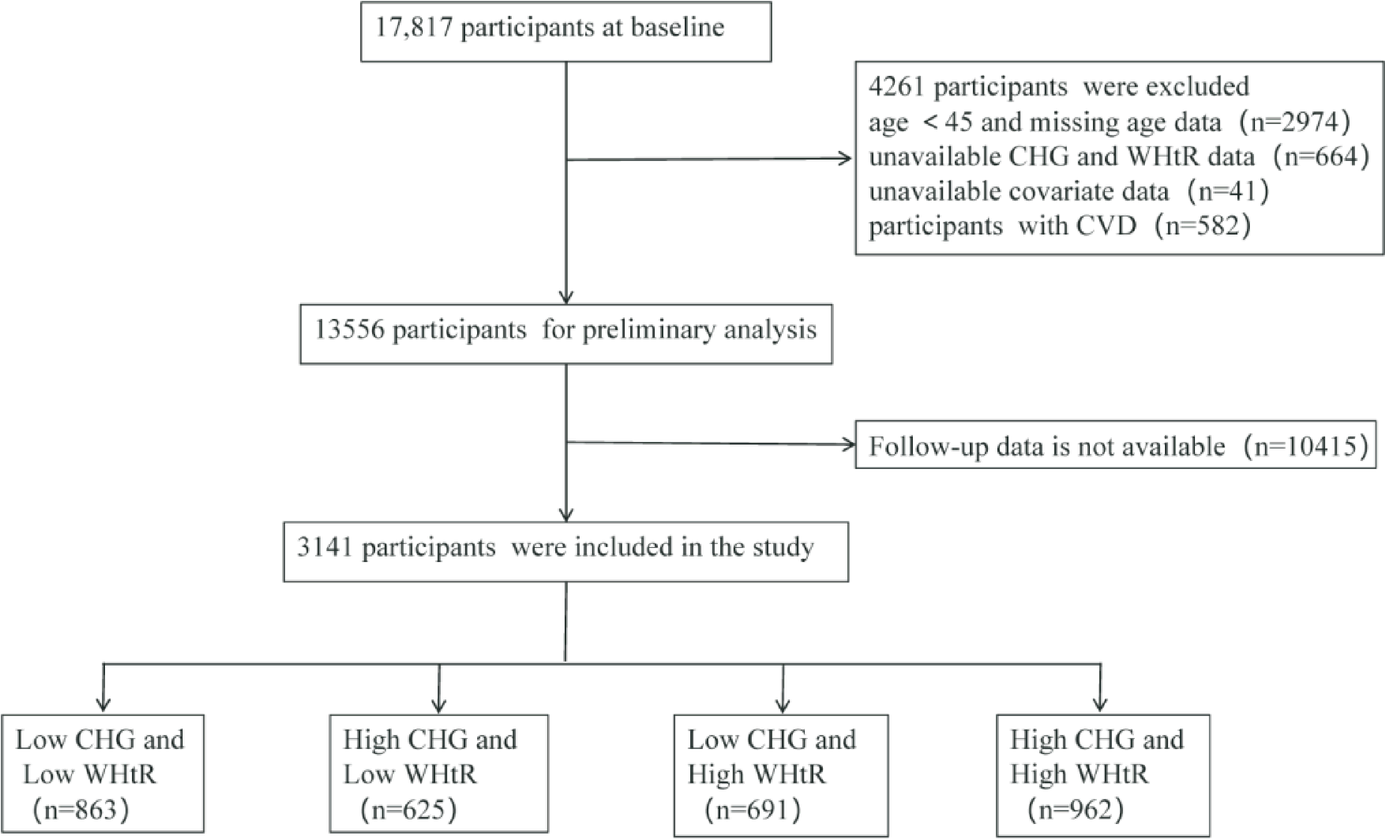
Insulin resistance (IR) and visceral obesity have been recognized as important risk factors for cardiovascular disease. Insulin resistance (IR) is quantified by the cholesterol–high-density lipoprotein–glucose (CHG) index, and visceral obesity is assessed by the waist-to-height ratio (WHtR). However, the combined impact of these two indicators on cardiovascular disease risk has not been thoroughly investigated. Our study aims to investigate the joint association of the CHG index and WHtR with incident cardiovascular disease. This study is based on data from the Ningxia region of the China Cardiovascular Disease High-Risk Population Screening and Comprehensive Intervention Project, including 3141 high-risk cardiovascular individuals without a history of CVD at baseline, for a prospective cohort analysis. Participants were categorized based on the median values of the CHG index and WHtR. Cox proportional hazards model and restricted cubic spline (RCS) were used to analyze the association of the CHG index and WHtR with the risk of CVD, evaluate the model’s predictive performance using C-index, Brier score, NRI, and IDI, and conduct subgroup analysis and sensitivity analysis. Among 3141 participants aged 45 years or older, the mean age was 58 years. Females accounted for 60.74% of the population. The median follow-up duration was 6.7 years, during which a total of 536 (17.06%) participants experienced CVD events. Compared with participants with low CHG and low WHtR, those in the high CHG and high WHtR group had a 52% increased risk of CVD ( HR = 1.52, 95% CI 1.15–2.00, P = 0.003), with a significant increasing trend. When examined separately, participants with high CHG alone had a significantly increased risk of cardiovascular disease ( HR = 1.33, 95% CI 1.11–1.58, P = 0.002), whereas those with high WHtR alone did not ( HR = 1.19, 95% CI 0.96–1.49, P = 0.114). Neither of the two discordant groups, namely high CHG and low WHtR ,and low CHG and high WHtR, showed a statistically significant association with cardiovascular disease. The RCS regression analyses demonstrated a positive linear association of the CHG index and WHtR with the incidence of CVD ( P for non-linear > 0.05). Interaction analysis did not detect statistically significant multiplicative or additive interactions. The C-index was 0.613 for the joint grouping model and 0.608 for the baseline model, with an NRI of 0.041 ( P = 0.152) and an IDI of 0.005 ( P < 0.001). Subgroup analyses showed that the effect of the combined grouping was consistent across various subgroups, and sensitivity analyses supported the robustness of the main findings. This study based on a cohort of high-risk cardiovascular disease populations in the Ningxia region, found that individuals with both high CHG and high WHtR had an increased risk of incident CVD. However, this joint association is mainly driven by CHG, with WHtR making a limited independent contribution, and the incremental predictive value of the joint assessment is weak. Although CHG and WHtR are both simple, economical, and non-invasive clinical indicators, their combined assessment may provide some supplementary information for risk stratification in high-risk cardiovascular populations, but this finding needs to be further validated in general population cohorts.
- Cholesterol-high-density lipoprotein-glucose index
- Waist-to-height ratio
- Incident cardiovascular disease
- Cardiovascular disease
- Insulin resistance
- Humans
The paper
Ningxia Medical University; Ningxia Center for Diseases Prevention and Control
Scientific Reports, 14 Oct 2026, Open access, CC BY-NC-ND