Model-based identification of medication-associated fall-risk signals using EMG time-series analysis: an exploratory mechanistic approach in polypharmacy
Abstract
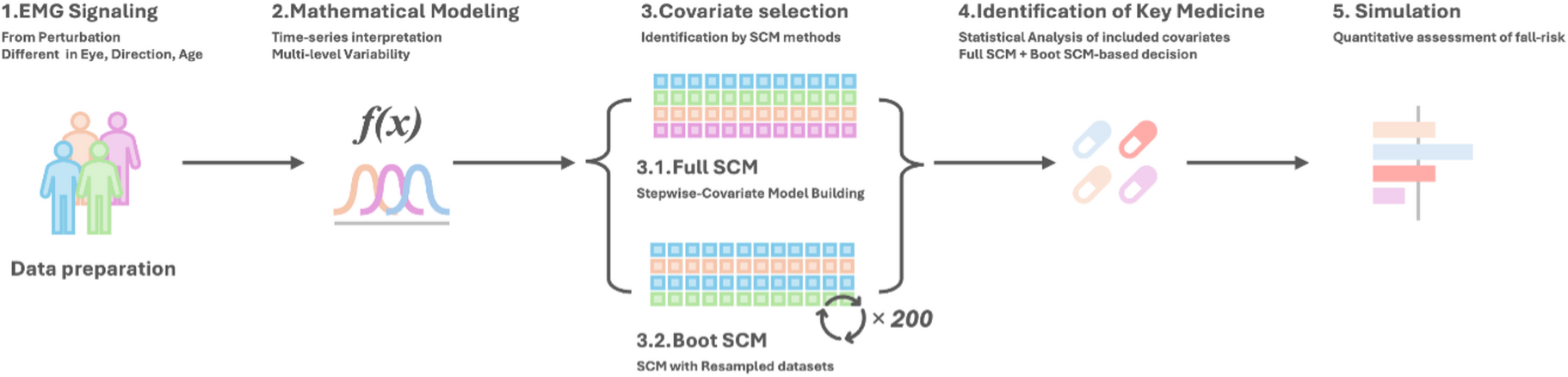
Falls are the leading cause of functional decline in older adults. Existing fall-risk assessments often overlook the contribution of medications, and emerging sensor-based methods predict who is likely to fall but rarely explain why. We present a model-based approach for identifying medication-related fall-risk signals using high-frequency time-series electromyography (EMG). Fifteen young and 15 older adults performed perturbation-based balance tasks, and nonlinear mixed-effects modelling with bootstrap-assisted covariate selection linked the EMG responses of seven lower-limb and trunk muscles to common medication classes. The simulation-derived co-contraction index (CCI) served as the outcome, compared against a benchmark derived from Falk et al. Through stepwise covariate modelling followed by bootstrap-based confirmation, two drug classes were retained as robust covariates: anticoagulants, associated with a higher co-contraction index, and statins, associated with a lower co-contraction index. In model-based simulations, anticoagulant exposure corresponded to significantly elevated odds of exceeding the CCI benchmark, whereas statins did not increase the simulated odds despite their consistent covariate signal. This exploratory, signal-generating framework foregrounds the identification of medication-associated neuromuscular changes from EMG and may provide a mechanistic context that complements conventional epidemiology. A companion web application illustrates this approach as a supplementary tool to support medication reviews during fall-risk evaluations.
The paper
CHA University; Chungnam National University
Scientific Reports, Oct 15, 2026, Open access, CC BY-NC-ND