Reproducible smoker’s paradox in COVID-19 - comparative evidence from Swedish and Norwegian cohorts
Abstract
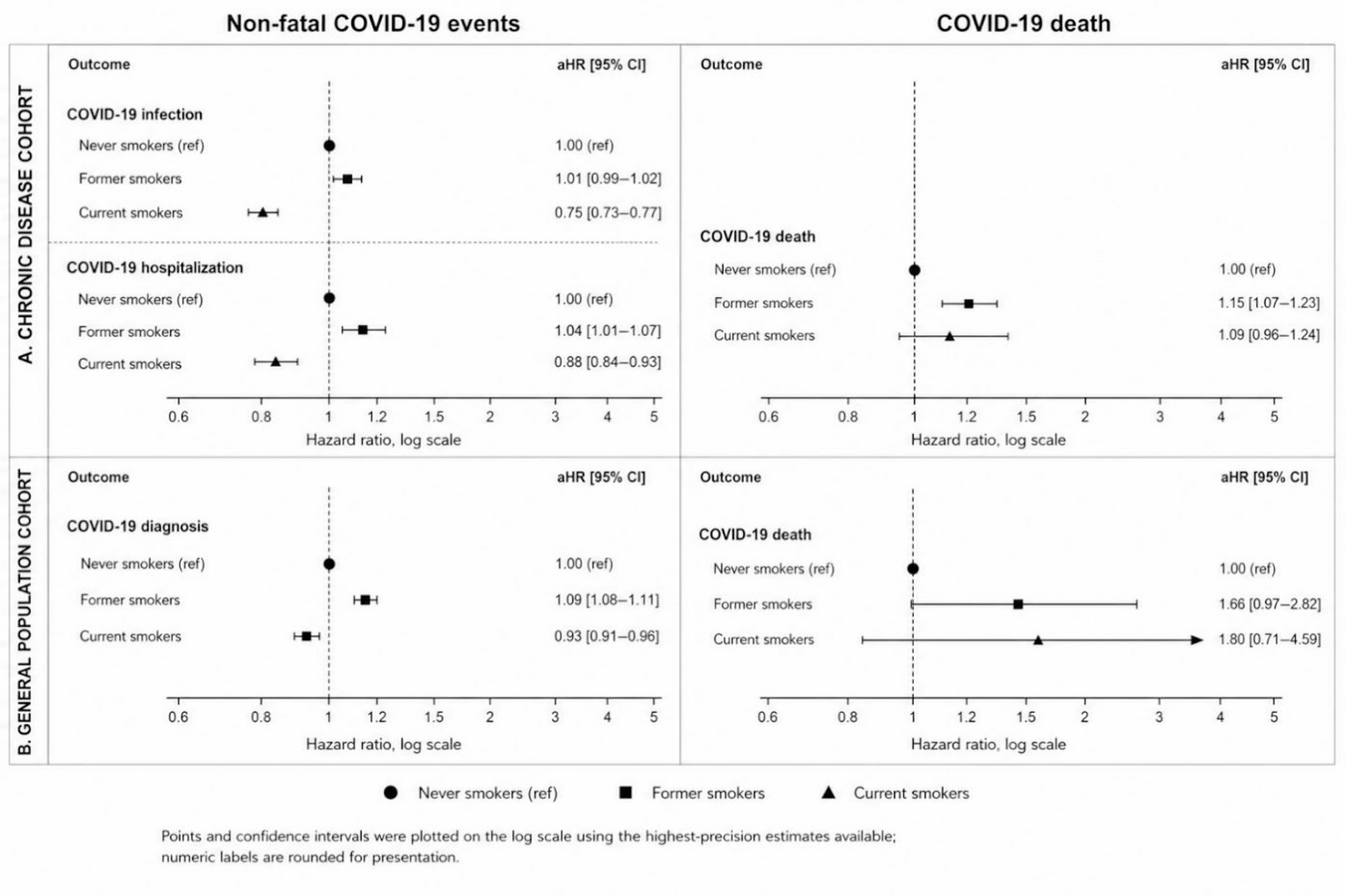
Literature on the impact of smoking on COVID-19 has been inconsistent, and the association remains incompletely understood. To assess the effect of smoking on COVID-19 outcomes using different data sources. We analyzed two cohorts with detailed smoking information linked to COVID-19: a cohort defined from Swedish chronic disease registers (airway disease, heart failure, cardiac disease, and diabetes) and a general population cohort from Norway. Participants with smoking information from 2019 (registers) or 2017–2019 (general population) were included and classified as never, former or current smokers. Adjusted Cox models were used to estimate hazard ratios (HRs) and 95% confidence intervals (CI) for COVID-19 outcomes from January 2020 to December 2022. The chronic disease register cohort included 506,745 individuals, and the general population cohort 155,333. Current smokers were the smallest group (13% and 11%), and never-smokers the largest (55% and 46%), in the two cohorts, respectively. Compared with never-smokers, current smokers had lower hazards of non-fatal COVID-19 events. For COVID-19 infection, HRs were 0.75 [CI: 0.73–0.77] in the chronic disease register cohort and for diagnosis 0.93 [0.91–0.96] in the general population cohort; for hospitalization, the HR was 0.88 [0.84–0.93] in the chronic disease register cohort. However, current smokers had higher hazards of COVID-19 death in both cohorts, although CIs included the null. Former smokers had clearly elevated hazards for most outcomes across both cohorts. While paradoxical inverse associations were observed for COVID-19 infection and hospitalization, current smokers consistently exhibited higher HR estimates for COVID-19 death across cohorts, although the confidence intervals were wide and included the null value.
From the paper
- Participants
The chronic disease register cohort included 506,745 individuals: 54.7% never-smokers, 32.3% former smokers, and 13.0% current smokers (Table 1).
- Result
Compared with never smoking, current smokers had lower hazards of COVID-19 infection (aHR 0.75, 95% CI 0.73–0.77) and hospitalization (0.88, 0.84–0.93), but higher risk of COVID-19 death, albeit with wide 95% CI including the null (1.10, 0.96–1.24) (Fig. 1A).
- Limitation
Smoking status may have changed during follow-up, resulting in likely non-differential exposure misclassification that would be expected on average to attenuate associations rather than generate inverse effects.
Quoted word for word from the full text on nature.com.
The paper
Scientific Reports, 13 Oct 2026, Open access, CC BY