Looser DNA packaging impairs energy supply in aged mouse neurons
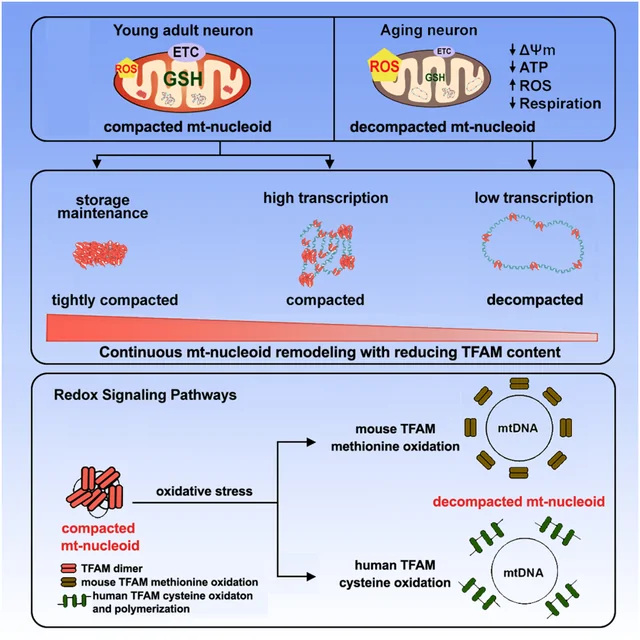
Experiments in aged mouse neurons linked oxidative stress to looser mitochondrial DNA packaging, fewer RNA copies from that DNA and impaired energy production.
Our read
Mechanisms- Studied:
- Experiments in cultured neurons from aged mice, against aged control neurons
- What changed:
- Oxidation-resistant TFAM tightened DNA packaging and raised mitochondrial ATP levels in aged mouse neurons compared with controls
- The catch:
- ATP and DNA-packaging measurements were quantified without blinding
- In the record:
- One of 210 papers on TFAM on record: 8 with results in people, 14 in animals.
Editor of record: Boris Djordjevic · AgingResearch.News
Aged mouse nerve cells and human nerve cells grown from reprogrammed stem cells were studied in laboratory experiments on mitochondria, the cells’ energy-producing structures. The researchers combined high-resolution imaging with measurements of gene activity.
Oxidative stress, a chemical imbalance that can damage cells, shifted mitochondrial DNA clusters from compact, active structures toward looser forms. This remodeling reduced the abundance of RNA copies made from mitochondrial DNA and impaired production of ATP, a molecule that supplies energy. The changes involved different chemical alterations to TFAM, a protein that packages mitochondrial DNA, in the mouse and human systems. Expressing an oxidation-resistant version of TFAM restored DNA cluster organization, RNA abundance and ATP production in aged neurons.
Why it matters
Declining mitochondrial energy production is a hallmark of neuronal aging. The authors identify mitochondrial DNA organization as a potential target for preserving nerve cells’ energy supply.
Caveats
The human results came from lab-grown nerve cells, not people. These results do not show whether the same approach would preserve energy production in aging human brains.
Where the evidence stands
TFAM
- 23 independent labs in 9 countries
- 2 findings against
- Funders: National Institutes of Health and others
- 6 of 41 findings with company ties
Mitochondrial DNA maintenance
- 18 independent labs in 12 countries
- Funders: National Institute on Aging and others


Comments
Be the first to comment.