Lab-grown human muscle models mimic key exercise responses
Muscle models grown from human donor cells showed gene activity responses to electrical stimulation that overlapped with responses in those donors’ muscles after exercise.
Our read
Interventions- Studied:
- Experiments in donor-derived human skeletal muscle organoids
- What changed:
- Electrically stimulated muscle organoids showed gene activity changes overlapping with those in the same donors’ muscles after exercise
- The catch:
- Whole-body metabolic effects of exercise were not measured
- In the record:
- One of 5 papers on electrical pulse stimulation on record: 1 with results in people, 2 in animals.
Editor of record: Boris Djordjevic · AgingResearch.News
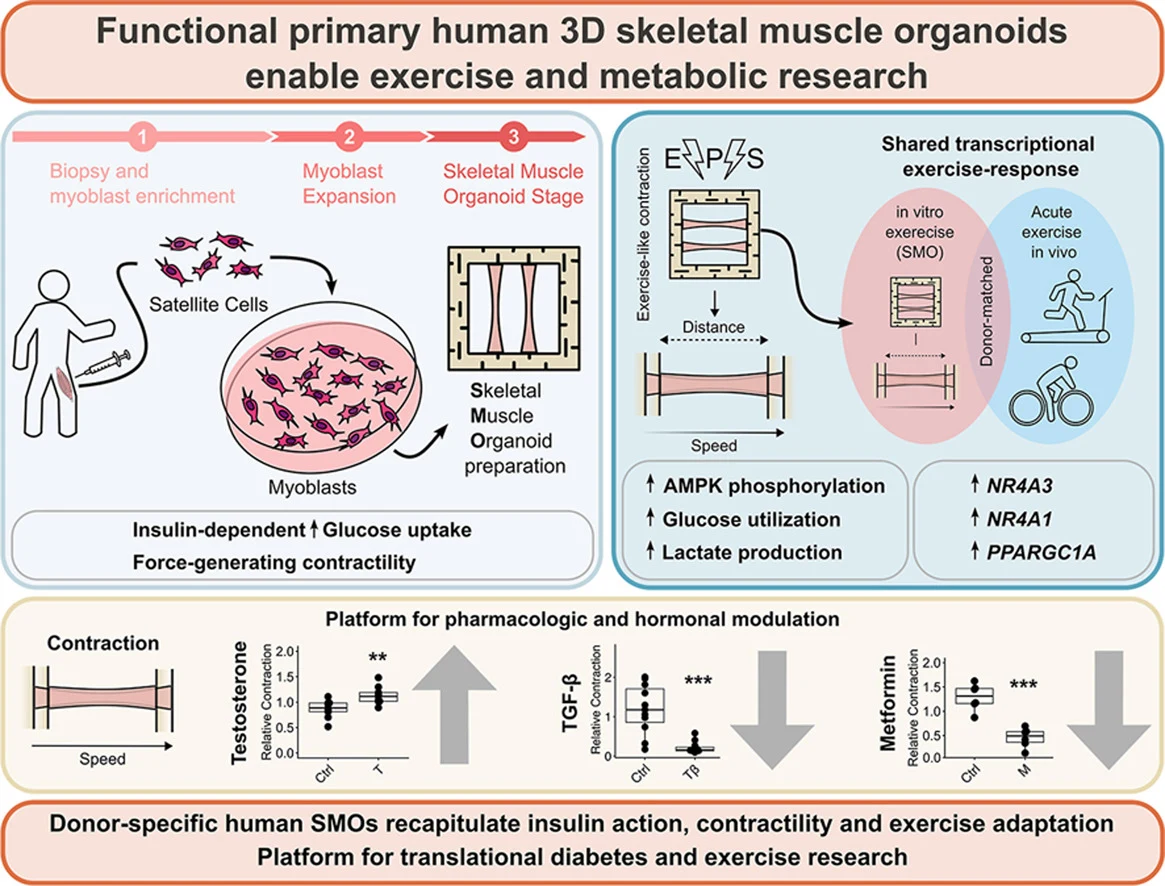
Primary human skeletal muscle organoids—three-dimensional muscle models grown from donors’ muscle-forming cells—responded to insulin and electrical stimulation in lab experiments. Insulin is a hormone that helps control blood sugar. Researchers guided the cells’ development into muscle in a collagen-based support. The models formed aligned, contracting muscle tissue, took up glucose in response to insulin and generated repeatable force.
Electrical pulses increased glucose use and the activity of genes that typically respond to exercise. These changes in gene activity overlapped with responses seen in muscle tissue samples taken from the same donors after a single bout of exercise.
Why it matters
The authors suggest these models may help researchers study muscle metabolism and interventions relevant to diabetes.
Caveats
Responses in lab-grown muscle do not show how exercise or drug exposure would affect a whole person.
Where the evidence stands
Exercise
- 1,434 independent labs in 89 countries
- 806 findings against
- 292 trials, 24 with no results posted
- Funders: National Institutes of Health and others
- 384 of 8,018 findings with company ties
AMPK signaling
- 248 independent labs in 33 countries
- 12 findings against
- Funders: National Natural Science Foundation of China and others
- 23 of 461 findings with company ties
Exercise is part of Bryan Johnson's Blueprint
The paper
Functional primary human 3D skeletal muscle models enable exercise and metabolic research
Molecular Metabolism, Nov 2026, CC BY-NC-ND
Comments
Be the first to comment.