Calcium channel links radiation to salivary gland problems in mice
Mice lacking the channel resisted early salivary gland dysfunction after irradiation; the authors linked its effects to cells entering a nondividing state.
Our read
Mechanisms- Studied:
- Experiments in mice lacking TRPM2
- What changed:
- Mice lacking TRPM2 resisted early salivary gland dysfunction after irradiation
- The catch:
- The duration of resistance to salivary gland dysfunction was not reported
- In the record:
- One of 22 papers on piperlongumine on record: 5 with results in people, 2 in animals.
- Why it’s aging research:
- Something that builds up with age.
Editor of record: Boris Djordjevic · AgingResearch.News
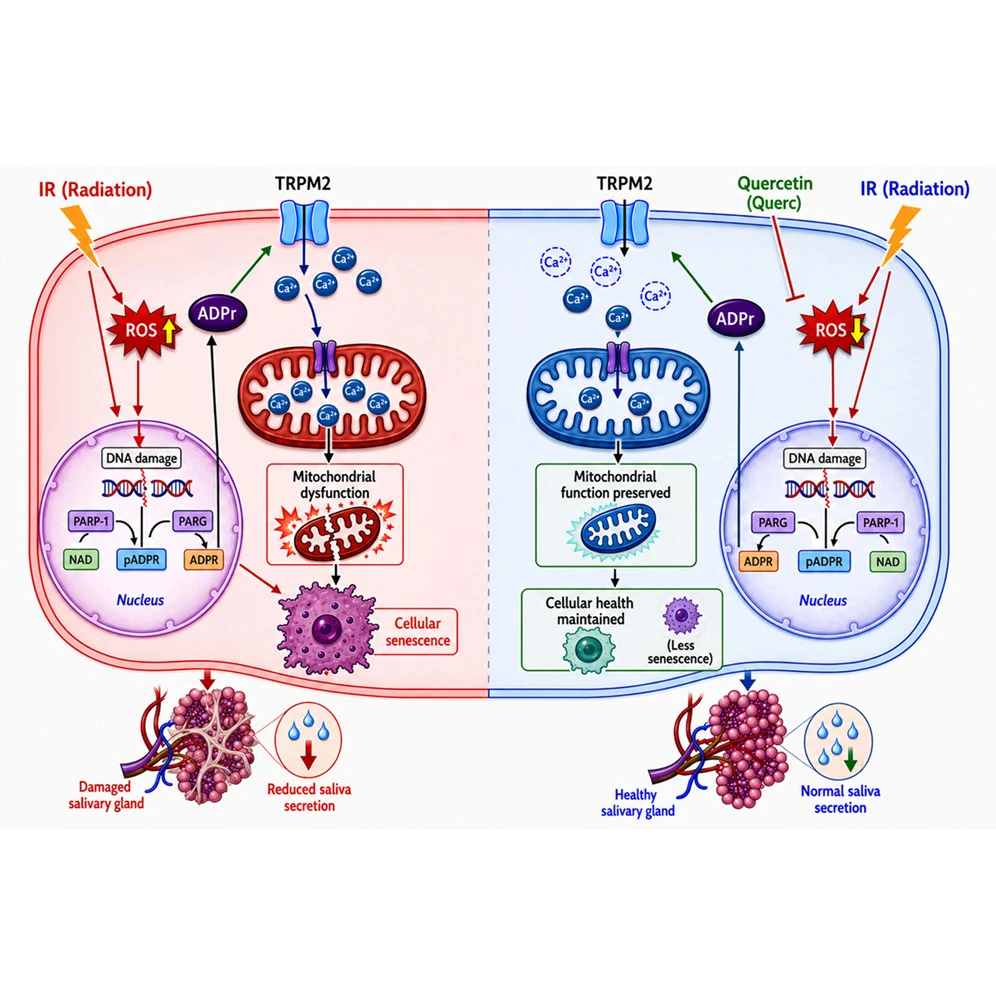
In experiments in mice, researchers identified TRPM2, a channel that lets calcium enter cells, as a key mediator of salivary gland dysfunction after irradiation. Mice lacking the gene for this channel resisted the dysfunction in the early period after irradiation.
Analysis of gene activity in these mice found increased activity in pathways involved in cell division. The mice also had lower levels of reactive oxygen molecules and reduced activity in associated pathways. The authors concluded that calcium entry through TRPM2 promoted cellular senescence, a state in which cells stop dividing, contributing to radiation-induced gland dysfunction.
Why it matters
Cellular senescence is a focus of aging research. The findings point to this process as a possible target for limiting radiation-induced salivary gland dysfunction.
Caveats
These were mouse experiments, not evidence of benefit in people. The abstract describes early resistance after irradiation but does not report how long it lasted.
Where the evidence stands
Piperlongumine
- 7 independent labs in 5 countries
- Funders: Indian Institute of Technology Kanpur and others
- 3 of 19 findings with company ties
Quercetin
- 160 independent labs in 33 countries
- 49 findings against
- 51 trials, 12 with no results posted
- Funders: National Natural Science Foundation of China and others
- 19 of 603 findings with company ties

Comments
Be the first to comment.