Loss of an enzyme reduced age-related tissue decline in mice
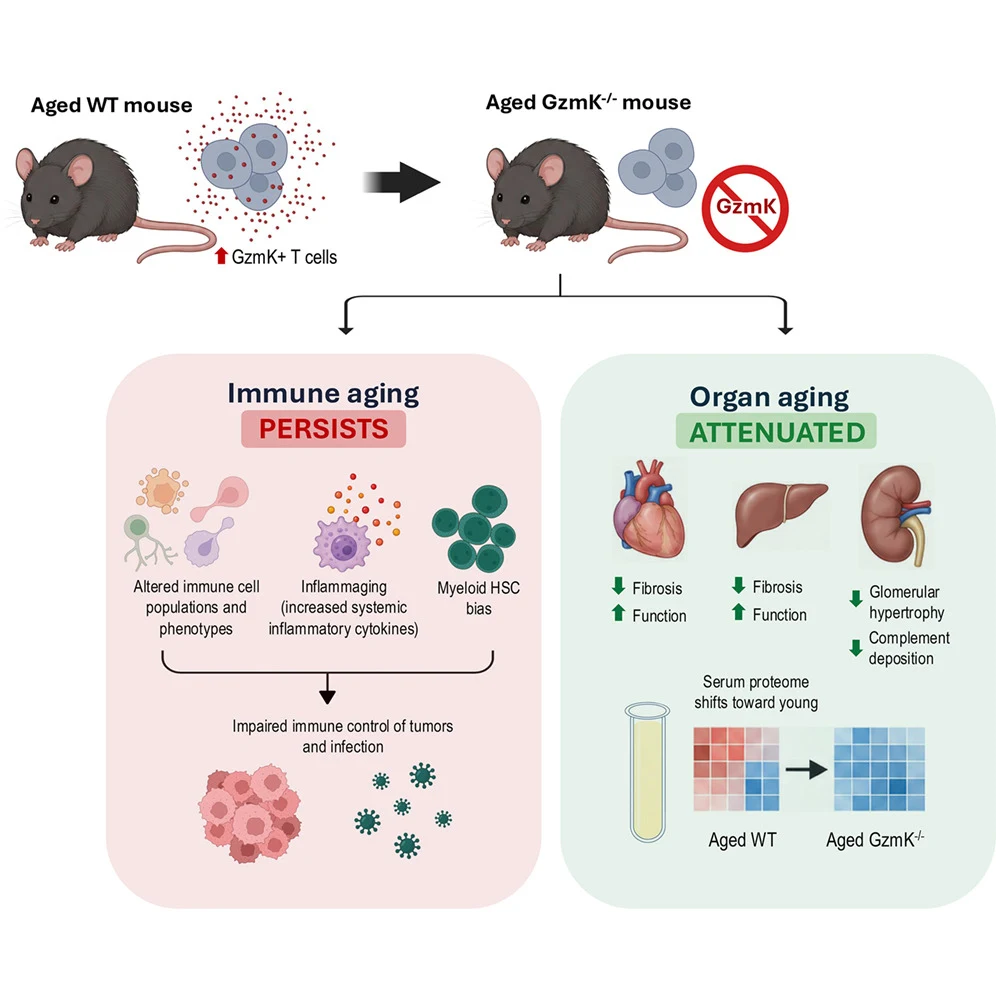
Experiments in young and aged mice lacking a protein-cutting enzyme found less organ aging despite persistent signs of immune aging.
Our read
Mechanisms- Studied:
- Experiments in young and aged mice
- What changed:
- Age-related organ decline decreased in mice lacking granzyme K throughout life
- The catch:
- Only lifelong enzyme loss was studied, not blocking granzyme K after tissue aging began
- In the record:
- One of 41 papers on GZMK on record: 3 with results in people, 5 in animals.
Editor of record: Boris Djordjevic · AgingResearch.News
Young and aged mice lacking granzyme K, an enzyme that cuts proteins, were studied in an animal experiment on immune and tissue aging. Mice without the enzyme still showed major features of immune aging, including impaired function of T cells, a type of immune cell. Yet the enzyme’s absence markedly reduced age-related organ decline.
In the kidneys, this was associated with less buildup of complement proteins, which form part of the immune system. In the liver, function improved and fibrosis, or tissue scarring, decreased independently of complement. The authors concluded that granzyme K drove tissue aging, but not immune aging or chronic, low-grade inflammation throughout the body.
Why it matters
Chronic, low-grade inflammation is implicated in age-related organ decline. The work offers a way to investigate tissue aging separately from declining immune function.
Caveats
The experiments used mice lacking granzyme K throughout life. They did not test whether blocking the enzyme after tissue aging had begun would have the same effects.


Comments
Be the first to comment.