Gene change reduced dementia-linked protein clumps in mice
Experiments in genetically engineered mice found that the Christchurch mutation reduced some protein clumps associated with Alzheimer’s disease and other dementias.
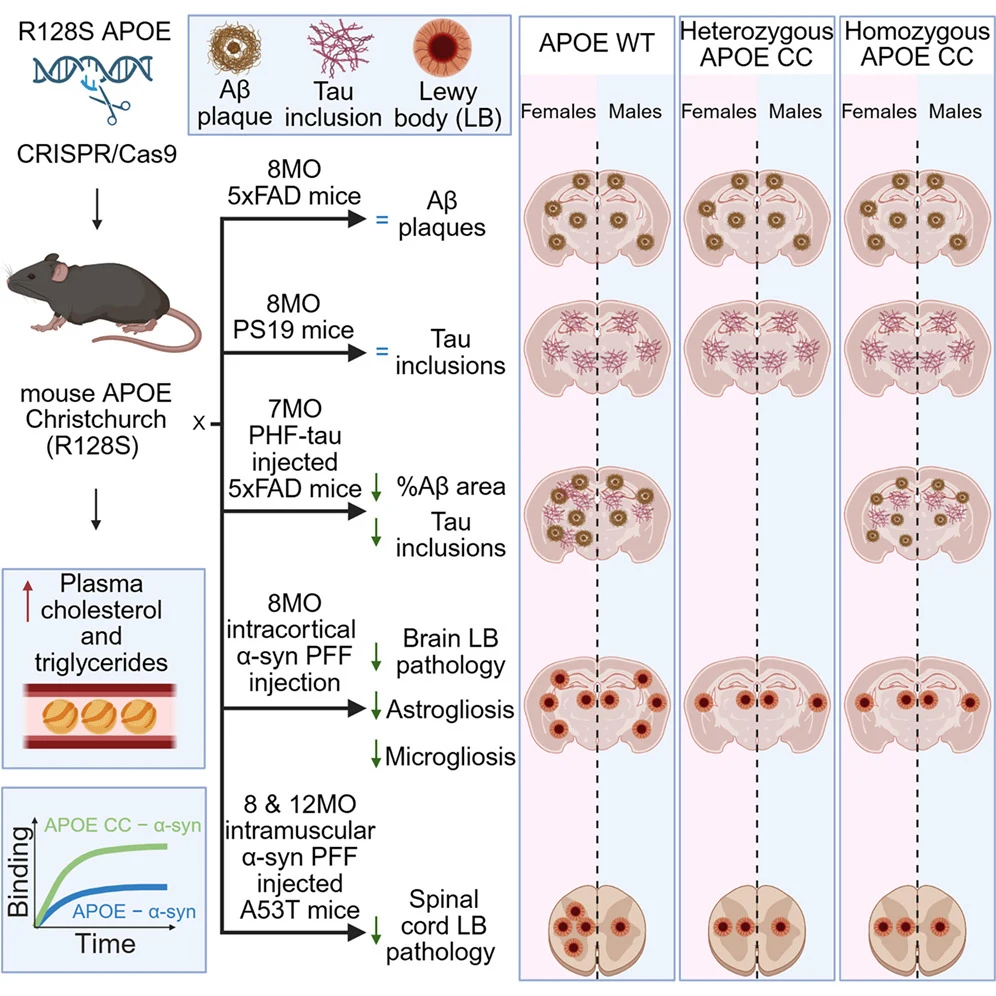
Our read
Mechanisms- Studied:
- Experiments in mice with the APOE Christchurch mutation, against APOE WT mice
- What changed:
- Mice with the Christchurch mutation had less formation and spread of alpha-synuclein clumps than mice with unaltered APOE
- The catch:
- The mutation did not reduce amyloid or tau abnormalities in models without brain injections
Editor of record: Boris Djordjevic · AgingResearch.News
Mice with the Christchurch mutation engineered into their own APOE gene underwent experiments tracking dementia-linked protein buildup. APOE provides instructions for a protein that transports fats. In an Alzheimer’s mouse model, the mutation reduced amyloid-beta buildup and amyloid-triggered tau abnormalities after researchers injected Alzheimer’s-related tau into the brain. Amyloid-beta and tau are proteins linked to Alzheimer’s disease. The mutation did not change either protein’s abnormalities in separate genetically engineered mouse models without those injections.
The mutation also reduced the formation and spread of alpha-synuclein clumps in the brain. This protein is linked to Parkinson’s disease and dementia with Lewy bodies. The altered APOE protein bound more strongly to alpha-synuclein than the unaltered version did. Mice carrying the mutation also had higher blood cholesterol and triglycerides, another type of fat.
Why it matters
Age-related brain diseases involve several kinds of protein buildup. These experiments address whether APOE’s effects extend beyond the proteins most closely associated with Alzheimer’s disease.
Caveats
The experiments tested a mutation in mice’s own APOE gene, leaving open whether it would have the same effects in people.
Where the evidence stands
APOE
- 302 independent labs in 53 countries
- 124 findings against
- Funders: National Institute on Aging and others
- 200 of 1,430 findings with company ties
APP
- 89 independent labs in 24 countries
- 4 findings against
- 57 trials, 9 with no results posted
- Funders: National Institute on Aging and others
- 31 of 208 findings with company ties
- 56 of 57 trials sponsored by developers of drugs aimed at it
Comments
Be the first to comment.