Engineered cell packages sped bone regrowth in aged rats
Cell-released packages carrying genetic instructions and an antioxidant accelerated bone regeneration in experiments on aged rats with osteoporosis and skull defects.
Our read
Interventions- Studied:
- Experiments in aged osteoporotic rats with skull defects
- What changed:
- Engineered cell packages sped bone regrowth in aged osteoporotic rats with skull defects
- The catch:
- Bone repair was assessed in skull defects, not fracture injuries
- Why it’s aging research:
- It studies organisms or tissues that aged naturally.
Editor of record: Boris Djordjevic · AgingResearch.News
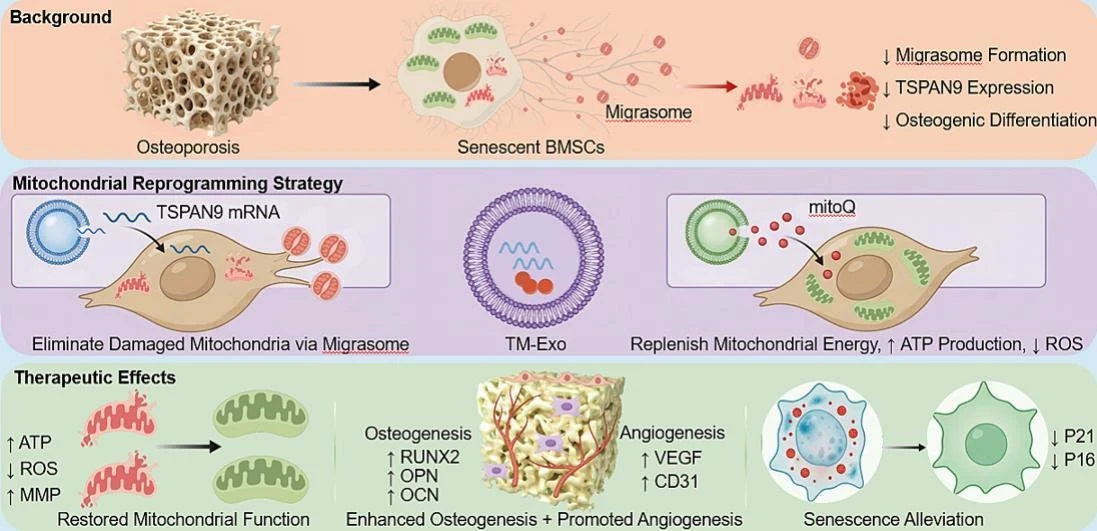
Bone marrow mesenchymal stem cells, which can form bone, and bone tissue from 2-month-old and 20-month-old Sprague-Dawley rats were compared in laboratory experiments. Older cells had less TSPAN9, a protein involved in forming migrasomes—structures that help dispose of material from mitochondria, the cell’s energy-producing components. Older cells also had impaired mitochondrial function and a reduced ability to develop into bone-forming cells. Increasing TSPAN9 restored mitochondrial function and bone-forming capacity.
The researchers engineered exosomes, tiny packages released by cells, to carry genetic instructions for TSPAN9 and an antioxidant targeted to mitochondria. In cell experiments, these packages reduced stress from reactive molecules in mitochondria and promoted development into bone-forming cells. In aged rats with osteoporosis and skull defects, they accelerated bone regeneration.
Why it matters
Age-related decline in bone marrow stem cells impairs bone repair in osteoporosis. The findings suggest that supporting mitochondrial maintenance may offer a strategy for addressing that decline.
Caveats
The animal tests addressed skull defects in aged osteoporotic rats, not fracture healing in people.
Where the evidence stands
MitoQ
- 10 independent labs in 4 countries
- 1 finding against
- 19 trials, 4 with no results posted
- Funders: National Institute on Aging and others
- 4 of 29 findings with company ties
- 3 of 19 trials sponsored by its developers
Angiogenesis
- 212 independent labs in 33 countries
- 17 findings against
- Funders: National Natural Science Foundation of China and others
- 26 of 416 findings with company ties
Comments
Be the first to comment.