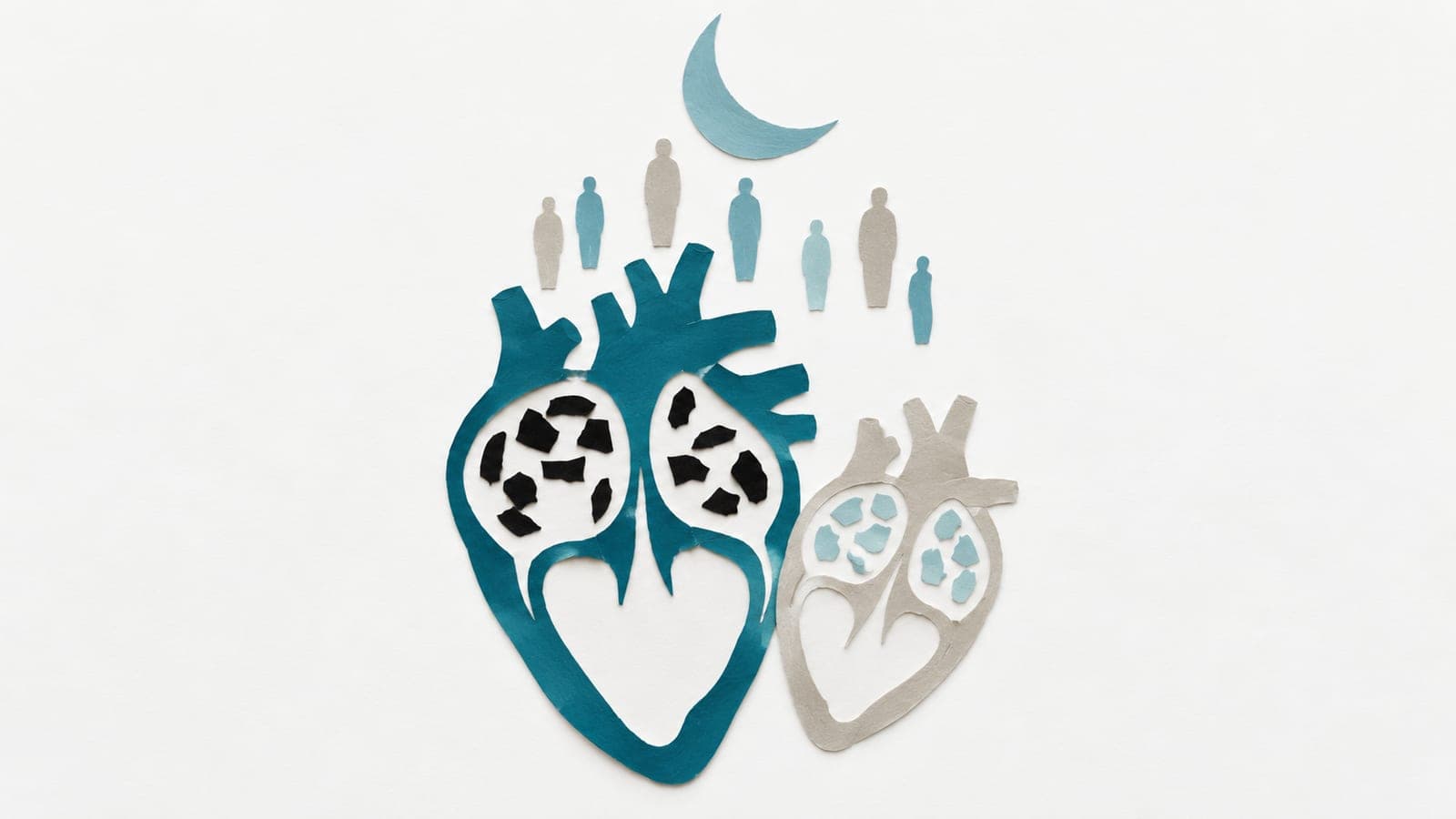
Heart recordings offer continuous sleep depth scores in people
Correlations with ranked sleep stages, excluding rapid eye movement sleep, were 0.828 in internal testing and 0.848 in external testing.
Limit: Reported sleep-depth profiles required reference sleep-stage labels for normalization, not ECG alone
An observational study used 12,392 overnight sleep recordings from people to develop and validate a computer model that estimated sleep depth from a single electrical recording of the heart. The model learned from conventional sleep-stage labels. It produced continuous overnight profiles that captured variation within each stage.
In the Sleep Heart Health Study, researchers identified a disturbed-sleep group using measures derived from these profiles. That group had poorer self-reported sleep quality and a higher relative rate of death from any cause, with an adjusted hazard ratio of 1.20.
Why it matters
Continuous sleep profiles may help lifespan researchers examine aspects of sleep health that broad sleep stages miss.
Caveats
The study was observational, so the mortality association does not show that disturbed sleep caused deaths. The model learned from conventional stage labels, and the preprint has not yet been peer-reviewed.
From the paper
- Participants
Covariate-adjusted regression analyses included 395 paired participants per model.
- Result
The hazard ratio for all-cause mortality was 1.39 (95% CI, 1.24 – 1.56 ) in Model 1 and 1.34 (95% CI, 1.19 – 1.51 ) in Model 2 (both P<0.001 ).
Quoted word for word from the full text on arXiv.
The paper
arXiv, Oct 16, 2026, Open access, Preprint, not peer-reviewed