Deafness

Papers on deafness

128 papers2 new in 30 days

Sunday, November 22

Friday, November 20

Wednesday, October 14

The Lancet Healthy Longevity

Hearing loss linked to higher risk of death in adults

Compared with the reference group, relative rates of death were 1.19 for mild, 1.55 for moderate and 1.56 for moderately severe or worse hearing loss.Compared with the reference group, relative rates of death were 1.19 for mild, 1.55 for moderate and 1.56 for moderately severe or worse hearing loss.

Figure from The Lancet Healthy Longevity
Meta-analysis · 13,851 peopleHearing loss

Thursday, October 8

JAMA Otolaryngology-- Head & Neck Surgery

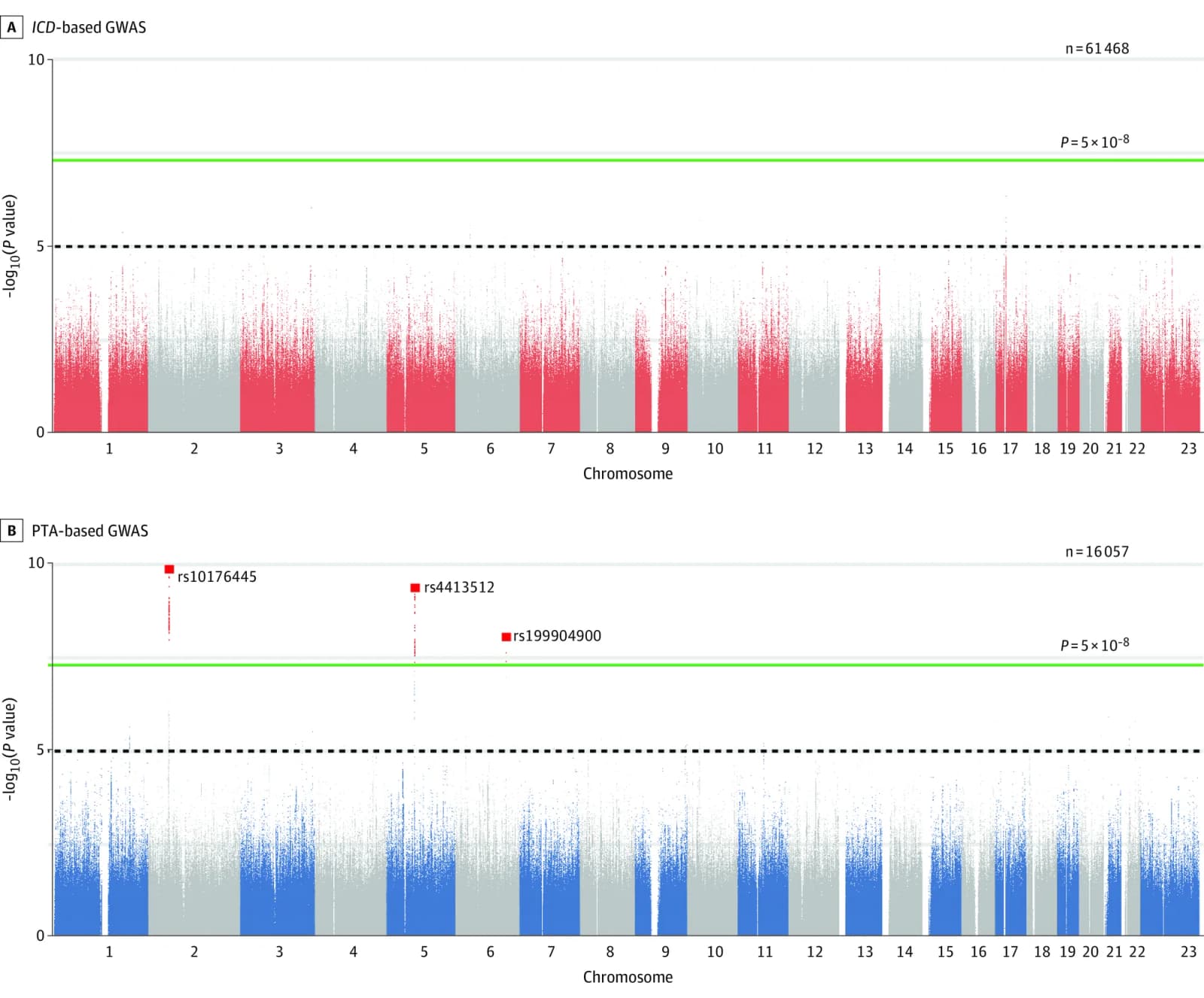
Detailed hearing tests uncover genes linked to hearing loss

Analyzing hearing tests in 16,057 participants identified four candidate genes and yielded risk scores linked to deafness, whereas diagnostic codes found none.Analyzing hearing tests in 16,057 participants identified four candidate genes and yielded risk scores linked to deafness, whereas diagnostic codes found none.

Scatterplot of Genetic Architecture of Sensorineural Hearing Loss Based on International Classification of Diseases (ICD) and Pure-Tone Average (PTA) Definitions.
Genetic association study of 51,305 peopleBiomarkers

Tuesday, October 6

bioRxiv

A protein promoted hair cell regeneration in newborn mice

Genetically modified newborn mice produced extra TRIM71, a protein that binds RNA, which promoted spontaneous regrowth of sound-detecting cells in the inner ear.Genetically modified newborn mice produced extra TRIM71, a protein that binds RNA, which promoted spontaneous regrowth of sound-detecting cells in the inner ear.

Concurrent FST and TRIM71 overexpression promotes HC formation in cochlear organoid cultures at stage P5.
Preprint: experiments in miceEar

Friday, October 2

Journal of the International Neuropsychological Society

Older deaf bilinguals show larger Stroop effects in English

In a study of 108 deaf ASL-English bilinguals aged 21 to 88, older adults showed larger Stroop interference than younger adults, particularly in English response times.In a study of 108 deaf ASL-English bilinguals aged 21 to 88, older adults showed larger Stroop interference than younger adults, particularly in English response times.

Figure from Journal of the International Neuropsychological Society
Cross-sectional study of 108 peoplePopulations

Thursday, September 24

Wednesday, August 26

Wednesday, July 1

Wednesday, June 10

Saturday, April 25

Friday, April 10

Thursday, March 26

Tuesday, March 24

Thursday, March 12

Monday, March 9

Sunday, March 1

Wednesday, February 11

Thursday, February 5

Wednesday, January 21

Friday, January 16

Tuesday, January 13

Monday, December 29

Friday, December 26

Thursday, December 25

Tuesday, December 23

Wednesday, November 12