PREVENT equations

Papers on PREVENT equations

93 papers39 new in 30 days

Friday, November 20

Thursday, November 19

Wednesday, November 18

Hypertension

Tighter blood pressure control linked to lower cardiovascular risk

Compared with usual care, hazard ratios—relative measures of cardiovascular risk over time—were 0.53, 0.58 and 0.60 in low-, intermediate- and high-risk adults.Compared with usual care, hazard ratios—relative measures of cardiovascular risk over time—were 0.53, 0.58 and 0.60 in low-, intermediate- and high-risk adults.
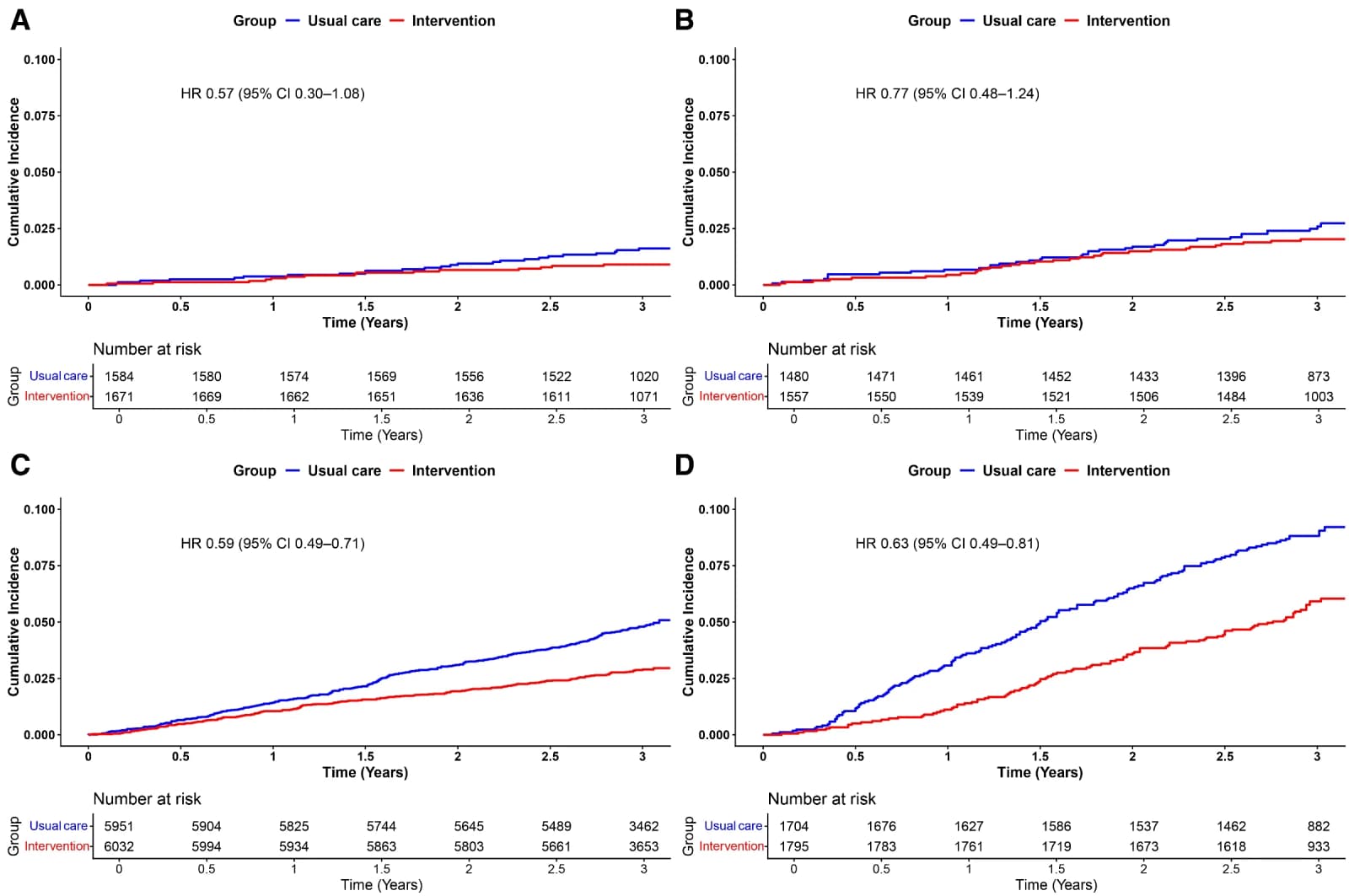
Kaplan-Meier curves for major cardiovascular outcomes according to the baseline 10-year Predicting Risk of Cardiovascular Disease Events (PREVENT) total cardiovascular disease (CVD) equation.
Non-randomized trial in 21,872 peopleCardiovascular disease

Monday, November 16

Wednesday, November 11

medRxiv

Obesity and diabetes rose as smoking fell among US adults

From 1999–2000 to 2021–2023, obesity rose from 47.4% to 57.2% and diabetes from 8.2% to 12.7%, while smoking declined.From 1999–2000 to 2021–2023, obesity rose from 47.4% to 57.2% and diabetes from 8.2% to 12.7%, while smoking declined.

Groups of upright adults contrast broader waists, denser glucose specks in blood, and fewer cigarettes with slimmer figures and more cigarettes.
Preprint: cross-sectional · 60,199 peopleDiabetes mellitus

Monday, November 9

AHA Scientific Sessions 2026 Abstract

Inflammation protein may help refine heart disease risk estimates

The inflammation marker interleukin-6 separated event rates between people reassigned to higher and lower risk groups by 1.15 per 1,000 person-years, versus 0.54 for…The inflammation marker interleukin-6 separated event rates between people reassigned to higher and lower risk groups by 1.15 per 1,000 person-years, versus 0.54 for C-reactive protein.

Blood cells surround dense protein clusters beside scarred heart tissue and sparse proteins beside intact tissue, with a small group of people nearby.
Cohort · 32,920 peopleBiomarkers

Sunday, November 8

Saturday, November 7

AHA Scientific Sessions 2026 Abstract

Newer equations lower estimated artery disease risk in US adults

Average estimated 10-year risk of cardiovascular disease from fatty buildup in arteries was 4.56% with newer equations versus 8.84% with older equations.Average estimated 10-year risk of cardiovascular disease from fatty buildup in arteries was 4.56% with newer equations versus 8.84% with older equations.

An artery cross-section with fatty buildup sits beneath overlapping upright adults, with fewer dark figures among larger gray and light blue groups.
Cross-sectional · 6,814 peoplePooled Cohort Equations
AHA Scientific Sessions 2026 Abstract

Cancer survivors had higher predicted cardiovascular risk

Average predicted 10-year cardiovascular risk was 10.0% in cancer survivors without known cardiovascular disease, compared with 5.2% in adults without a cancer history.Average predicted 10-year cardiovascular risk was 10.0% in cancer survivors without known cardiovascular disease, compared with 5.2% in adults without a cancer history.

Groups of upright adults stand beside hearts, with a large dark patch on the blue-green group’s heart and a smaller patch on the gray group’s heart.
Cross-sectional · 15,055 peopleAtherosclerotic cardiovascular disease
AHA Scientific Sessions 2026 Abstract

Heart risk equation outperformed machine learning in adults

The equation scored 0.822 on a measure of how well it distinguished cardiovascular deaths from other outcomes, outperforming machine-learning models in 5,690 adults.The equation scored 0.822 on a measure of how well it distinguished cardiovascular deaths from other outcomes, outperforming machine-learning models in 5,690 adults.

Heart cross-section surrounded by scattered pale upright figures and blood cells, with a small cluster of dark figures beside its lower edge.
Cohort · 5,690 peopleBiomarkers
AHA Scientific Sessions 2026 Abstract

Some low-risk Korean adults moved into higher heart-risk groups

Among adults with low 10-year risk but high 30-year risk or high “bad” cholesterol, 47.71% progressed to higher risk categories within five years.Among adults with low 10-year risk but high 30-year risk or high “bad” cholesterol, 47.71% progressed to higher risk categories within five years.

Artery cross-sections beside small groups of people show heavy fatty buildup narrowing one opening and little buildup around the other.
Cohort · 5,353,877 peoplePopulations

Wednesday, November 4

Monday, November 2