Retatrutide cut knee osteoarthritis pain in obesity without diabetes
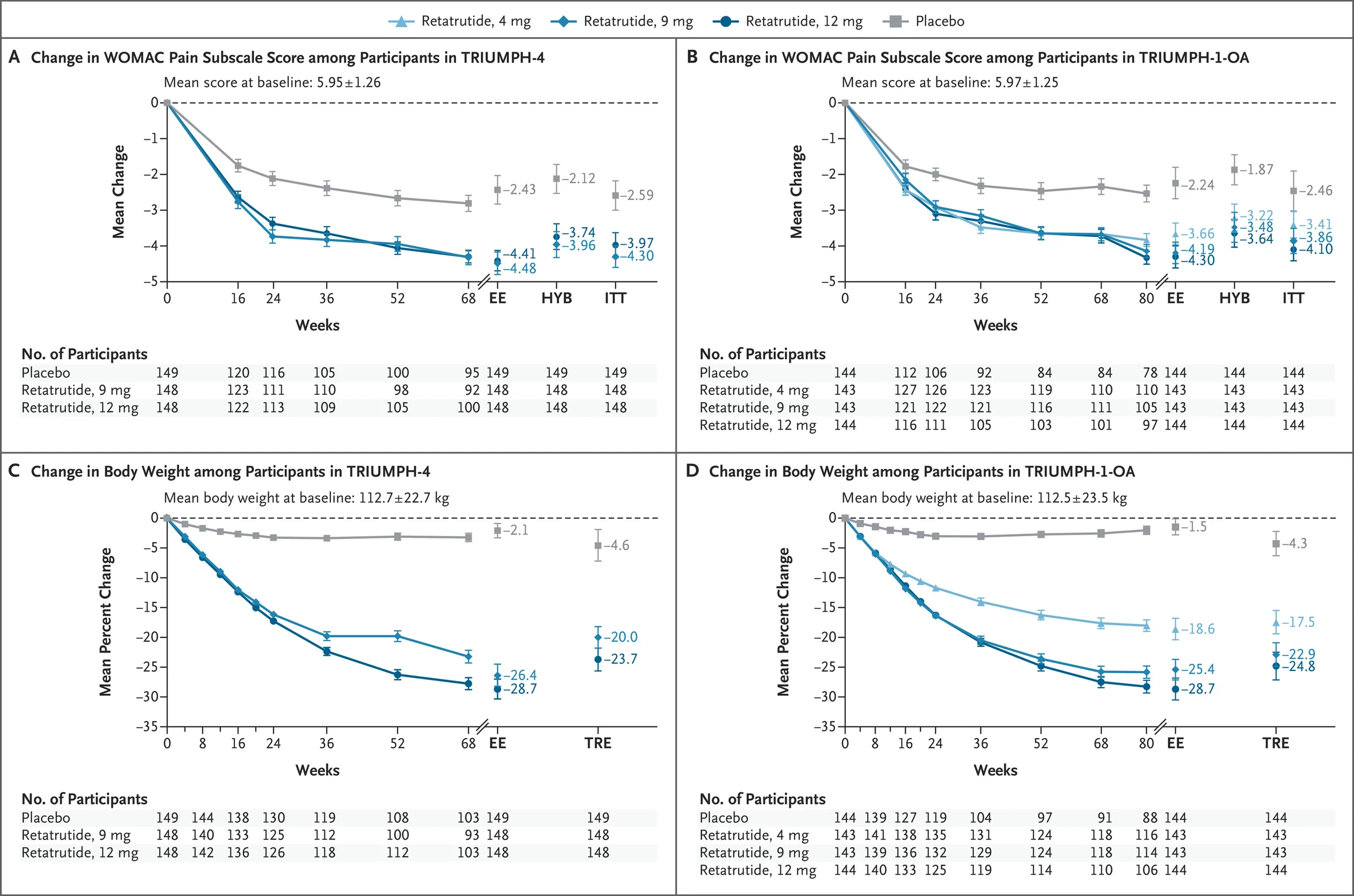
At 68 weeks, pain scores fell 3.96 points with 9-milligram retatrutide versus 2.12 with placebo on a scale from 0 to 10.
Our read
Interventions- Studied:
- Randomized trial in 445 adults with obesity and painful knee osteoarthritis, against placebo (Placebo-controlled, registered NCT05931367)
- What changed:
- Knee pain fell 3.96 points with 9-milligram retatrutide versus 2.12 with placebo
- The catch:
- Pain estimates used hypothetical outcomes after events suggesting treatment failure
- Stake:
- Eli Lilly and Company, which develops retatrutide, funded the study.
- In the record:
- The 54th paper on retatrutide with results in people; 137 on record in all. Its result on body weight agrees with all 41 other findings on record.
Editor of record: Boris Djordjevic · AgingResearch.News
Adults without diabetes who had painful knee osteoarthritis and a body mass index—a weight-to-height measure—of at least 27 entered two randomized, placebo-controlled phase 3 trials. TRIUMPH-4 enrolled 445 participants; TRIUMPH-1-OA enrolled 574. The trials tested weekly retatrutide injections at 9 or 12 milligrams over 68 weeks in TRIUMPH-4, and 4, 9 or 12 milligrams over 80 weeks in TRIUMPH-1-OA.
All tested doses reduced pain scores more than placebo. At 80 weeks, scores fell 3.22, 3.48 and 3.64 points, respectively, versus 1.87 with placebo. In TRIUMPH-4, body weight fell 20.0% with 9 milligrams and 23.7% with 12 milligrams, versus 4.6% with placebo. Both trials reported more serious adverse events with retatrutide than placebo. Gastrointestinal problems were the most common adverse events.
Why it matters
For people aging with painful knee osteoarthritis and obesity, the findings bear on whether care can target joint pain and body weight together.
Caveats
The main pain estimates used hypothetical outcomes after events suggesting treatment failure; an intention-to-treat analysis, which assessed participants as randomized, also favored retatrutide. Participants had no diabetes and a body mass index of at least 27; the abstract does not give serious adverse-event rates.
The paper
Retatrutide Once Weekly in Adults with Knee Osteoarthritis Pain and Obesity
Northwestern University; Eli Lilly (United States)
The New England Journal of Medicine, Nov 8, 2026, Open access, accepted manuscript
Comments
Be the first to comment.