Analysis flags possible therapy-response markers in human muscle
A computational analysis used seven exercise datasets across three species to identify candidate therapy-response markers in Duchenne muscular dystrophy muscle biopsies.
Our read
Biomarkers- Studied:
- Preprint: computational study
- In the record:
- The 1,681st paper on resistance training with results in people; 3,681 on record in all.
Editor of record: Boris Djordjevic · AgingResearch.News
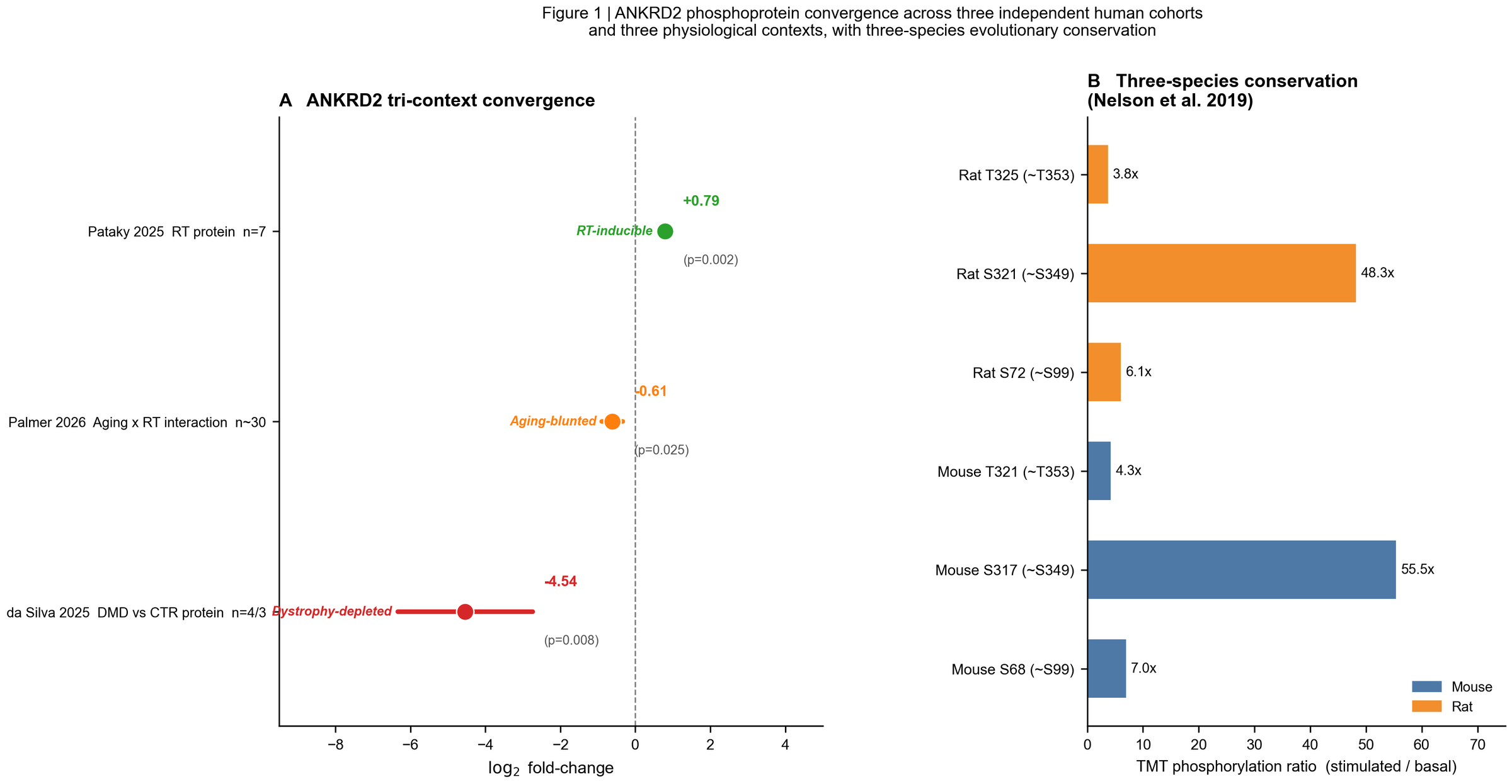
Human muscle biopsy data from people with Duchenne muscular dystrophy were examined alongside exercise data in a computational study seeking candidate markers for tracking therapy responses. The analysis drew on seven independent exercise datasets spanning three species and scored 147 established muscle genes.
The stretch-sensing protein ANKRD2 showed a training-induced molecular pattern in healthy young muscle, a blunted pattern in long-term trained older adults, and lower levels in dystrophy biopsies. The authors used this pattern to anchor their search. Leading candidates included UCP3 and FBXO32, two proteins depleted in dystrophy biopsies that also showed evidence of increases with resistance training in aging muscle. Each had supporting RNA evidence from at least two independent Duchenne datasets. A separate gene-network analysis also supported UCP3.
Why it matters
The authors propose a link between weakened muscle adaptation with aging and disrupted muscle structure and signaling in Duchenne muscular dystrophy. They propose using the framework to select measures for early therapy trials.
Caveats
The computational analysis nominated candidates; it did not establish that their levels track responses to Duchenne therapies. The work is a preprint and has not been peer-reviewed.
Where the evidence stands
Exercise
- 1,419 independent labs in 89 countries
- 788 findings against
- 282 trials, 21 with no results posted
- Funders: National Institutes of Health and others
- 371 of 7,870 findings with company ties
Resistance training
- 666 independent labs in 73 countries
- 343 findings against
- 81 trials, 1 with no results posted
- Funders: Coordenação de Aperfeiçoamento de Pessoal de Nível Superior and others
- 173 of 3,740 findings with company ties
Exercise is part of Bryan Johnson's Blueprint
The paper
HealthLogiks
Research Square, Nov 11, 2026, Open access, Preprint, not yet peer-reviewed


Comments
Be the first to comment.